The Truth of Red Terror: Inside the Mind of a Surrendered Maoist in an Exclusive Interview with Sonu, alias Bhupati
Through frank admissions and regret, Bhupati outlines how violence, isolation, and outdated strategies eroded the Maoist movement’s claim to revolutionary purpose.
Total Views |


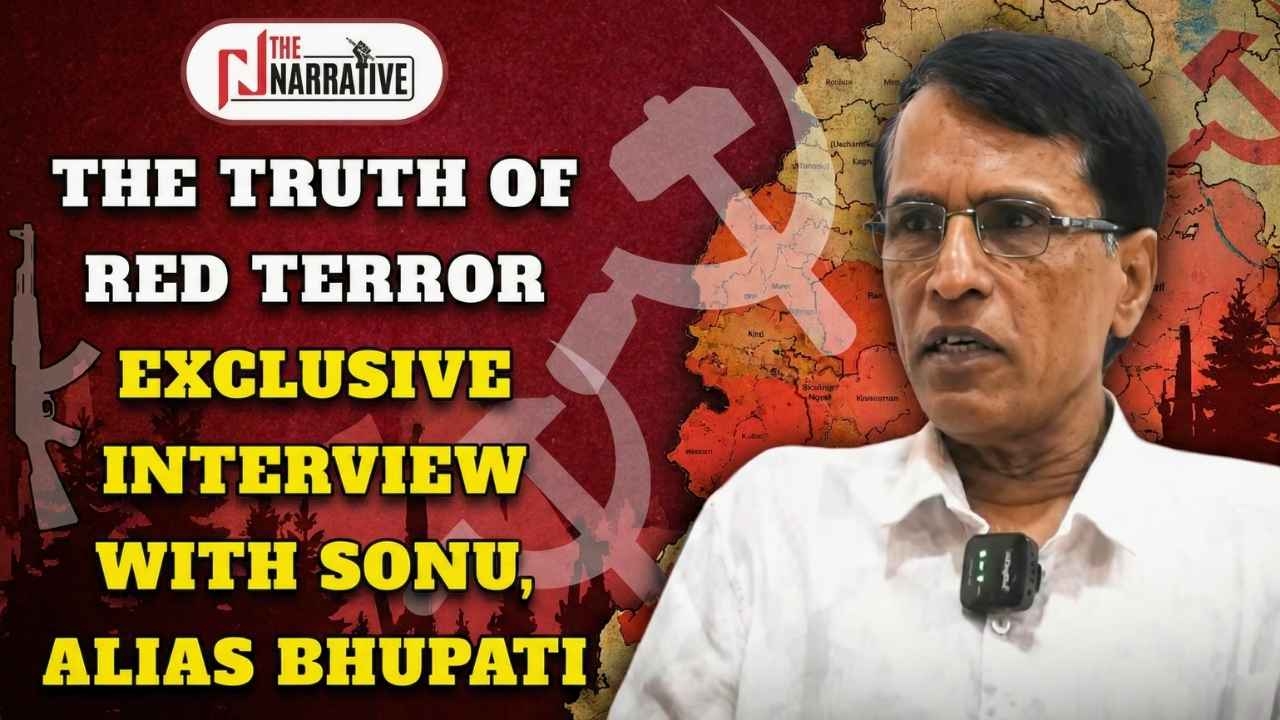
In one of the most candid and revealing conversations ever recorded with a surrendered Maoist, Sonu, alias Bhupati, once a hardened operative of the CPI (Maoist), opens up about the ideological decay, internal collapse, and moral contradictions that have pushed the Red movement into retreat. Ex-Maoist Bhupati’s interview exposes the hollow reality of a movement that masquerades under revolutionary legitimacy but today is left fragmented and discredited.
When asked about his stance on the ‘rehabilitation’ of Maoists, he urges that the decision to surrender was neither a tactical retreat nor a consequence of internal factionalism. It was, as he insists, a long-pending realisation that the Maoist movement had fundamentally “lost the trust of the public”.
The policy being described as your party’s ‘retreat’ or rehabilitation, are you a part of that? Or is it the pressure from security forces? Or internal factionalism within the organisation?
He says, “No, it’s not like that… The world is changing, and we needed to evolve. Surrender was not a one-day decision. Since 2011, 2015, and 2020, we realised we were losing public trust. There is no hidden interest, no factionalism. We simply realised we were not on the right path.”
When confronted with the historic claim that true communists do not swear by the Indian Constitution – echoing Charu Majumdar – and that global reformist figures like Deng Xiaoping and Gorbachev were seen as ideological traitors, Bhupati acknowledges, “Yes, reformists – that could be true. Even Lenin said parliamentary politics is just tactics. Sometimes he boycotted, sometimes he joined elections. Our party also saw elections merely as tactics. In 2004, we campaigned ‘Drive TDP out’. Similarly, ‘Drive BJP out of Bastar’ simply means vote against BJP. Even our ‘Great Guru ji’ used elections tactically.”
Further, when it was asked, CPI (Maoist) attempted to run a ‘protracted war’ in India through both parliamentary and military means. Now that ordinary members are returning to the mainstream, what becomes of this protracted war? He answered, “It is also a reformist concept. Lenin spoke of insurrection; Mao reinterpreted it for China. Our party considered India semi-colonial and semi-feudal, so we targeted rural zones. But India has changed. Communication, welfare, and governance are now developed. The party line alone decides the method.”
Acknowledging the other activists, Bhupati answers to “Will your struggle now resemble that of activists like Manish Kunjam or Soni Sori?
“Maybe. They have public trust. We will work with tribals, groups, and organisations – whoever works for people through legal means. We will work with everyone.” Bhupati answers.
When asked, 'Will you also work with people like Arundhati Roy, Bela Bhatia, Nandini Sundar, or Yogendra Yadav?' Bhupati says, “The path we chose requires cooperation. We have no issue working with them. It depends on them; we are branded as ex-Maoists.”
Talking about the urban support system of Maoists, Bhupati says, “By 2024, the party admitted we were isolated, neither connected to labour groups nor to urban groups. Earlier an urban perspective existed, but now the urban mechanism is gone. Violence destroyed our network.”
When asked about CPI Maoist’s gruesomeness and brutal attacks in rural areas, Bhupati asks for forgiveness; he says, “I regret them deeply. Until 12 October this year, I was a Maoist. I ask forgiveness from everyone who suffered.”
Though he seeks forgiveness over the gruesomeness of Maoists, yet on Salwa Judum, forced conversions in tribal belts, or the Maoist leadership’s non-tribal dominance, he offers evasive responses. His refusal to take a position on rampant tribal conversions underscores the movement’s long-time reluctance to confront socio-cultural realities on the ground.
What is your view on Salwa Judum? Was the killing of Mahendra Karma an act of revenge?
“Salwa Judum was a wrong step. It was run by those against the people. After it was banned, we could form battalions. Activists like Nandini Sundar opposed it.”
Why are Naxals unwilling to join the DRG or police forces?
“We always campaigned, ‘Do not join the police force.’ If ex-cadres join the police, there will be clashes. We have left guns and do not want to join any police force.”
What is your relationship with the Mulwasi Bachao Manch? Will you continue to work with it?
“It is a legal organisation. We support it because we have abandoned arms. Thousands joined it on my call. We will work with all who adopt legal struggle.”
CPI (Maoist) talks about tribal rights, yet why is there no local tribal person in its central leadership?
“We work for all oppressed communities, but yes, there is no tribal in the Politburo. Only Ramdev and Hidma come from tribal backgrounds.”
Large-scale forced religious conversions are happening in Bastar. Will you fight against them?
“We have nothing to do with religious beliefs. Christianisation is happening, but that is their ideology. We will not interfere.”
Bhupati’s testimony exposes a failing movement ideologically confused, socially isolated, and organisationally collapsed structure of Maoist terrorism, and his surrender to the Bharat is a window into the terminal decline of left-wing extremism in Bharat.
Transcribed by
Kewali Kabir Jain
Journalism Student, Makhanlal Chaturvedi National University of Journalism and Communication