Inside the PFI Network: Weapons, Riots, Conversions and the Jihadist Blueprint Against Bharat
NIA evidence details how PFI evolved from a front group into an organised extremist network focused on riots, radicalisation, and long term destabilisation.
Total Views |



The name Popular Front of India, or PFI, has once again come under intense national scrutiny. On 21 December 2025, the National Investigation Agency, while presenting its arguments before the Patiala House Court in New Delhi, made a series of explosive disclosures that stripped the organisation of any remaining façade of being a mere socio-political group. According to the agency, PFI actively planned to procure weapons from neighbouring countries and train its cadres for armed action. Investigators further revealed a sinister plot to seize control of South India in the event of a war between India and Pakistan.
NIA’s 2025 Revelation: A Blueprint for Insurrection
During the court proceedings, the NIA revealed that PFI cadres underwent systematic indoctrination centred on a clear wartime strategy. Trainers instructed them to exploit a hypothetical India–Pakistan conflict by launching attacks from the southern part of the country, assuming that India’s armed forces would remain heavily engaged along the northern borders. The prosecution stated that the objective went far beyond sporadic violence and aimed at destabilising and capturing parts of South India.
This revelation reinforces the rationale behind the five-year ban imposed on PFI in September 2022 by the Ministry of Home Affairs under the Unlawful Activities (Prevention) Act. The ban followed years of intelligence inputs that pointed towards PFI’s transformation into a structured extremist organisation with long-term insurgent ambitions.
From SIMI to ISIS: Continuity of Jihadist Ideology
PFI emerged in 2006 in Kerala shortly after the ban on the Students Islamic Movement of India. In 2012, the Kerala government stated in an official affidavit that PFI effectively functioned as a rebranded version of SIMI, carrying forward the same ideology, organisational framework, and operational methods.
As early as July 2010, during the investigation into the brutal attack on Professor T. J. Joseph, police raids on PFI-linked premises recovered explosives, weapons, bomb-making materials, and literature linked to Al-Qaeda and the Taliban. These recoveries clearly indicated ideological alignment with global jihadist movements rather than any democratic or reformist agenda.
In 2017, the Kerala Police confirmed that several PFI members travelled to Syria using forged passports and joined ISIS. Investigations established that radicalisation took place through PFI networks before their departure. Some of these recruits later died during ISIS operations, further cementing PFI’s role as a feeder organisation for international terror groups.
Domestic Unrest and Engineered Violence
PFI’s footprint has repeatedly surfaced in episodes of mass violence and civil unrest across India. Investigative agencies have linked the organisation to several major incidents.
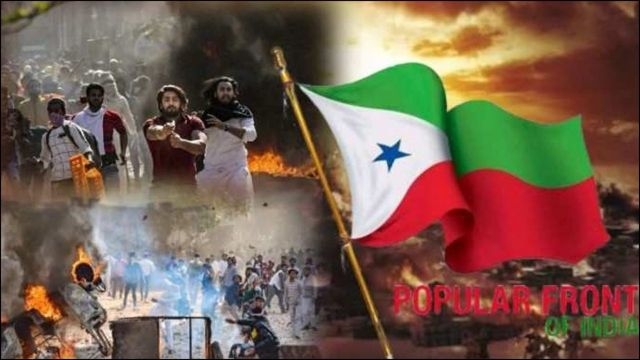
Authorities connected PFI operatives to the anti-Hindu Delhi riots of 2020, where they allegedly provided financial and logistical support to violent mobs. During the CAA–NRC protests in Kanpur, agencies reported that crores of rupees were funnelled to incite unrest. In the Hathras case, investigators alleged that PFI activists held secret meetings to provoke communal violence under the guise of social justice activism.
Similarly, during the Assam violence of 2012, agencies accused PFI of coordinating riots in collaboration with foreign-linked terror outfits through an organised SMS campaign. These incidents collectively point to a consistent strategy of exploiting social flashpoints to inflame communal tensions and weaken internal security.
Conversion Rackets and ‘Love Jihad’ Networks
Investigative agencies have extensively documented PFI’s role as a central facilitator of organised religious conversions. Its women’s and student wings reportedly played a key role in targeted conversion drives and grooming operations.
In Kerala, the organisation operated conversion centres such as Sathyasarani, whose head admitted to converting thousands of individuals over a decade. Authorities uncovered similar networks in Varanasi, Delhi, and Ghaziabad, where yoga classes, counselling sessions, and false identities served as fronts for ideological indoctrination.

The NIA also exposed the existence of so-called Shaheen Groups, allegedly funded by PFI, tasked with targeting Hindu girls through false identities and emotional manipulation. Investigators categorised this pattern as organised love jihad rather than isolated personal relationships.
Attempted Legitimisation and Institutional Penetration
PFI did not restrict its activities to street-level mobilisation or underground modules. The organisation also attempted to gain legitimacy by associating with prominent public figures and respected institutions.
The controversy surrounding the 2017 participation of former Vice President Hamid Ansari in a PFI-linked programme highlighted these efforts. Allegations made by a former RAW officer regarding intelligence compromises during Ansari’s diplomatic tenure further intensified public debate over PFI’s proximity to influential circles.
Taken together, these disclosures reveal a deeply entrenched network that combined ideological radicalisation, street violence, covert recruitment, and institutional penetration. The NIA’s latest revelations underline that PFI functioned not as a benign socio-political organisation but as a coordinated extremist entity pursuing a long-term jihadist agenda against Bharat.
Article by
Kewali Kabir Jain
Journalism Student, Makhanlal Chaturvedi National University of Journalism and Communication