Inside the I.N.D.I. Alliance’s Pattern of Anti-Hindu Rhetoric
A documented series of statements highlights how multiple I.N.D.I. alliance leaders repeatedly targeted Hindu beliefs, symbols, and traditions in public discourse.
Total Views |


A year-long review of public statements made between January and December 2025 indicates a sustained and recurring pattern of remarks by leaders associated with the I.N.D.I. alliance that many observers have described as derogatory towards Hindu beliefs, symbols, traditions, and historical figures. This compilation, based on nineteen widely reported incidents across public rallies, party meetings, media interviews, legislative proceedings, and social media platforms, raises serious concerns regarding the quality of political discourse, adherence to constitutional values, and the selective application of standards relating to hate speech.
The issue assumed a sharper legal dimension on January 20, 2026, when the Madras High Court’s Madurai Bench made a significant observation while quashing an FIR filed against BJP leader Amit Malviya. The case stemmed from a 2023 social media post in which Malviya questioned remarks made by Tamil Nadu Deputy Chief Minister Udhayanidhi Stalin. Stalin had compared Sanatan Dharma to diseases such as dengue and malaria and had used the phrase "Sanatana Ozhippu," meaning the eradication of Sanatan Dharma. Justice S. Srimathy observed that terminology implying the complete elimination of a religion falls within the ambit of hate speech. The court clarified that questioning such remarks does not constitute an offence and expressed concern that individuals making provocative statements often escape accountability, while those responding to them face legal action.
A Nationwide Spread of Controversies
The documented incidents span multiple states and political parties within the I.N.D.I. alliance spectrum, reflecting a geographically widespread pattern rather than isolated or localised occurrences.
In West Bengal, Trinamool Congress MLA Madan Mitra sparked outrage in December 2025 by claiming at a public meeting that Lord Ram was "not Hindu but Muslim," a statement widely criticised as factually baseless and deliberately provocative.
In Telangana, Chief Minister Revanth Reddy, speaking at an event in Hyderabad in December 2025, questioned the plurality of Hindu deities. Critics argued that his remarks trivialised foundational aspects of Hindu theology and philosophy.
Samajwadi Party chief Akhilesh Yadav’s comments during Deepotsav 2025 in Ayodhya, where he compared expenditure on the festival with Christmas celebrations abroad, were described by the Vishwa Hindu Parishad as indicative of a "Sanatan-virodhi mindset."
In Bihar, Rashtriya Janata Dal MLA Fateh Bahadur Singh faced widespread public anger in the Rohtas district after reportedly describing Goddess Durga as "imaginary" and referring to temples as pathways of superstition. His remarks led to protests and incidents of disorder.
In Karnataka, Chief Minister Siddaramaiah’s comments on religious conversion in September 2025, in which he sought to justify conversions by citing social inequalities within Hindu society, triggered a political storm. Critics accused him of making sweeping generalisations and imputing collective blame.
Sanatan Dharma as a Political Target
Several of the recorded statements directly invoked Sanatan Dharma in a pejorative or dismissive context, further intensifying the controversy.
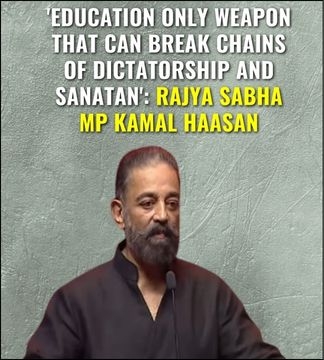
Actor-politician Kamal Haasan, addressing a gathering in Chennai in August 2025, described education as a weapon to break what he called "the shackles of tyranny and Sanatan." He also used the phrase "majority fools," remarks that drew sharp reactions across the political and social spectrum.
In Maharashtra, certain Congress leaders revived the controversial phrase "Sanatani terrorism" following acquittals in the Malegaon blast case. Some of these statements went on to link the term to the assassination of Mahatma Gandhi, claims that were strongly contested and criticised.
NCP MLA Jitendra Awhad, from the Sharad Pawar faction, described Sanatan Dharma as a "distorted ideology" that had "ruined the country." Separately, senior DMK leaders K. Ponmudy and A. Raja made remarks targeting Hindu religious symbols. One allegedly resorted to obscene analogies involving the sacred tilak, while the other reportedly advised party workers to avoid religious symbols altogether in order to signal ideological distinction.
Remarks on Sacred Practices and Figures
Sacred practices and revered figures were also subjected to repeated disparagement. RJD patriarch Lalu Prasad Yadav dismissed the Kumbh Mela as "futile," while Congress president Mallikarjun Kharge questioned the efficacy of ritual bathing. Both remarks were criticised as ridiculing deeply held religious practices.
In Jammu and Kashmir, AAP MLA Mehraj Malik made sweeping generalisations about Hindus and morality during proceedings in the Assembly, prompting sharp reactions. Elsewhere, Samajwadi Party leaders questioned the sanctity of temple traditions and the use of slogans such as "Jai Shri Ram," further adding to the list of contentious statements.
Perhaps the most controversial episode involved Rahul Gandhi, who, while speaking at an academic forum in Boston in April 2025, referred to Lord Ram and other Hindu deities as "mythological" and "imaginary." The remarks reignited an intense debate over cultural sensitivity, freedom of expression, and the responsibilities of national political leaders when speaking on religious traditions, particularly on international platforms.
Taken together, these incidents have fuelled a broader national debate on the boundaries of political speech, the consistent application of hate speech norms, and the obligation of public figures to exercise restraint and responsibility when addressing matters of faith and belief in a pluralistic society.
Article by
Kewali Kabir Jain
Journalism Student, Makhanlal Chaturvedi National University of Journalism and Communication