The Supreme Court Is No One’s Political Chamber: Opposition’s Private Outreach to the CJI Crosses a Dangerous Line
Opposition’s private letters to the CJI and open pressure tactics threaten the separation of powers and the independence of India’s highest court
Total Views |


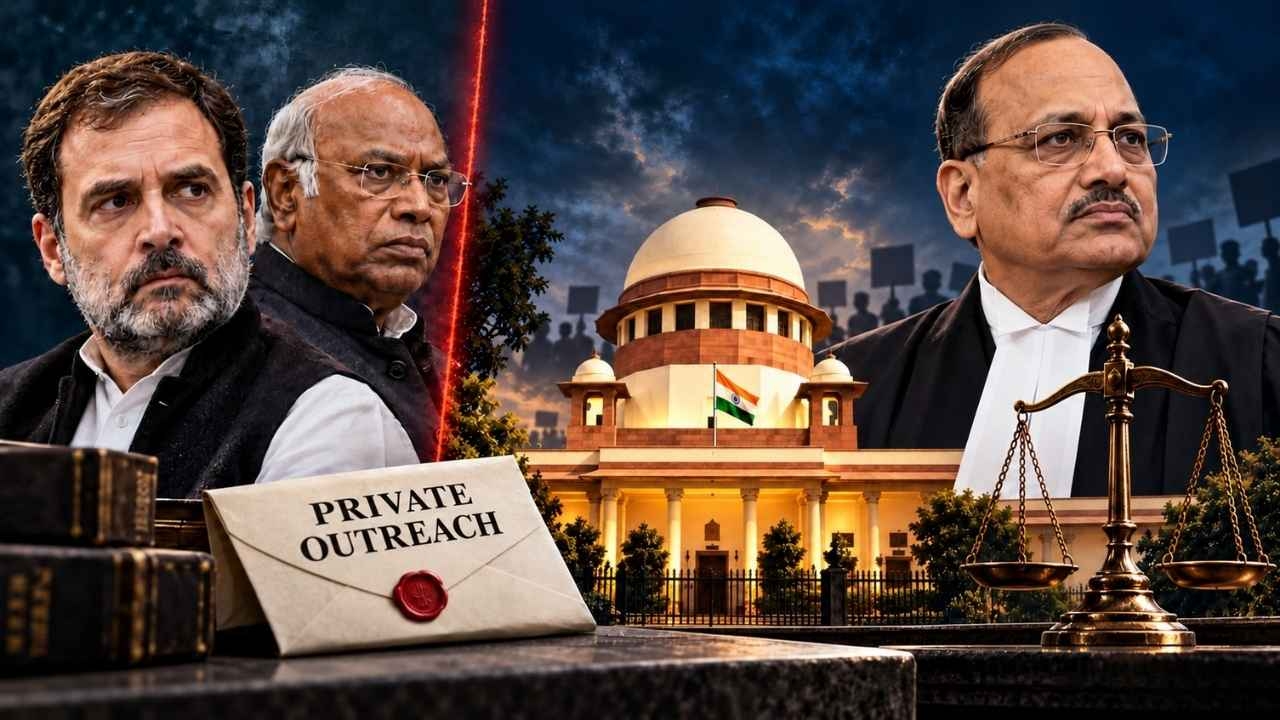
On 10 October 2026, opposition leaders sought a private meeting with India’s Chief Justice over nationwide protests demanding the Chief Election Commissioner’s resignation, raising concerns about political pressure on the Supreme Court during pending proceedings.
Democratic life requires a constant tension between legitimate dissent and the duty of the elected government to deliver orderly administration. Dissent does keep the power honest and governance also fulfils the mandate of the people. Both lose meaning the moment the constitutional institutions that hold the system together are treated as tools of political theatre.
_202610151047087593_H@@IGHT_360_W@@IDTH_640.jpg "1 image (2)")
That is precisely what happened when opposition-led protests escalated into an open assault on the authority of the Supreme Court and the office of the Chief Justice of India.
Citizens possess the fundamental rights of free speech and peaceful assembly under Article 19(1)(a) and 19(1)(b). They also have the right to approach the Supreme Court under Article 32 – the provision Dr B.R. Ambedkar called the heart and soul of the Constitution. The Court is bound to protect these liberties. Yet the manner in which those rights are now being exercised, and the channels being used to enforce them, raises a serious institutional warning.
_202610151047310719_H@@IGHT_360_W@@IDTH_640.jpg "2 image (4)")
On 10 October 2026 the Leaders of the Opposition in both Houses of Parliament wrote to the Chief Justice seeking a private meeting. Their declared purpose was to “brief” him about the “chaos” created by nationwide protests demanding the resignation of the Chief Election Commissioner. The request was especially ill-judged because an opposition Member of Parliament had already placed the same grievances before the Court. The Court responded with urgency, constituting a special bench that sat on a Sunday to hear the matter.
_202610151047518844_H@@IGHT_360_W@@IDTH_640.jpg "3 image (4)")
The letters are objectionable on two independent grounds
First, they undermine the separation of powers. Dr Ambedkar reminded the Constituent Assembly that India had long desired the judiciary to be kept distinct from the executive; that principle is embodied in Article 50. The same logic applies with equal force to political interference from any quarter. When senior political leaders demand a closed-door audience with the head of the judiciary to discuss a live, highly charged political dispute, the boundary that Ambedkar carefully drew is erased.
Second, the letters amount to an attempt to influence proceedings already pending before the Court. Whatever the professed intention, a private conversation with the Chief Justice about matters under judicial consideration is interference with the administration of justice.
_202610151048245095_H@@IGHT_360_W@@IDTH_640.jpg "4 image (4)")
This was not an isolated mis-step. On the eve of the hearing, a senior advocate appearing for petitioners in the same protest cases publicly declared that he had little hope in the Supreme Court of India. Shortly thereafter an official social-media handle of a state unit of the principal opposition party posted a demand for the Chief Justice’s resignation. The post was later deleted, but the damage was done: it revealed the reckless political atmosphere the opposition has chosen to create around the Court.
If the opposition genuinely believes constitutional questions arise from the appointment of the Chief Election Commissioner or from the state’s handling of the protests, the Constitution already supplies the proper forums, the floor of Parliament and the open court that is already seized of the matter. Neither forum requires, or permits, a private sitting with the Chief Justice.
_202610151048459627_H@@IGHT_360_W@@IDTH_640.jpg "5 image (5)")
India has a record of defending judicial independence. That record is written in the names of Justices – J.M. Shelat, K.S. Hegde and A.N. Grover, superseded in 1973, and Justice H.R. Khanna, superseded in 1977. Each paid a professional price for standing by the Constitution against executive pressure. Today the roles have reversed: it is the principal opposition that seeks to bend the judiciary to a partisan agenda.
_202610151049070097_H@@IGHT_360_W@@IDTH_640.jpg "6 image (1)")
A new form of pressure is being applied as the blunt force of street mobilisation and political spectacle directed at the highest court. This is not a campaign for independent adjudication; it is an attempt to force the most important constitutional institution to deliver a predetermined political outcome.
Coercion of the judiciary is no more acceptable when it comes from the streets than when it comes from the government. The independence that the nation defended in the 1970s must now be defended against a different, populist variety of pressure.
The Supreme Court must be left free to decide the cases before it on the record, in open court, and without influence from any political quarter including the opposition that currently claims to speak for constitutional values.
Written by

Kewali Kabir Jain
Journalism Student, Makhanlal Chaturvedi National University of Journalism and Communication