The CPI’s Opposition to the Quit India Movement
The CPI’s support for the Allied war effort brought it into conflict with the Congress’s 1942 campaign, raising questions about Soviet influence and its wartime political priorities.
Total Views |


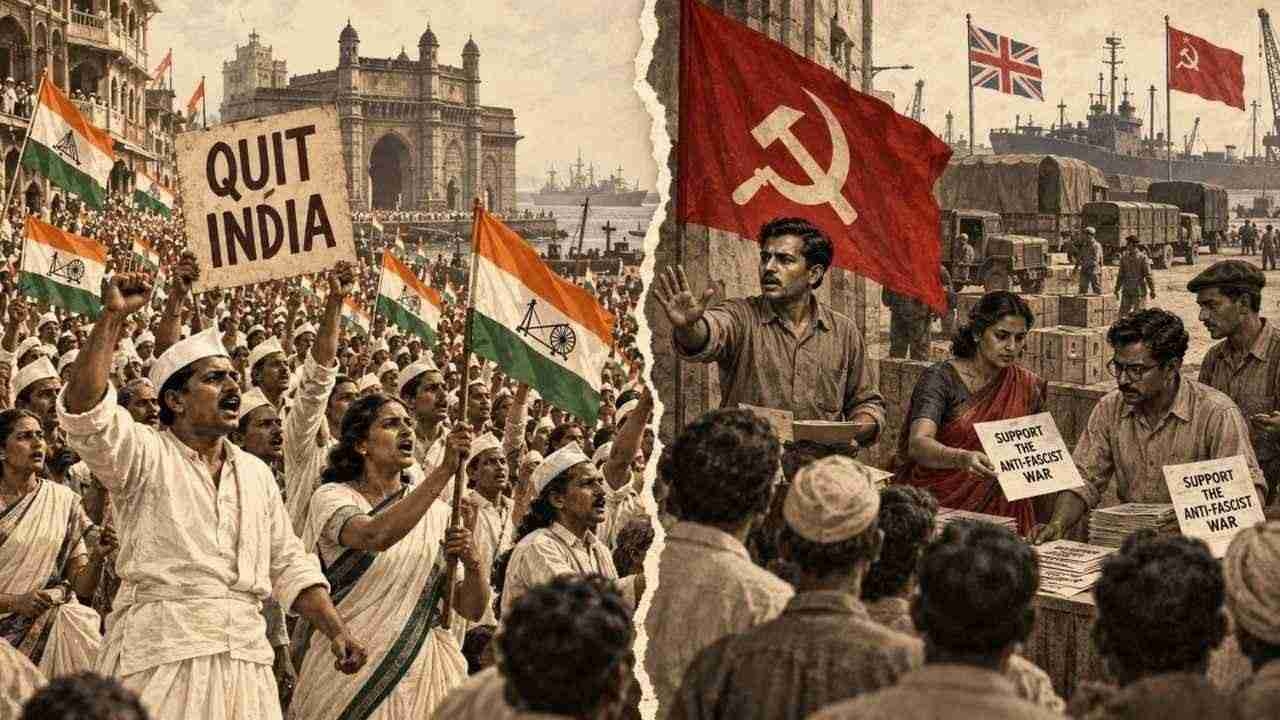
During the 1942 Quit India Movement, the Communist Party of India opposed Congress’s campaign against British rule, prioritising the Allied struggle against fascism following Germany’s invasion of the Soviet Union, deepening divisions within nationalist politics.
What can you expect from a political party formed outside India? In Tashkent, part of the Communist Soviet Union, to be precise. This is the Communist Party of India (CPI) founded on 17th October 1920. In the beginning it was at the beck and call of the Communist International or Comintern based in Moscow. Later with the expulsion of M. N. Roy from the party in 1929, it also came to be controlled by the Communist party of Great Britain (CPGB). British Communists like Rajani Palme Dutt, Ben Bradley and Harry Pollitt became the influencers of the struggle for the rights of the Indian farmers and workers. Loyalty to external forces is what the Communist Party of India is, its splinters included, of course!
It is very alarming that the ‘intellectuals’ who are supposed to form the core of the Communist movement anywhere have to be so hollow, even in matters of national interest! Many examples exist to prove this skewed outlook of the Communists. When Gandhi ji launched the Civil Disobedience Movement, the Communists in India called for an anti-Gandhi league with a slogan ‘Anti-Gandhi is anti-imperialism’, as the Indian National Congress (INC) was considered a party of the Bourgeoisie. The Communist party ideologues in India were made to believe by their external Godfathers that India’s freedom struggle and class antagonism will go hand in hand, together.
The Soviet International Comintern came out with a policy for the colonies in 1935 and the local communists were advised to infiltrate the main Bourgeoisie political movement in their respective countries. The Communist Party of India was banned by the British government by then and the Communists had organized themselves under the banner of ‘National front’ under the leadership of Puran Chand Joshi.
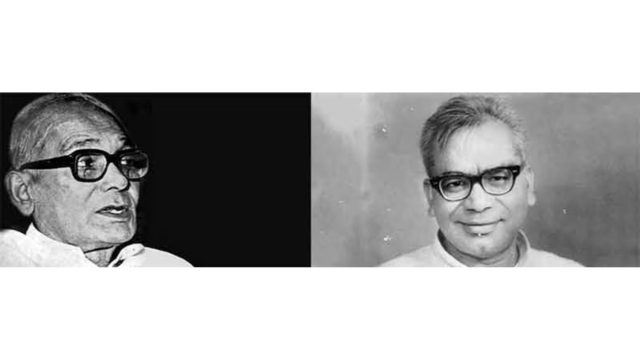
The Indian National Congress already had many Communists and socialists in its fold. Firebrand leaders like Jai Prakash Narayan, Ram Manohar Lohia and others had formed the Congress Socialist Party (CSP) within INC. In 1936, the communists under the National Front joined the Congress with a plan to infiltrate CSP and dominate the Congress decisions through CSP. Thus, two communists, viz., EMS Namboodiripad and ZA Ahmed became the Joint Secretaries of CSP.
Puran Chand Joshi’s gameplan was always to infiltrate a competing organization and take over its working. Thus, Joshi tried to infiltrate and take over not only the Congress party but also the All-India Trade Union Congress (AITUC), the Kisan Sabha and the Muslim League! He also set up many ancillary wings to work amongst specific interest groups like students, farmers, artistes, culture etc that appeared to be independent of the Communist Party but ideologically similar. The theatre and cultural groups attracted many artistes and this helped to romanticise Russian revolution and the Marxist ideology.
Then the 2nd World War came in 1939. Initially, it was between Germany and European countries, Britain, Commonwealth and France and the war was branded as an ‘Imperialist war’. Later when Germany invaded the Soviet Union in June 1941, the imperialist war became termed a ‘People’s war’ by the Communists in India, in tune with their Master’s voice. The voice of the Communist Soviet Union and its new allies became the voice of the whole world.
Thus, the approach towards imperialistic Britain and the Bourgeoisie USA changed overnight in the Soviet sphere, with no predicament as to how to convince this somersault of support to Britain to be in the interest of the Indian people.
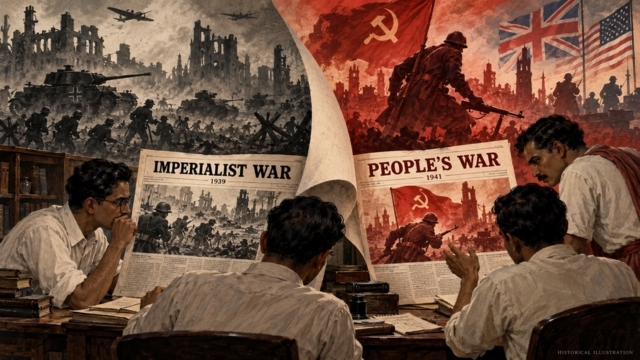
There was a general anti-imperial undercurrent in the entire country and if at all, the people were willing to align with the anti-Britain Axis powers. A communication from Harry Pollitt, Secretary of CPGB cleared all doubts to the Indian as well as the world communists; they have to align with Soviet interests by supporting the ‘People’s war’ and oppose Germany’s fascism. They were duty-bound to defend the world ‘revolution’ and no other interests could be valid in this war. Thus, the politburo adopted a resolution in favour of the People’s war on 15th December 1941. The Colonial Government of India responded with accommodation by declaring that it had no desire to keep any person in jail if he earnestly helped the war effort against the Axis forces.
The Indian Communists did not think even for a second how to ally with the Colonial British State? They did not even think it appropriate to extract some assurance from Britain that India would be free after the war. Such was the loyalty of the Indian Communists to the Soviet cause! The line adopted was clear - “Maximum mass mobilisation against fascism, full cooperation with all those who oppose fascism irrespective of political differences, no action of the present ruler as long as they stand by the alliance to resist fascism, should deflect us from this line” - wrote Rajani Palme Dutt (CPGB) to Indian comrades (Published in People’s War and quoted by Minoo Masani in ‘The Communist Party of India’ p. 80-82).
The British government lapped up this stand and Sir Reginald declared: “If there be any person whose attitude is to earnestly help the war effort, I have no desire whatsoever to keep him in jail” The communists immediately extended unconditional support to the government’s war efforts. A letter to the Additional Secretary to the Government of Bengal declared: “The enemy is at our doors, and the government should be well-aware of that. There is a widespread fifth-columnist activity, busy sowing pro-Japan or defeatist feeling among the masses. Unless the government gives full facilities to popular organizations like ours to counteract fifth column propagation.”
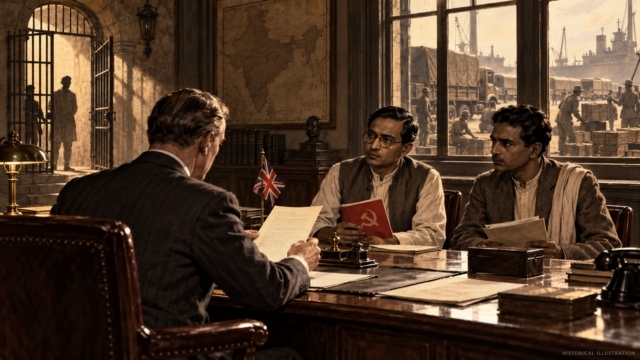
The CPI sought the release of imprisoned communist leaders and members so that they could participate in the anti-fascist war effort.
In July 1942, the British government legalised the CPI and began releasing communist prisoners. According to Gene D. Overstreet and Marshall Windmiller’s Communism in India (p. 206), British authorities also organised guerrilla training, largely for communist volunteers, against a possible Japanese invasion. One trainee described approximately 300 volunteers receiving a twelve-day course under British officers. A separate account described smaller units near Poona receiving instruction from American and Chinese officers.
Meanwhile, the Cripps Mission failed in its negotiation with the Congress in 1942. The Congress gave an ultimatum to Britain to Quit India and in the Bombay session AICC held on 8th August 1942, Gandhi ji gave a call for ‘Do or Die’. The British government immediately banned the Indian National Congress and put all the leaders behind bars. This did not quell the people’s uprising. There was a widespread upheaval with leaders going underground and mobilising people to form liberated zones. Freedom became a non-negotiable popular demand and every repressive action against the leaders and the people further fuelled nationalist fervour.
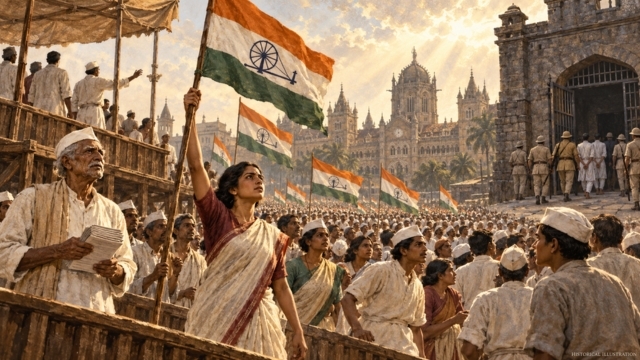
Communist members within the Congress sought to prevent a direct confrontation with the British government during the AICC session ( Source - P. N. Chopra, Quit India Movement, p. 265). Their position prioritised support for the Soviet war effort through its ally, Britain, over launching an anti-colonial movement at that stage. However, they failed to persuade the Congress leadership.
Immediately, the Congress turned retrograde to the Communists and their propaganda machinery started attacking Congress: “The resolution it has produced has bankruptcy writ large on it. From the rut of inactivity, it now seeks to lead the nation into the blind desperation and disaster” (People’s War, 19th July 1942). The Communists reserved their choicest abuses for the Congress and other organizations that supported its Quit India resolution: they were branded ‘fifth-columnists’.
The Communists were most venomous towards Netaji Subhas Chandra Bose. For them, Netaji was the lap-dog of Japanese imperialism. “The Assam office of Japan-German Independence Association published a message from Subhas Bose. The appeal will certainly fall on deaf ears. The Communist Party will rise to the occasion and give the only reply which traitors and quislings have got from honest patriots. Bose’s mercenary army of ‘liberation’, of rapine and plunder, will feel the wrath and indignation of our people if it dares to set foot on Indian soil to enact acts of pillage and robbery” cried the party mouth-piece ’People’s war’ on 10th January 1943.
What did the Communists achieve with this diatribe and vitriol against the patriotic efforts of Netaji Bose and the Congress? It established many ancillary organizations to propagate its anti-India policies. Taking advantage of government support, the Communist Party did not shy away even from mobilising juveniles (under 15 years of age) under the banner of ‘Bal Sangh’ or ‘Kishore Bahini’ to work along with the Students’ Federation in its programme to support anti-Japanese campaigns to benefit the imperial British government and also campaign for its own brand of national unity on the basis of self-determination i.e., creation of Pakistan. With government patronage, the sales of ‘People’s War’ rose by 124%. The party membership increased manifold.
During the entire Quit India movement, the Communists actively aligned with the British government as informers to sabotage the efforts of Netaji Subhas Bose, the Congress and other patriotic organizations by identifying their activists working underground to turn them around to the government and by spreading misinformation. The Communist Party of India grew in its membership, money power and influence with the government, while the nationalistic organizations were hounded and miserably suffered.
Written by
Sahadev Bharti