Communist, Muslim League and Partition of India
Why did the CPI back the Muslim League’s demand for Pakistan, and how did its position change as Partition approached?
Total Views |


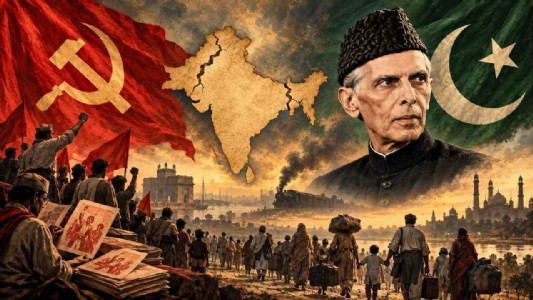
In the 1940s, the CPI backed Muslim self-determination as a way to resolve communal divisions in British India. Its cooperation with the Muslim League, followed by policy shifts, raises questions about its role before Partition.
The claim of the All-India Muslim League that it represented the Muslims of India was put to test in the provincial elections in 1937. It failed miserably in these elections, securing only 4.8% of Muslim votes. The Muslim voters then favoured the Unionists in Punjab and the Krishak Praj Party in Bengal over the Muslim League and the Congress. The demand for a separate nation to be called Pakistan found echo in the Lahore Declaration by the All-India Muslim League on 23rd March 1940. To the League, India was not one nation, but two and a united Hindustan was a ruse for the Hindus to enslave the Muslims and exploit them.
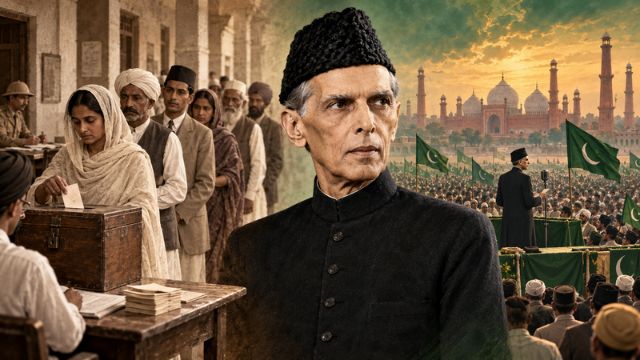
The League received support from the expected quarters for its demand for a separate Pakistan – the Communist Party of India (CPI). It adopted the ‘Nationality Theory’ borrowed from the Soviet Union and declared that wherever the Muslims live together in a majority in a territorial unit, they formed a nationality and had a right to autonomous existence as a State. The communists did not stop there. Led by Dr Gangadhar Adhikari, they viewed the Hindu-Muslim conflict as one of nationalities that could be solved only through the right of self-determination and freedom for secession.
It was an active support by the Communist Party of India to the Muslim League in its demand for Pakistan at the ground level. In the 1942 Plenum of the Central Committee, the CPI decided to ‘educate’ the Hindus as to what is just in the demand for Pakistan, the right for an autonomous State as well as the right for self-determination and separation The party mouthpiece, People’s War, also asked the cadre to showcase the progressive character of the League and Mr Jinnah. With the party extending support to the League in Pakistan, the communists started coordinating work with the Muslim League in the field through meetings and rallies. All India Students Federation (AISF), the students wing of CPI, took active part in these efforts.
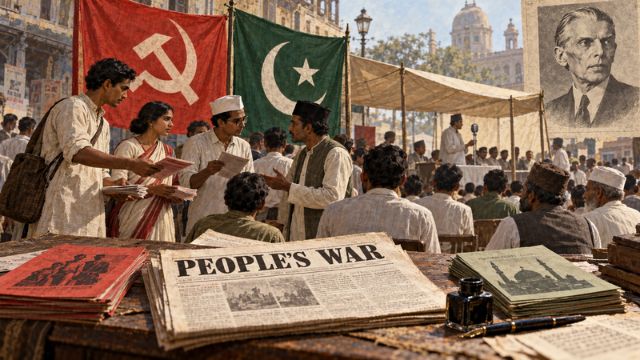
Under PC Joshi, the communists allegedly continued their efforts to infiltrate and ambush other organisations, including Congress. Their moles in the All India Trade Union Congress (AITUC) and the All India Kisan Sabha tried to dictate the CPI’s Pakistan policy through sponsored resolutions. Such an effort made in the AITUC session held on 1st May 1943 at Nagpur failed but a similar effort to take over the Kisan Sabha succeeded with its founder Swami Sahajanand Saraswati being forced to resign, opposing the treacherous stand of the communists on Quit India movement and Pakistan policy!
Many communists from Punjab like Sardar Baldev Singh Bedi, Baba Karim Singh and Giani Sardar Singh also quit CPI protesting against the party’s support to the Muslim League to vivisect India by advocating self-determination. N G Ranga representing the farmers observed: “The only lead the CPI claims to give us is that - we decide here and now to divide India before we can get India for Indians and make bits of India the sporting ground for Imperialist rivalries between the Anglo-American and Soviet expansions”
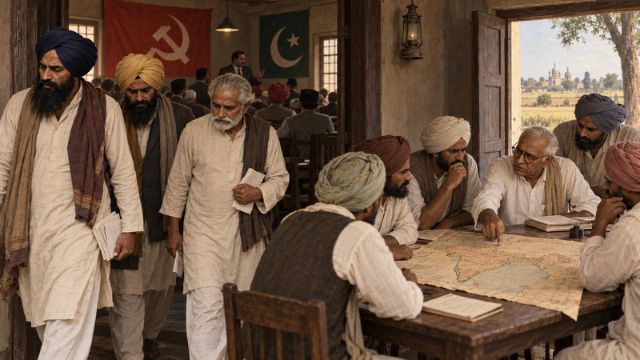
However, P C Joshi was unapologetic and declared, “We support the aim of the league, which is nothing more than the right of sovereign freedom of the Muslims. Just as we are against British domination over our country, we are against any Hindu domination over Muslim Homelands. PC Joshi continued with his threatening pose: “We Indian Communists consider this anti-League and anti-Communist policy of the CWC as direct encouragement to the forces of civil war which will lead to the country’s ruin”. It was a classic case of betrayal by the communists for the posterity to judge and punish.
Forced to leave the Congress for this divisive stand, the communists continued to align with the Muslim League and its partition agenda. As usual, PC Joshi advised the Muslim members of his party to infiltrate the Muslim League. For example, the Students’ Federation unit of the party at Aligarh Muslim University was disbanded and joined the Muslim League Students’ federation. It was sheer opportunism that the Communist Party which termed religion as opium, was actively supporting the Muslim League, a party based on religion! Back to the era of Russian revolution, it is confounding to note that the Russian Bolshevists who opposed the Russian Orthodox Church in 1918 had no conflict with Islam. They even promised to preserve the Shariat courts and were called the ‘Red Shariatists’ by the Russian Muslim clergy!
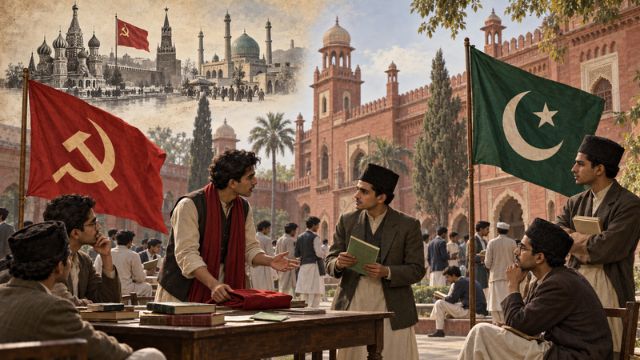
Another contradiction was that the Muslim League was a party of feudal lords, Zamindars and Nawabs who were supposed to be the enemies of the farmers and working class, but the communists supported the party of the oppressors! Political opportunism won over class struggle! For example, in Punjab where the Muslim League, which represented the Zamindars and feudal lords, was in a minority against the formidable Unionist Party, the communists joined hands with the League and gave it legitimacy with the poor farmers in rural areas. However, in Bengal the conservatives within the Muslim League saw through the infiltration policy of the communists to take over their party and resisted all such moves, castigating the communists as fifth-columnists and the greatest enemies of Islam!
Communist support for Congress-League parity can be criticised for strengthening the League’s political standing. However, by the 1946 elections, the League had demonstrated substantial electoral strength in Muslim constituencies, despite continuing opposition from regional and Congress-aligned Muslim organizations.
CPI entered the election arena on the promise of the right of self-determination and freedom to secede to Muslims as well as different nationalities. The Muslim League fought the elections on the war cry “Ladke Lenge Pakistan”, directed against the Hindus and the Congress. Finally, when the elections got over in 1946, the Communist Party of India was routed, but the Muslim League got the mandate it wanted the most, to represent the Muslims of India and the support for its call for Pakistan for the Muslims.
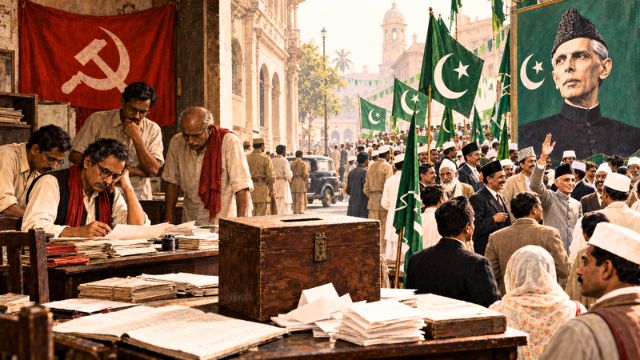
After the elections that decided which parties the power would be transferred to, the British government sent a three-member delegation called the ‘Cabinet Mission’. The Mission declared that it had only one purpose – to help Indians achieve their independence and beyond that, they have an open mind. In his interaction with the Mission on 17th April 1946, PC Joshi presented a memorandum titled ‘The Communist solution of the Indian problem’. He proposed that the people should have the right of self-determination to decide freely whether they would join the Indian Union or form a separate Sovereign State.
The communists stood firm in support of the Muslim League’s Pakistan demand with their borrowed theory of nationalities and considered it to be the urge for freedom of the Muslims in India. Rajani Palme Dutt of CPGB had this to say: “Indian Communists take the Muslim League as one of the patriotic parties in India. It is no use dubbing all of them as reactionaries and coming in the way of the country's freedom. There is real mass expression behind the Muslim League and there need not be a partition of India”. With this endorsement from CPGB, the Communists continued to support the League in its demand for self-determination.
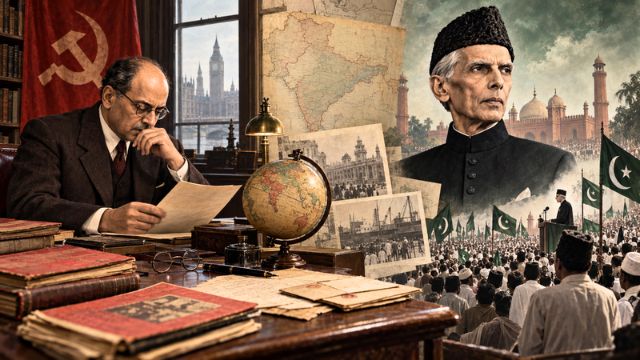
Upon the Award of the Cabinet Mission in June 1946, the Congress decided to join the interim government and the League followed suit. By accepting the Cabinet Mission proposals, it appeared that the League had given up its demand for a separate, independent Pakistan. However, the statement given by Jawaharlal Nehru that “What we do in the Constituent Assembly we are entirely and absolutely free to determine”. It became reason enough for the Muslim League to reject the Cabinet Mission proposal. Immediately, the League gave a call to all its members to give up all the titles bestowed on them by the British government and resort to Direct Action.
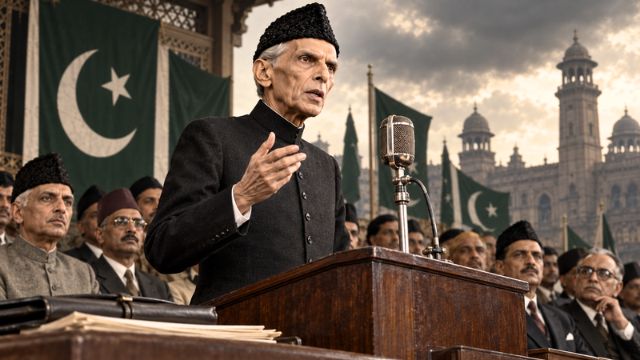
The call for Direct Action gave rise to cries for bloodshed to vindicate the honour of the Muslims and safeguard their interests. Emotions held sway over rationalism when fanatics gained dominance and threatened the havoc that the Muslims would play would put to shame what ‘Changez Khan and Halaku’ did. Jinnah declared: “What we have done today is the most historic act in our history. The day we bid goodbye to the constitutional methods”. Instead of criticizing the League for its rejection of constitutional methods, PC Joshi echoed the view of the Muslim League by criticizing the Congress that - “The League resolution must come as an eye-opener to the Congress leadership. All their plans based on the constitution-making body will be blown up if the League persists in its rejection”.
With H S Suhrawardy at the top as the Bengal Premier, the call for Direct Action was destined to be remembered as the blackest days in the history of the sub-continent. He wrote an article in ‘The Statesman’ on 5th August 1946 stating “Bloodshed and disorder are not necessarily evil in themselves if resorted to for a noble cause. Among Muslims today, no cause is dearer or nobler than Pakistan”. As expected, when the Congress proposed a walk-out in the Bengal Assembly, the three Communist MLAs did not participate.
The Muslim League organised strikes, processions and a mass rally for Direct Action Day on 16 August 1946. Some accounts record Communist cooperation with its observance, alongside appeals for communal peace. This cooperation is criticised as politically legitimising the League’s mobilisation, but claiming that it enabled the subsequent Calcutta killings requires stronger evidence.
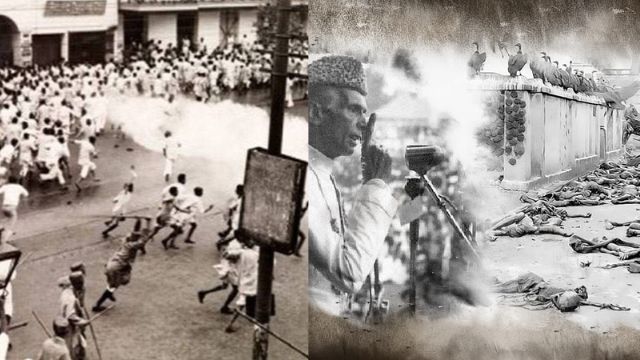
On 16 August 1946, Muslim League supporters gathered at Calcutta’s Maidan for a rally addressed by Suhrawardy and other League leaders. Some Communist trade unionists also marched to the Maidan, according to participant Jolly Mohan Kaul’s later testimony. His account records that they withdrew after learning of the violence and sought to protect their neighbourhood.
In the four days of mayhem, over 4000 were dead and about 15000 were injured, both Hindus and Muslims. The enormity of the riot proved that it was pre-planned and organized. Days ahead of 16th August, the Press affiliated to the Muslim League roused the emotions of Muslims by highlighting the significance of the month of Ramadan and spread hatred by advocating violence against the Hindus. For days, the streets were littered with corpses with vultures feeding on them. Governance had collapsed. “The many empty stomachs, together with the filth and garbage that have strewn the place, a plague that will make a pale thing even of the most hideous of holocaust”.
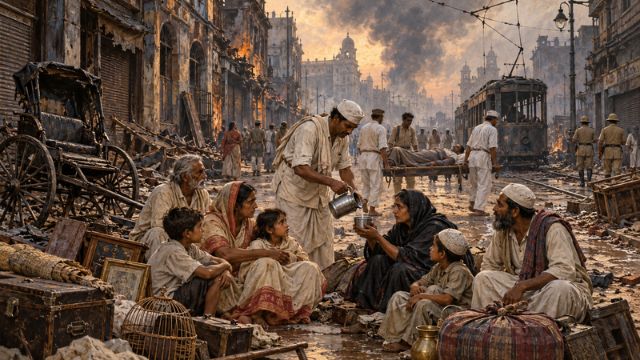
In the aftermath of the bloodshed, the CPI took a dubious neutral stand and blamed the Cabinet Mission for the riots. PC Joshi issued a statement that the Muslim League’s struggle was directly against the Hindus, thus showing false sympathy and distancing his party from the responsibility. Yet, the CPI did not vote against the League government when a no-confidence motion was moved against it in the Assembly! In a political circular of 23rd August 1946, PC Joshi admitted that “there are no water-tight compartments between the league masses and the Red Flag masses”. The party continued to lend indirect support to the Muslim League without any remorse.
By the end of 1946, it was getting clearer that the two major parties forming part of the interim government could not see eye to eye on most of the administrative issues. Partition and Pakistan were becoming a certainty but the shape it would take was uncertain yet. Meanwhile, tension on the ground was leading to communal riots, spreading like fire from Calcutta to Naokhali and Bihar to Punjab and various other places.
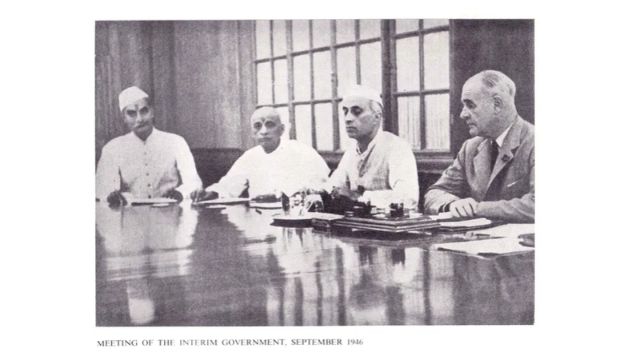
The danger of the flare ups turning into a civil war loomed large. An organization called ‘Bengal Provincial Conference’ emerged demanding division of Bengal in case Pakistan is to be created, because it doubted that the Muslim League will be a danger to the Bengali culture and way of life. Sardar Patel was of the view that if Pakistan becomes a reality, then both Bengal and Punjab have to be divided on the basis of religion, failing which there will be civil war.
However, Sarat Chandra Bose opposed the division of Bengal and called for a united Bengal province under the Indian Union, the bond being Bengali sub-nationalism. He found support in this cause surprisingly from Suhrawardy, who probably sensed that his importance would go down if Bengal became part of Pakistan. This opportunism of Suhrawardy only created more doubt and the call for division of Bengal grew more. In Punjab, the situation was similar with no trust prevailing between the Muslims on one hand and the Sikhs and Hindus on the other. With such distrust between warring religious groups, partition came to be increasingly acceptable as the only possible solution.
The stand of the CPI kept changing from time to time. From nationality theory to the right of self-determination and forming an autonomous region within Bengal to forming a separate State, the communists kept contradicting their own stand in many ways. However, even while talking about two nationalities within Bengal, they continued to be vocal on the right of self-determination and a separate State for East Bengal Muslims.
Finally, the CPI came out with its election manifesto in 1946 which concluded its stand: “The CPI stands for a united and free Bengal in a free India. Bengal as the common homeland of the Bengali Hindus and Muslims should be free to exercise its right of self-determination”. By this, the communists who had lent support to the demand for Pakistan, now concurred with the lofty line proposed by Sarat Bose - Suhrawardy of united Bengal in a free India with a right to self-determination! However, no solution was given to the deep chasm of communal distrust that prevailed between Hindus and Muslims.
The Hindus demanded partition as they were not confident enough to trust the Muslim League and support a United Bengal. The Muslims, however, demanded the whole of Bengal. Congress was not in favour of a separate Bengal as it doubted the safety of Hindus as minorities in a separate Bengal and suspected the scheme as a ploy to make the whole of Bengal a part of Pakistan in the end. Finally in June 1947, Viceroy Mountbatten gave his award to divide Bengal and Punjab on communal lines. Congress accepted partition as it feared balkanization of India and civil war otherwise. Muslim League was forced to accept what it called ‘a moth-eaten’ Pakistan.
This is the painful history of the rendezvous of the communists with the Muslim League that paved the way for the vivisection of our Motherland. However, this bloodied past is whitewashed in our history within a few decades by the leftist historians to hide the deceit of the communists. Now we find the same chameleon taking different shades to suit its diabolical plans to devastate our Motherland. The people of India are alert now to the dangers they face as a nation and hopefully, they will not allow these internal enemies to succeed in their devious schemes.
Written by
Sahdev Bharti