Exposing the Global Toolkit: Anti-Bharat Disinformation Campaigns Orchestrated by Foreign Elements
AI-generated deepfakes targeting the Armed Forces and fabricated narratives of economic panic reveal a coordinated Pakistan-led global nexus spreading fake news to destabilise Bharat"s strategic and internal security.
Total Views |


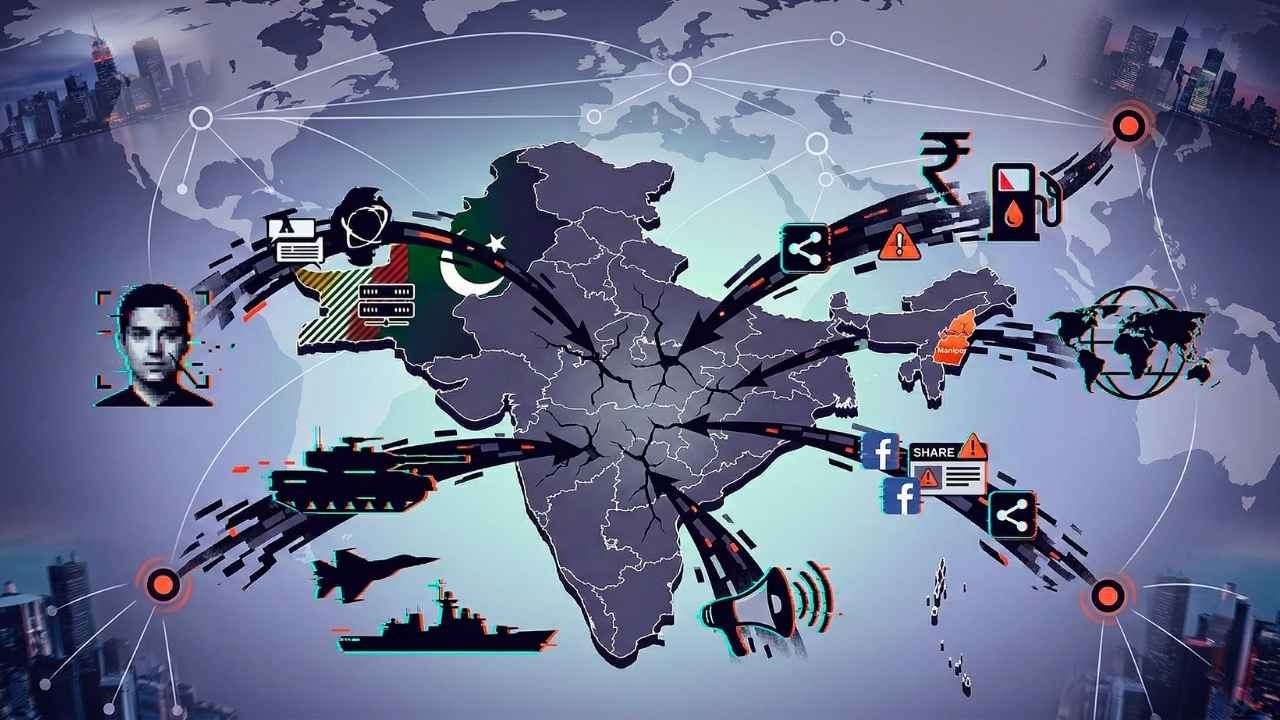
In a relentless and coordinated attempt to malign Bharat's global standing, internal harmony and strategic strength, foreign media portals and influencers orchestrated a massive disinformation campaign throughout March 2026. A comprehensive fact-check report has meticulously documented 40 major incidents of fake news circulated by international actors between 1 March and 31 March 2026. Notably, every single one of these widely shared cases has been exposed and verified as misleading or entirely false.
This report serves as a critical instrument in unmasking the sustained propaganda being injected into public discourse by anti-Bharat forces.
The Epicentre of Deceit: The Pakistani Nexus
It is evident that the primary hub of this anti-Bharat propaganda ecosystem lies across the western border. Out of the 40 documented incidents, a staggering 50 percent, amounting to 20 cases, originated directly from Pakistan-linked sources. When combined with the broader South Asian network, this regional concentration accounts for 65 percent of the total disinformation attacks, that is 26 cases.
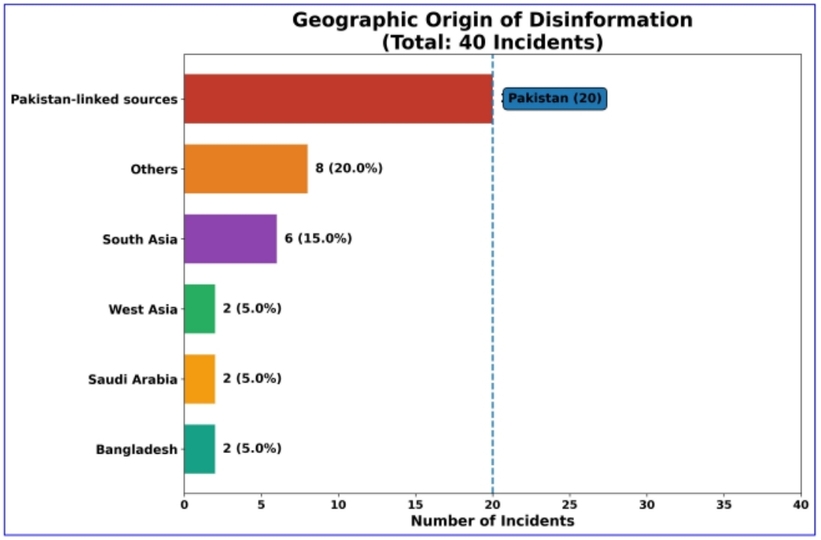
The widespread amplification of these narratives across regions such as Europe, the United States and the Middle East highlights a highly coordinated, multi-nodal strategy aimed at spreading falsehoods on a global scale.
Targeting Bharat's Core Pillars: Defence and Diplomacy
The campaign clearly focused on undermining Bharat's strategic and geopolitical foundations.
Defence and security formed the largest share of these attacks, constituting nearly 43 percent of the incidents. Diplomacy and international relations followed at approximately 30 percent. Together, these two sectors accounted for nearly 75 percent of all fabricated narratives.
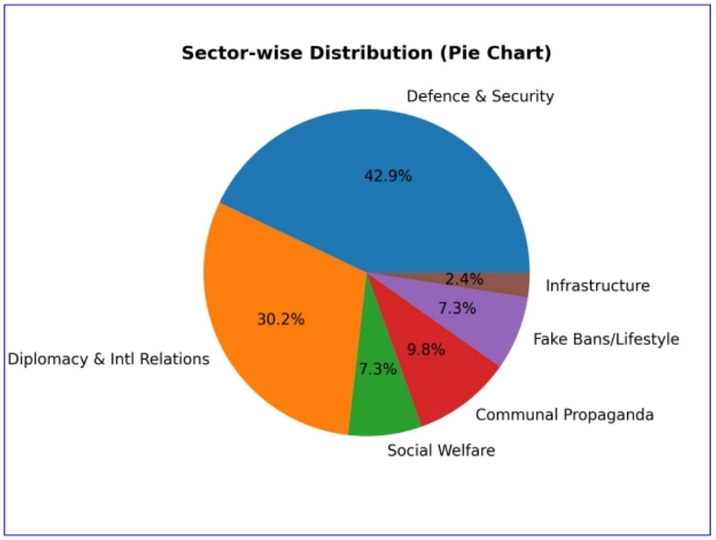
This distribution reveals a deliberate attempt to weaken Bharat's military credibility, which alone formed 40 percent of the target category, along with efforts to undermine its sovereign foreign policy, which accounted for 30 percent.
A particularly dangerous trend emerging from this campaign is the increasing use of artificial intelligence and deepfakes to target defence leadership and erode institutional credibility. In one egregious instance, a digitally manipulated video of Indian Army General Upendra Dwivedi was circulated by Pakistan-linked accounts. The deepfake falsely claimed that Bharat had shared the location of an Iranian naval vessel with Israel as part of a so-called new strategic arrangement. In reality, General Dwivedi made no such statement at the Raisina Dialogue.
Similarly, fabricated statements were attributed to Home Minister Amit Shah by a Pakistan-based social media handle. The manipulated video falsely suggested that he had stated in Parliament that Pakistan was meant to be a part of India. No such remarks were made, and the video was digitally altered.
Weaponising Internal Fault Lines and Economic Panic
The perpetrators aggressively exploited the situation in Manipur to construct a narrative of internal instability and collapse.
Manipur-related disinformation accounted for 22 percent of the targeted narratives. In one extreme case, anti-Bharat elements falsely claimed that a so-called Manipur Armed National Army had shot down an Indian fighter jet. In reality, an Indian Air Force Sukhoi-30MKI aircraft tragically crashed during a routine training mission in Assam.
The claim that Manipur Armed National Army shot down an Indian fighter jet is false; the aircraft crashed during an Indian Air Force training mission. pic.twitter.com/G5myF3xwd1
— Only Fact (@OnlyFactIndia) March 6, 2026
In addition to security narratives, the campaign also attempted to destabilise economic confidence by triggering resource-related panic.
Pakistan-based social media handles circulated fabricated claims that Bharat had only two days of petrol reserves remaining. Authorities have repeatedly clarified that there is no such shortage, with refineries operating at more than full capacity.
Furthermore, social media accounts based in the United States and Saudi Arabia shared misleading maps alleging that ammonia and urea plants across Bharat had been shut down. These claims were entirely baseless and aimed at creating unnecessary alarm.
The Dawn Delusion
Even established media platforms were not immune to spreading misinformation. The publication Dawn carried a report falsely claiming that Bharat was investing 60 billion dollars in storage dams on the Jhelum and Chenab rivers. The report alleged that these non-existent dams could be used as a strategic weapon to induce floods or droughts.
Subsequent fact-checking confirmed that no such storage dam projects exist on either river, exposing the claim as entirely fabricated.
A Call for Vigilance
The evolving geopolitical dynamics involving Bharat, Iran and Israel are being deliberately exploited to portray Bharat as an unstable and aggressive actor on the global stage. However, government agencies such as PIB Fact Check and Ministry of External Affairs Fact Check, along with independent verification organisations, have consistently countered these false narratives through timely detection, verification and public dissemination of facts.
As the digital battlefield continues to expand, citizens of Bharat must remain vigilant. This foreign disinformation toolkit is designed not only to mislead but also to divide and demoralise. Awareness, critical thinking and reliance on verified information remain the strongest defences against such coordinated propaganda campaigns.
Written by

Kewali Kabir Jain
Journalism Student, Makhanlal Chaturvedi National University of Journalism and Communication