Religious Intolerance Exposed: Hindu Symbols Face Hostility Abroad While Christianity Thrives Unhindered in Bharat
As Hindu communities establish temples overseas, growing hostility toward their sacred symbols contrasts strongly with Bharat"s long-standing accommodation of prominent Christian institutions.
Total Views |


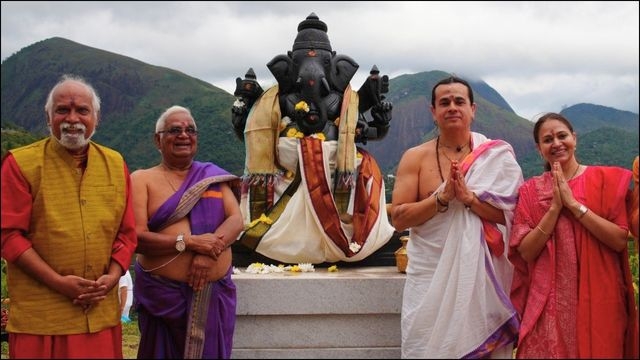
In a world that frequently lectures Bharat on secularism and tolerance, a glaring double standard has become impossible to ignore. On May 9, 2026, the Hindu community in Brazil achieved a historic milestone with the Pran Pratishtha of the first Lord Ganesha idol in Latin America at Petrópolis, Rio de Janeiro. This event should have marked a moment of cultural sharing and celebration for the region's 300,000 to 400,000 Hindus. Instead, it triggered a wave of racist, anti-Bharatiya, and anti-Hindu vitriol on social media, with users employing terms such as "cultural colonization 2.0," "insects," and demanding deportation from what they called a "Christian continent."
This incident is not isolated. It reflects a deeper pattern of intolerance toward Hindu sacred symbols in the West, even as Christian institutions continue to enjoy unparalleled freedom and prominence within Bharat.
The Texas Hanuman Statue and Sustained Campaign of Derision
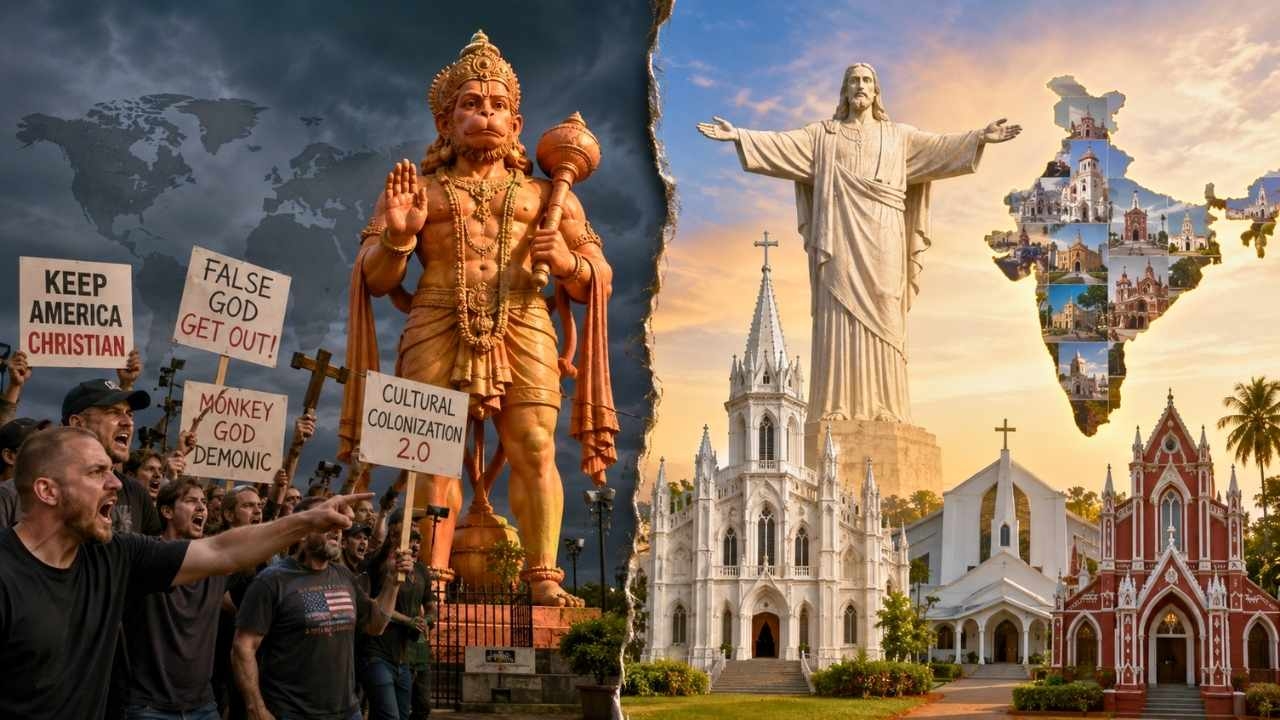
The backlash in Brazil echoes the fierce opposition faced by the 90-foot Lord Hanuman statue, known as the Statue of Union, at the Sri Ashtalakshmi Temple in Sugar Land, Texas. Installed in 2024, the statue has repeatedly attracted hostility and organised campaigns of opposition.
Why are we allowing a false statue of a false Hindu God to be here in Texas? We are a CHRISTIAN nation!pic.twitter.com/uAPJegLie0
— Alexander Duncan (@AlexDuncanTX) September 20, 2025
Republican leader Alexander Duncan openly declared on September 20, 2025, that the United States is a "CHRISTIAN nation" and questioned the presence of what he called a "false statue of a false Hindu God," citing Exodus 20:3-4. Other users and influencers followed with even cruder attacks, describing the statue as a "poop demon monkey," "satanic," and "demonic filth," while bizarrely linking it to floods, monkeypox, and demographic "replacement." Church groups also staged physical protests, with leaders such as Greg Gervais branding Hanuman a "demon god." Consequently, the temple administration had to install cameras and hire additional security personnel.
Now that we are kicking out all of the H1B Indians it shouldn’t be too hard to get the government to take down this hindu demon monkey statue in Fort Bend County, Texas pic.twitter.com/yPVvg69xe8
— Spinachbrah 🥗 (@basedspinach) September 20, 2025
These reactions reveal more than mere theological disagreement. They expose a civilisational discomfort with visible Hindu assertion in Western spaces. Terms such as "monkey god," "foreign demons," and dehumanising references to Indians as street-shitters or colonisers reflect deep-seated racial and religious prejudice rather than principled secularism.
Last year a 90-foot statue of a Hindu god went up at a temple in Sugar Land, Texas.
— JuliansRum (@ItsJuliansRum) August 6, 2025
We are being replaced. pic.twitter.com/Qtm7CiWUXW
From August 2024 through 2026, nearly 20 documented incidents involving politicians, influencers, church activists, and media figures framed Hindu deities as satanic or idolatrous threats. This outrage remains highly selective. The same voices rarely apply equivalent scrutiny to other non-Christian religious symbols, yet Hindu icons appear to provoke a particularly hostile response.
Bharat's Generous Embrace of Christian Institutions
In contrast, Bharat presents a vastly different reality. The country officially hosts more than 28,278 churches. The Catholic Church alone ranks among the largest landowners after the Government of India, controlling vast estates estimated at seven crore hectares and valued at approximately Rs 20,000 crore.
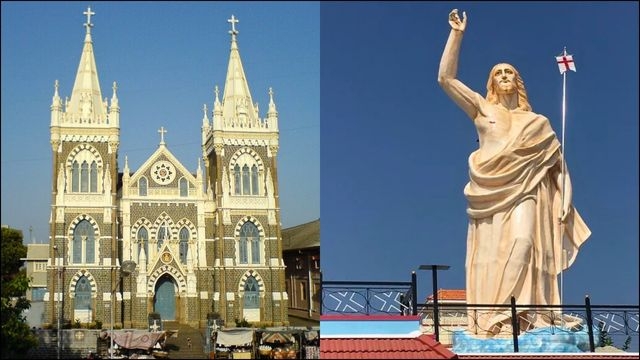
Bharat is also home to numerous grand Jesus statues and Christian landmarks across multiple states:
- A massive 114-foot white granite Jesus statue currently under construction in Ramanagara, Karnataka.
- A 35-foot statue at Mount Olive, Gethsemane Garden, Bengaluru.
- Prominent Christian installations in Velankanni, Mumbai, Kanyakumari, Goa, Hyderabad, Mysore, Thiruvalla, and Kolkata.
- Statues of Christ the Redeemer, Sacred Heart of Jesus, Christ the King, and several others that stand prominently without facing mass protests or being labelled "demonic" by the Hindu majority.
This contrast raises an important question regarding reciprocity and mutual respect in multicultural societies.
Reciprocity and Civilisational Confidence
The Hindu diaspora, particularly in the United States, has earned its place through hard work, innovation, and significant contributions in technology, medicine, academia, and business. The construction of temples and majestic icons such as the Hanuman statue symbolises cultural rootedness and gratitude toward Bharat's civilisational heritage. Yet, instead of welcoming this diversity, certain Christian fundamentalist and nativist groups respond with hostility, invoking "Christian nation" rhetoric that conveniently overlooks America's own constitutional principles of religious liberty.
This intolerance appears especially striking given Christianity's own long history of missionary expansion across continents, often accompanied by the suppression of indigenous traditions and native belief systems. Today, when Hindus peacefully establish sacred spaces abroad, some critics hastily label these efforts as "colonisation."
The debate, therefore, extends beyond isolated social media outrage or local protests. It reflects a broader question about whether multiculturalism and religious freedom truly apply equally to all faiths, or whether Hindu symbols alone remain acceptable targets for ridicule and exclusion in sections of the Western world.
Written by

Kewali Kabir Jain
Journalism Student, Makhanlal Chaturvedi National University of Journalism and Communication