Attack on Hindu Identity: Exam Frisking or Cultural Friction?
Why are students repeatedly asked to remove sacred threads and mangalsutras when exam guidelines do not explicitly require it?
Total Views |


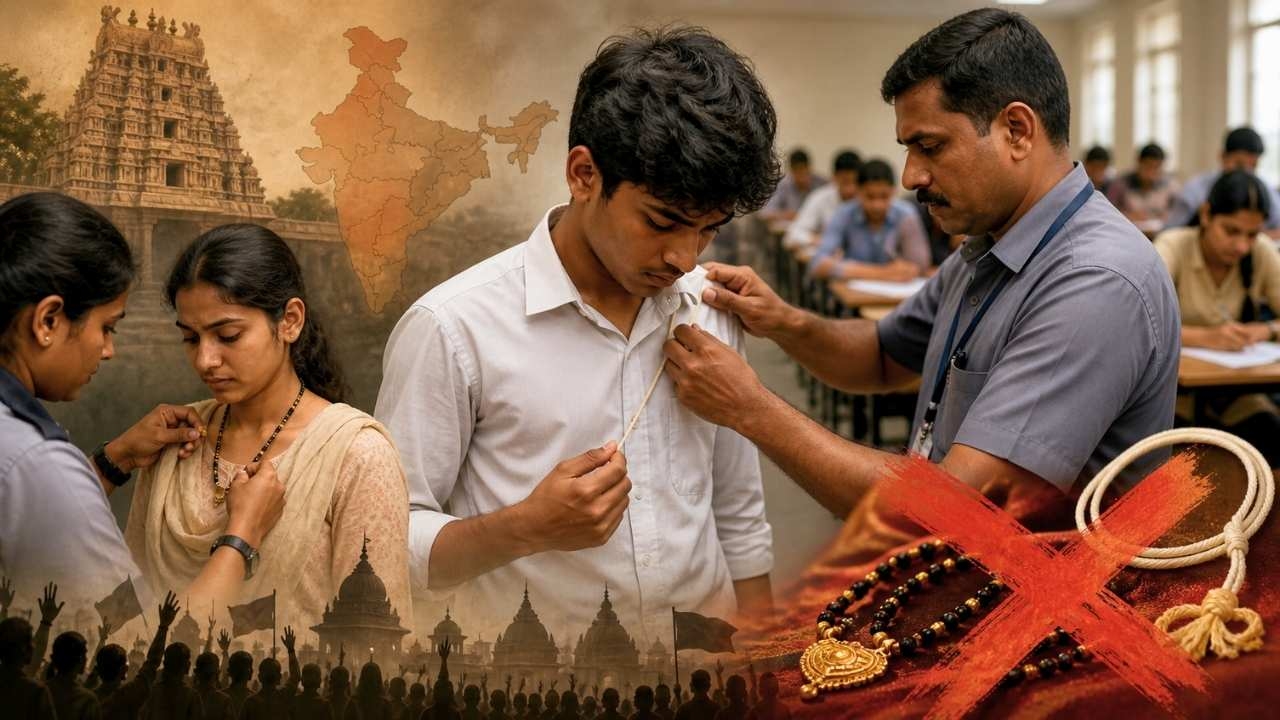
The integrity of public examinations in Bharat has long required strict protocols, including frisking, surveillance, and standardised procedures designed to curb malpractice. However, a growing pattern of incidents across the country suggests that these measures increasingly collide with deeply held cultural and religious practices. From sacred threads such as janeu or Janivara to mangalsutras and traditional adornments, several candidates have found themselves at the intersection of administrative rigidity and civilisational identity.
The latest flashpoint emerged on 23 April 2026 at a pre-university college in Bengaluru during the Karnataka Common Entrance Test. Five Brahmin students were reportedly compelled to remove their sacred threads during frisking. The incident triggered immediate backlash from parents and community members, prompting the institution to suspend three staff members and issue a formal apology. State authorities clarified that no such directive existed in official guidelines, raising questions about procedural overreach at the ground level.
Notably, a review of incidents between 2018 and 2026 reveals a recurring trend in which the enforcement of exam discipline appears to encroach upon personal and religious freedoms.
A Pattern Across States and Examinations
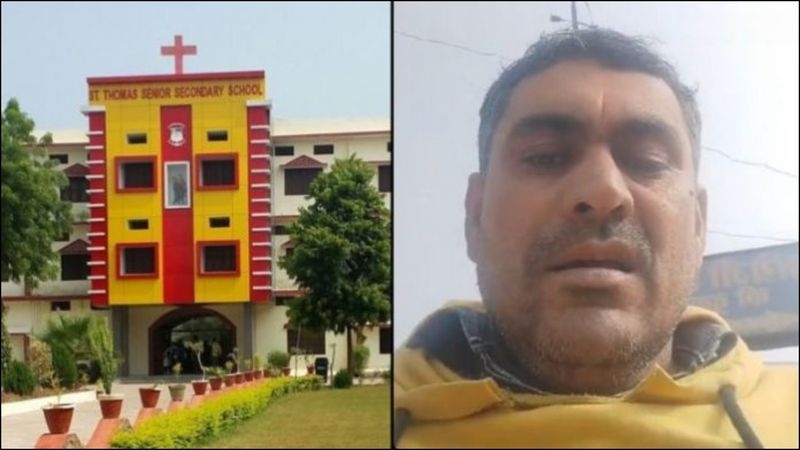
In January 2025, a student in Uttar Pradesh’s Chitrakoot was allegedly barred from appearing in a pre-board examination after chanting a religious slogan on campus. Police intervention ensured his participation, but protests erupted beforehand, highlighting concerns over freedom of expression within educational spaces.
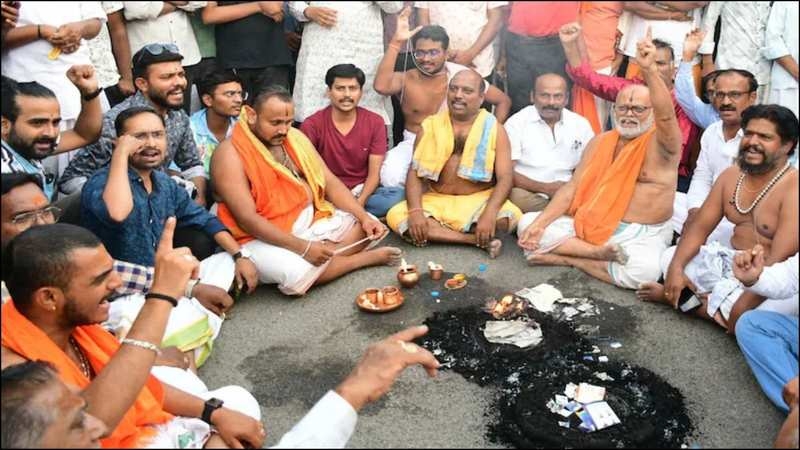
Similarly, in Rajasthan in March 2025, a candidate was asked to remove his janeu during a recruitment examination. The matter gained traction after a video went viral, leading to administrative action, including the suspension of personnel. Community voices argued that the sacred thread, being non-metallic, posed no security risk and questioned the rationale behind such directives.
Karnataka, notably, has witnessed multiple such incidents. In Kalaburagi in May 2025, a NEET aspirant was allegedly forced to remove or cut his sacred thread, resulting in FIRs and arrests. In Bidar in April 2025, another Karnataka Common Entrance Test candidate faced similar restrictions, prompting an official inquiry. In Mangaluru, guidelines reportedly barred religious items altogether, leading to confusion and objections.
The issue extends beyond male religious symbols. In 2023, female candidates in Kalaburagi were asked to remove mangalsutras and toe rings during a recruitment examination, citing concerns over hidden electronic devices. The directive drew widespread criticism as insensitive and excessive.
The earliest recorded case in this series dates back to 2018 in Telangana, where women were asked to remove mangalsutras at an examination centre. Following public outrage, authorities blacklisted the centre and clarified that no such rule had been officially mandated.
Security vs Sensitivity: A Structural Gap
At the heart of these controversies lies a structural ambiguity. Examination bodies often issue broad guidelines aimed at preventing cheating, particularly the use of concealed electronic devices. However, the absence of clear and uniform instructions on handling religious or cultural symbols leaves scope for inconsistent interpretation by on-ground staff.
This gap results in ad hoc decisions, where invigilators and security personnel, acting out of caution or misinterpretation, enforce measures that candidates perceive as intrusive or discriminatory. A consistent feature across these incidents is the nature of the administrative response. Authorities typically take actions such as suspending staff, registering FIRs, and initiating inquiries only after public outrage emerges. While these steps signal accountability, they also underscore a reactive governance model.
In several cases, authorities have clarified after the fact that no guideline mandated the removal of such items. This raises a critical question: why does this misinterpretation recur so frequently?
Moreover, the pattern repeatedly places Hindu students under scrutiny, intensifying concerns about the balance between security protocols and respect for cultural identity.
Written by

Kewali Kabir Jain
Journalism Student, Makhanlal Chaturvedi National University of Journalism and Communication