1956: Report of the Christian Missionary Activities Enquiry Committee (Part 3)
The 1956 enquiry report further examined how colonial policies, financial aid, and missionary institutions expanded conversions across tribal regions and socially vulnerable communities.
The Narrative World 20-May-2026
Total Views |


It is absolutely clear that British rule supported missionaries of many denominations. The administration extended assistance in several ways, and conversion often aligned with the colonial agenda.
The Catholic Directory noted in 1950 that the Catholic Church had 958,000 adherents within nearly 200 years of the Portuguese arrival in Bharat. The French supported Catholic missions, and the French Jesuit headquarters operated from Pondicherry from 1700 onwards. Even in Kolkata, a Catholic chapel was established in 1700. Catholics reached Tibet in 1713. After the Dutch arrived in Bharat, Protestant missionary activity began in 1706. The British established the first English mission in 1690. Obviously, these missions did not exist merely to serve people, but also to pursue conversions.
Even after conversion to Christianity, society did not remain untouched by the caste system. Lower castes continued to face discrimination and social exclusion.
Missionaries later decided to focus on Brahmins and other upper-caste groups. They attracted them with government jobs and other incentives. During the following 50 years, the administration granted lavish aid to missionary institutions. Educational institutions gradually adopted a secular framework, which many believed created a cultural and spiritual void in young minds. Indirectly, schools imparted knowledge of the Christian religion and distanced children from their traditional identity. Government aid also gave authorities significant influence over the education system. Aid to government schools reportedly remained five times higher than aid to private institutions. As political power expanded, missionaries received more active support from the administration. Officials often claimed that missionaries performed better work than many other branches of government.

In the later half of the 19th century, movements such as the Arya Samaj and Brahma Samaj emerged. Spiritual leaders like Swami Dayanand Saraswati, Ramakrishna Paramahamsa, and Swami Vivekananda appeared on the national scene. Their efforts created resistance against missionary activities. Vivekananda, in particular, deeply influenced the Bharatiya mind and encouraged people to think seriously about the Hindu way of life. Although missionary activities continued, these reform movements strengthened cultural confidence among many Indians.
The government provided land grants and financial aid to construct churches, hospitals, and educational institutions. Authorities also extended many other concessions. State funds directly supported missionary work, creating a unique example of administrative involvement.
Missionaries focused heavily on hill tribes, lower sections of society, and communities placed outside the mainstream Hindu social structure. In many cases, some groups were deliberately described as non-Hindu. At the same time, movements emerged to uplift aboriginal communities by encouraging the adoption of Hindu customs and traditions. Missionaries strongly opposed such developments because they feared losing influence. As missionary efforts intensified, the number of converts increased steadily.
On the other hand, several small princely states restricted missionary movement. Authorities limited the stay of priests to 48 hours and permitted visits only four times a month. However, after the merger of princely states following Independence in 1947, these restrictions disappeared, especially in the central regions of Bharat.
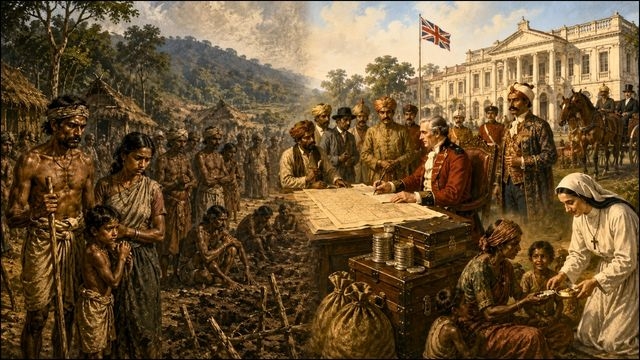
Economic and social problems also contributed to conversions. Under the Permanent Settlement introduced by Lord Cornwallis, land ownership patterns changed significantly. Traditionally, land belonged to aboriginal communities, while Rajas and zamindars collected revenue. The new system altered this arrangement and created distress among local populations. Converts often faced economic difficulties, and missionaries offered them assistance and protection.
Missionaries provided moral as well as financial support to converts. In regions such as Chhota Nagpur, Jesuit missionaries reportedly used these circumstances to encourage conversion. Such activities even contributed to uprisings, including movements in Bastar. According to the report, some missionaries encouraged discontent and disloyalty against local authorities.
Jesuit missionaries also attempted to enter the Udaipur State without authorisation. They distributed loans to attract people towards conversion and opened mission schools without obtaining the required permission.
In 1948, missionary groups reportedly received 8,000 US dollars, and in 1953 they obtained 90,000 US dollars from the Lutheran Church in America for conversion-related work. These funds contributed to large-scale conversions in the Surguja district. Competition reportedly existed among different missionary groups for converts. In some cases, missionaries offered Rs 30 to attract people. When the Lutheran Missionary Society requested additional support, it reportedly received 1,500 US dollars, after which more than 5,000 conversions took place.
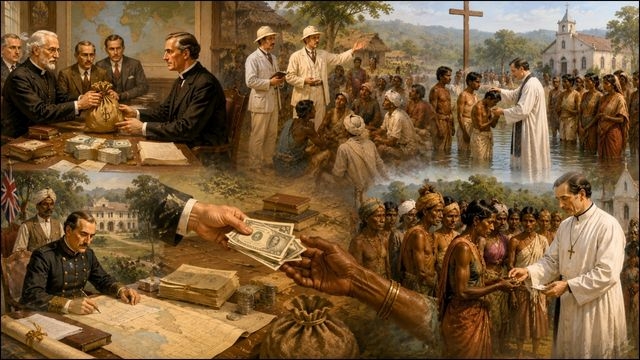
The report also noted that in 1893 the Commissioner of Chhattisgarh allowed land acquisition without consulting the local government. Political inaction, according to the report, worsened the situation.
One point became clear from these observations: many people viewed missionary institutions as sources of material benefit rather than centres of spiritual transformation.
Several smaller princely states recognised the objectives of missionary groups and therefore restricted their activities.
A detailed enquiry into missionary activities in Jashpur revealed that missionaries gained influence by providing loans to local people. At the same time, the Archbishop of Kolkata reportedly admitted that many people accepted conversion mainly for material benefits and possessed little emotional attachment to Christianity.
Not all communities accepted conversion. The Gonds, for example, actively participated in political movements such as the Satyagraha movement.
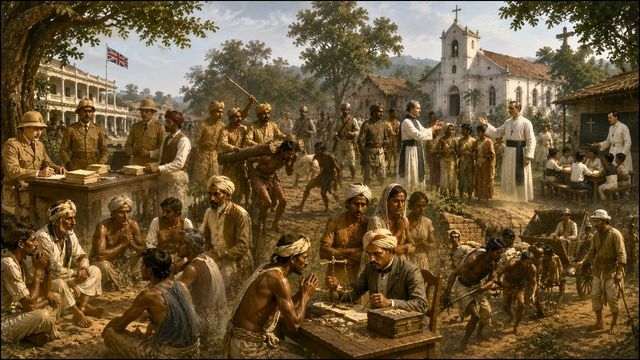
British rule weakened the authority of tribal elders and damaged traditional Panchayat systems. The new administrative structure introduced exploitation by petty officials, forced labour practices, and moneylenders, which disrupted tribal solidarity. This environment created space for missionary influence. Missionaries often interfered in various aspects of social life and projected themselves as all-powerful institutions, almost functioning as a state within a state.
The example of Jharkhand also reflected this trend. British policies deeply affected local social structures. In the 1931 Census, authorities separated tribal communities from Hindus. Later, some groups even demanded a separate state on the lines of Pakistan, reflecting the extent of social and political division.
What initially began as a religious movement to replace animist beliefs with Hindu doctrines eventually transformed into a political movement against landlords and a distrusted administration. Mission societies demanded larger grants by claiming that they dedicated their lives to the upliftment and education of tribals. They also demanded a separate administrative unit to protect the racial, economic, educational, cultural, and political interests of backward communities. Even before Independence, some groups demanded a separate Governor’s Province.
Observers described this development as the spirit of Religious Nationalism.
The report cited the example of the Karen community of Myanmar, which even sent a delegation to London demanding a separate Karen nation. According to the argument presented in the report, British colonial policies sowed seeds of division in many countries before withdrawal, leaving behind long-term social and political conflicts.
The report recorded several open appeals for conversion. It argued that people should not consider British rule entirely just or fair because colonial governance introduced divisive policies. Although supporters of British rule often highlight certain administrative and institutional reforms, the report maintained that these systems primarily served colonial interests and administrative convenience. It further argued that when one compares Britain’s own progress with India’s condition in 1947, the country remained far behind despite nearly two centuries of colonial rule.

प्रो. विद्या देशपांडे
Professor Vidya Deshpande has over four decades of experience in education. Her main expertise is philosophy; she taught philosophy and logic at Nowrosjee Wadia College for 36 years. She has been associated with the Janakalyan Blood Bank for the last 38 years and served as a management committee member of Karve Stree Shikshan Sanstha for 10 years. Her special fields of interest include the philosophy of social sciences, school education, development of self-reliance skills, and top-up skills to make students profession-ready.