TVK's Freebie Bonanza: Vijay's Populist Gamble Threatens Tamil Nadu's Fiscal Future
Can Tamil Nadu afford TVK"s costly freebie promises while public debt rises and infrastructure spending continues to shrink across the state?
Total Views |


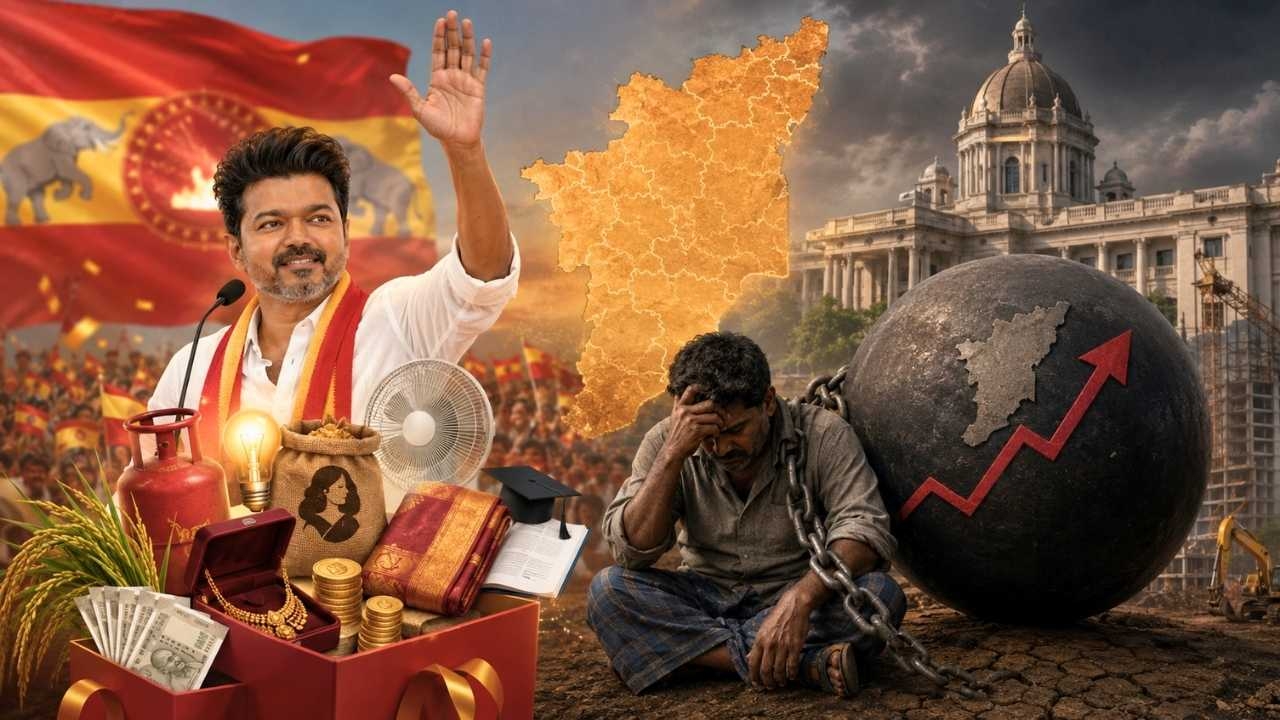
In the heat of the 2026 Tamil Nadu Assembly elections, Tamilaga Vettri Kazhagam (TVK) leader Vijay has embraced the familiar Dravidian playbook with gusto. His party's manifesto reads like a wishlist from a lavish giveaway show: ₹2,500 monthly assistance for women heads of households up to the age of 60, six free LPG cylinders per family annually, 200 units of free electricity, 8 grams of gold and silk sarees for brides, unemployment allowances of ₹4,000 for graduates and ₹2,500 for diploma holders, crop loan waivers, and a raft of collateral-free loans and health cover schemes.
This is not visionary governance. It is classic competitive populism wrapped in celluloid charisma. While promising a "Vettri Tamil Nadu" (Victorious Tamil Nadu), TVK has plunged into a model of competitive populism shaped by the soft rhetoric of welfare-driven politics. In doing so, Vijay risks jeopardising the fiscal future of Tamil Nadu.
Tamil Nadu, once regarded as a manufacturing and investment powerhouse, now risks slipping deeper into a debt trap where short-term voter appeasement has trumped, or threatens to trump, sustainable economic growth.
The Scale of the Promise: Billions in Recurring Handouts
The financial burden of these promises is staggering. Tamil Nadu's population stands at around 7.7 crore, with millions of households potentially eligible for these schemes. The ₹2,500 monthly stipend for women alone could cost thousands of crores annually, echoing and even exceeding the DMK government's existing Magalir Urimai Thogai scheme, which already strains the state's finances at nearly ₹13,800 crore per year. Once the costs of free LPG cylinders, free electricity, gold distributions, unemployment allowances, pensions, and loan waivers are added, the fiscal gap widens dramatically.
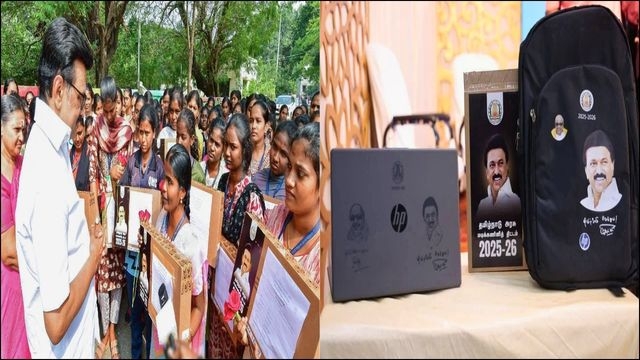
TVK insists these promises are "practical and deliverable". However, history suggests otherwise. Successive DMK and AIADMK governments have layered one freebie upon another, including mixers, grinders, fans, laptops, bicycles, and cash transfers, while public debt has continued to balloon. Tamil Nadu's current liabilities hover near or above ₹10 lakh crore, with debt-to-GSDP ratios approaching unsustainable levels despite the state's relatively robust economy. Interest payments already consume a significant share of revenue receipts, crowding out capital expenditure on roads, ports, power infrastructure, and industrial development.
Capital expenditure as a percentage of GSDP has declined steadily over the years. When governments borrow primarily to fund revenue expenditure such as salaries, pensions, and subsidies, they mortgage the future. Critics point out that every newborn in Tamil Nadu effectively enters the world carrying a notional debt burden. TVK's additional promises threaten to deepen this inherited liability even further.
Tamil Nadu continues to generate strong own-tax revenues through manufacturing and services, but revenue buoyancy has remained inconsistent. As expenditure growth outpaces revenue generation, the state increasingly relies on borrowings to sustain its welfare commitments.
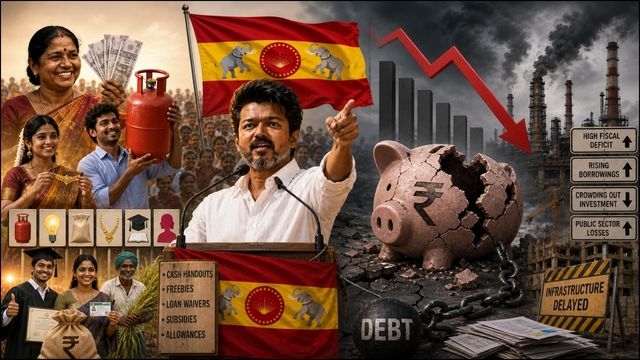
Prioritising welfare distribution over wealth creation through high fiscal deficits, unchecked freebies, and large-scale cash handouts risks severely undermining a state's economic future and industrial competitiveness, especially in heavily industrialised regions such as Tamil Nadu. These policies can crowd out private investment by raising borrowing costs and signalling fiscal unpredictability. Simultaneously, subsidies for electricity and LPG distort market dynamics and contribute to a vicious cycle of public sector losses.
Moreover, excessive reliance on unemployment allowances risks weakening human capital by reducing incentives for meaningful skill development. Genuine empowerment depends on quality education, entrepreneurship, and a strong business environment, not perpetual dependence on politically driven welfare rhetoric.
Ultimately, this heavy dependence on welfare politics creates a legacy of intergenerational injustice. It burdens future citizens with mounting debt, higher taxes, and deteriorating infrastructure while weakening Tamil Nadu's competitive edge against more fiscally disciplined states.
Written by

Kewali Kabir Jain
Journalism Student, Makhanlal Chaturvedi National University of Journalism and Communication