Reclaiming Bengal, Reclaiming Tagore
A civilisation may stumble and lose confidence in itself, but as long as its cultural soul survives, renewal remains possible.
Total Views |


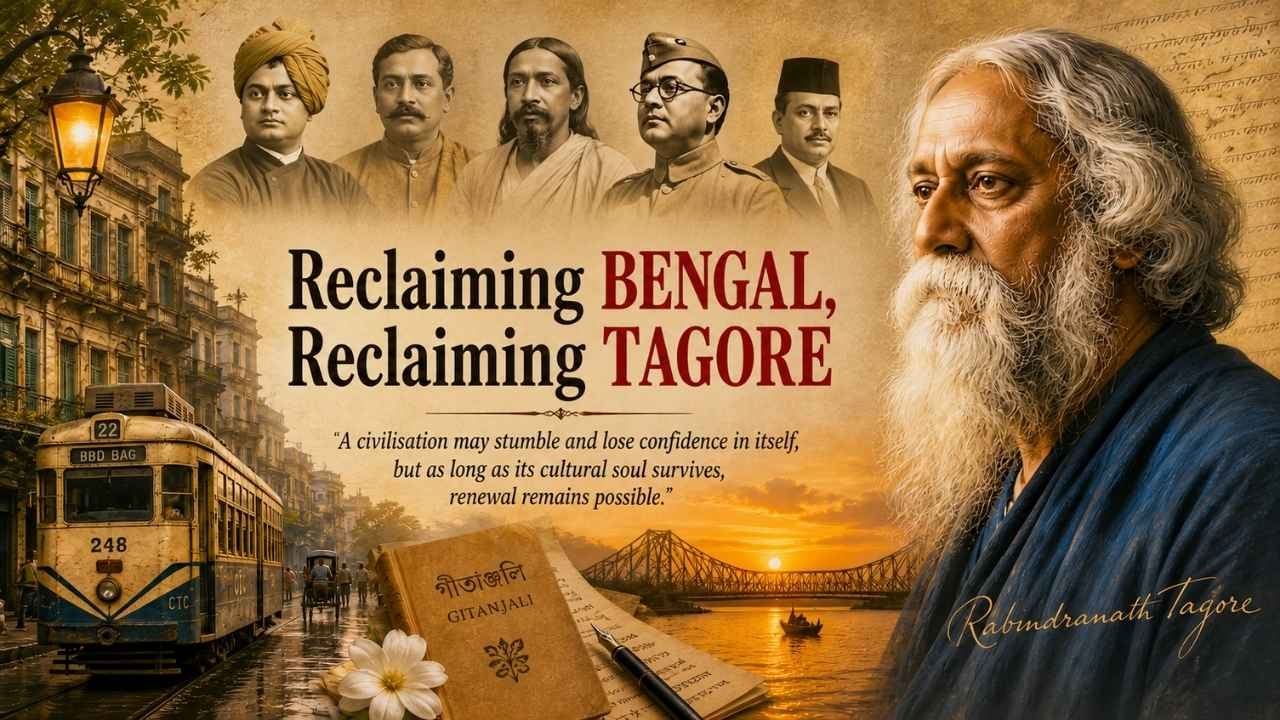
When the tram bells ring through the lanes of North Kolkata on evenings and rain settles softly over fading colonial balconies, Bengal does not feel like a state. It feels like a civilisation trying to remember itself.
Bengal is not a language or a geography. It is a civilisation shaped by memory, philosophy, sacrifice, literature, spirituality, revolution and cultural confidence.
This is the land that gave India Rabindranath Tagore, Swami Vivekananda, Subhas Chandra Bose, Bankim Chandra Chattopadhyay, Sri Aurobindo and Syama Prasad Mukherjee. Individuals who stood at the heart of India’s emotional and spiritual awakening. These people are Bengal’s pride.
Yet contemporary Bengal is increasingly described through a different lens. It is portrayed as a land of rigidity, endless political confrontation, hyper-liberal intellectualism and growing distance from the broader civilisational identity of India.
Somewhere along the way Bengal’s own story began to change.
Perhaps no figure reflects this transformation more clearly than Tagore himself. He was a poet and a complex person.
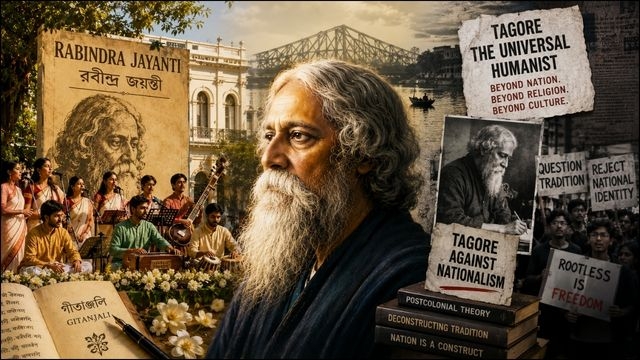
Every year Tagore Jayanti is celebrated with poetry recitals, songs and cultural events. Yet sections of the liberal intellectual ecosystem often reduce Tagore into a selective political symbol. They present him as a universal liberal detached from Indian nationalism, Hindu civilisational consciousness or cultural rootedness.
Tagore was far more complex than the political labels imposed upon him today. He had ideas and was not just a one-dimensional person.
He criticised nationalism and warned against emotional fanaticism. At the same time he also warned India against blindly imitating the West. He feared a civilisation becoming hollow, mechanically materialistic and disconnected from its own moral and cultural foundations.
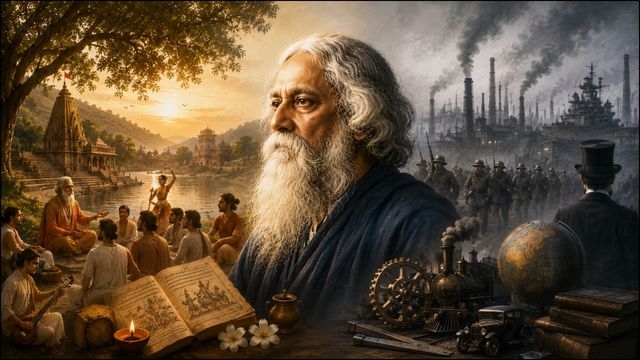
Tagore understood that India’s civilisation evolved differently from Western nation-states. European nationalism largely emerged through consolidation, military competition, industrial expansion and struggles between centralised powers. India’s civilisational continuity evolved through geography, pilgrimage traditions, epics, temples, philosophies, languages, saints and cultural coexistence across thousands of years.
That distinction matters.
Civilisational nationalism in India cannot be mechanically equated with twentieth-century European ultra-nationalism or racial nationalism. Yet many modern intellectual frameworks continue attempting that comparison, portraying every expression of Indian civilisational identity as inherently dangerous or regressive.
The irony is that much of this criticism itself emerges from intellectual models imported from Western societies whose own historical experiences were shaped by colonialism, racial conflict and industrial nationalism.
The contradiction becomes even sharper in Bengal.
For decades sections of Bengal’s intellectual culture attempted to create an artificial separation between Bengali identity and broader Indian civilisational identity. As though Bengal’s cultural sophistication existed independently of Bharat’s civilisational foundations.
Bengal’s greatness itself emerged from those foundations.
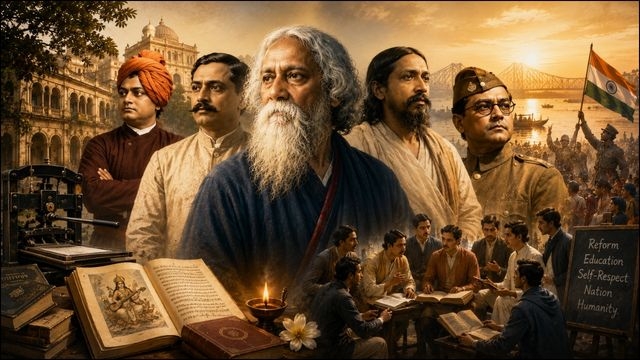
The Bengal Renaissance did not arise through rejection of civilisation. It emerged through engagement with it, reform within it and renewed confidence in it. Vivekananda, Bankim, Aurobindo, Tagore and Subhas Bose all engaged deeply with India’s civilisational inheritance while debating modernity, reform, nationalism and global engagement.
To portray Bengal as a post-national liberal space detached from India’s civilisational core is historically incomplete.
India’s uniqueness in fact lies in its ability to accommodate contradictory ideological currents within the same democratic framework.
Few civilisations have allowed intense coexistence of competing political ideas for so long. India gave space simultaneously to traditions, reform movements, liberals, conservatives, Marxists, atheists, regional movements and civilisational nationalists. All functioning within the same democratic structure.
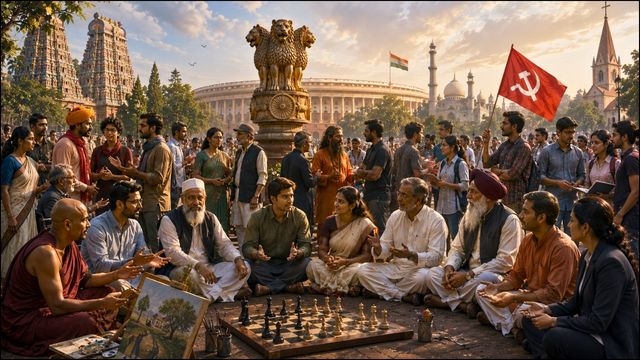
It is perhaps one of the countries where communist parties could rise electorally through democratic legitimacy rather than violent revolution.
That itself reflects India’s temperament.
Even ideologies critical of India’s civilisational structure were allowed political legitimacy within Indian democracy.
Today significantly, India no longer has any state governed by communist parties, marking the end of a long political era. The fact that communist governments ruled democratically for decades in India remains historically remarkable in itself.
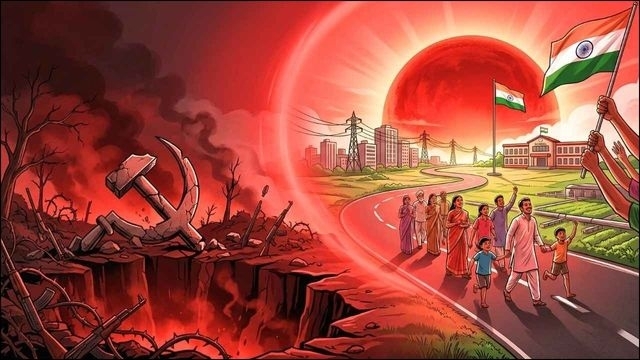
Such ideological coexistence would be difficult to imagine in centralised or ideologically rigid societies.
In countries such as Saudi Arabia or the United Arab Emirates, communist political movements have historically faced restrictions under centralised political systems. In parts of Eastern Europe such as Poland, anti-communist sentiment emerged after decades of Soviet domination, leading to deep public rejection of communist symbolism following the Cold War.
India’s trajectory remained different.
Here ideological conflict largely unfolded within democratic participation rather than total ideological elimination.
This reflects something within Indian civilisation itself. An ability to absorb, debate, accommodate and eventually rebalance competing intellectual currents without complete civilisational collapse.
This larger context also explains Bengal’s intellectual evolution.
The same Bengal that once led India’s awakening eventually became one of the strongest centres of communist symbolism in the country. Statues of Vladimir Lenin became normalised within political culture. Sections of intellectual circles romanticised Maoist revolutionary imagery despite the immense human suffering associated with Mao Zedong and Maoist political violence.
The irony was difficult to ignore.
The land of Vivekananda increasingly celebrated revolutionaries while distancing itself from its own spiritual inheritance.
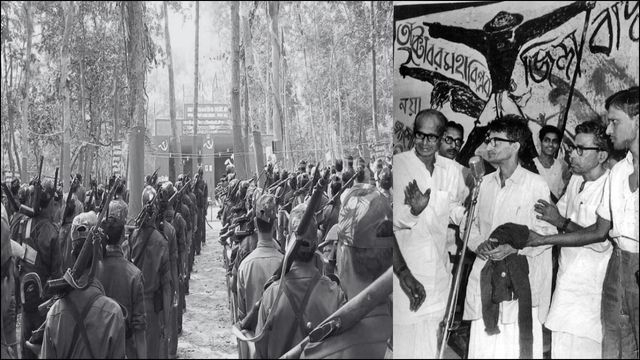
It was from this climate that the Naxalite movement emerged in Naxalbari in 1967, eventually developing into one of India’s longest-running internal insurgencies.
Meanwhile, Bengal’s economic and psychological decline deepened.
Few younger Indians fully recognise that Kolkata once ranked among Asia’s commercial and industrial centres. Bengal led in jute, shipping, engineering, printing, banking, manufacturing, education and trade. Much of India’s industrial and commercial architecture either emerged from Bengal or passed through Kolkata’s economic networks.
The decline was gradual but devastating. Industries relocated. Factories closed. Investment weakened. Entrepreneurs migrated.
Generations of Bengalis increasingly left the state in search of opportunity elsewhere. Yet Bengal’s deepest crisis was not merely economic.
It was uncertainty.
Over time sections of society began internalising the idea that Bengal’s role was to critique and protest rather than build and debate.
Still beneath decades of ideological polarisation, Bengal’s older civilisational memory remained alive.
That memory can increasingly be sensed again. In renewed assertion, revival of temple spaces, public engagement with civilisational questions, growing rejection of inherited cultural self-contempt and a visible shift among younger generations toward rediscovering Bengal’s deeper intellectual and spiritual roots.
This transformation is not merely electoral. It reflects a cultural rebalancing. Because Bengal historically was never separate from Bharat’s journey. It helped shape it.
Modern political narratives often frame cultural confidence primarily through certain northern geographies such as Uttar Pradesh or Bihar as though civilisational rootedness belongs exclusively there. Yet modern Indian nationalism itself remains impossible to understand without Bengal’s contribution.
Without Bengal there is no Bankim Chandra.
No Vivekananda.
No Aurobindo.
No Subhas Bose.
No Bengal Renaissance.
No cultural awakening that reshaped India.
Bengal did not merely participate in India’s awakening.
It helped define it. Perhaps that process has only begun once again.
Because Bengal has always been more than a province of India. It has been one of the mirrors through which Bharat has looked at itself. With pride, sometimes with confusion, sometimes with rebellion, but never without intensity.
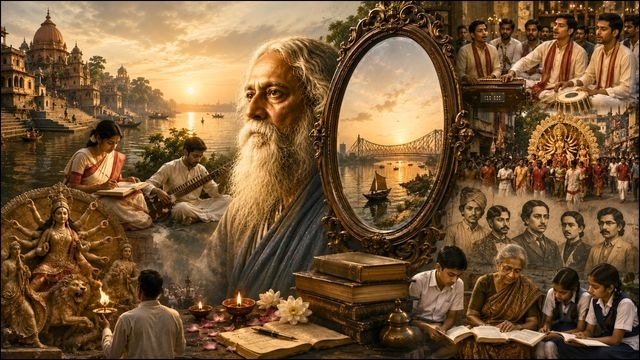
Civilisations do not vanish in a generation. They survive quietly in language, in memory, in festivals, in poetry, in temple bells, in songs carried across families and in the refusal of ordinary people to completely forget who they are.
For decades Bengal appeared trapped between nostalgia and cultural exhaustion. Beneath the political noise something older endured.
Perhaps that is the lesson Tagore leaves behind.
That a civilisation may stumble, imitate, argue with itself and even temporarily lose confidence in its voice. But if its cultural soul remains alive, renewal is always possible.
Today, as Bengal slowly searches for itself again, one is reminded of Tagore’s enduring image of a rising dawn. Not loud, not sudden, but inevitable.
Like the light returning quietly to the banks of the Hooghly after a long night.
Article by
Vikas Dubey
Raipur, Chhattisgarh