Digital Jihad Network Exposed? ATS Crackdown Reveals Alleged Pakistan-Linked Radical Module Across Multiple States
Are smartphones and online platforms becoming the primary tools for Jihadi recruitment as ATS investigates a cross-border radical module?
Total Views |


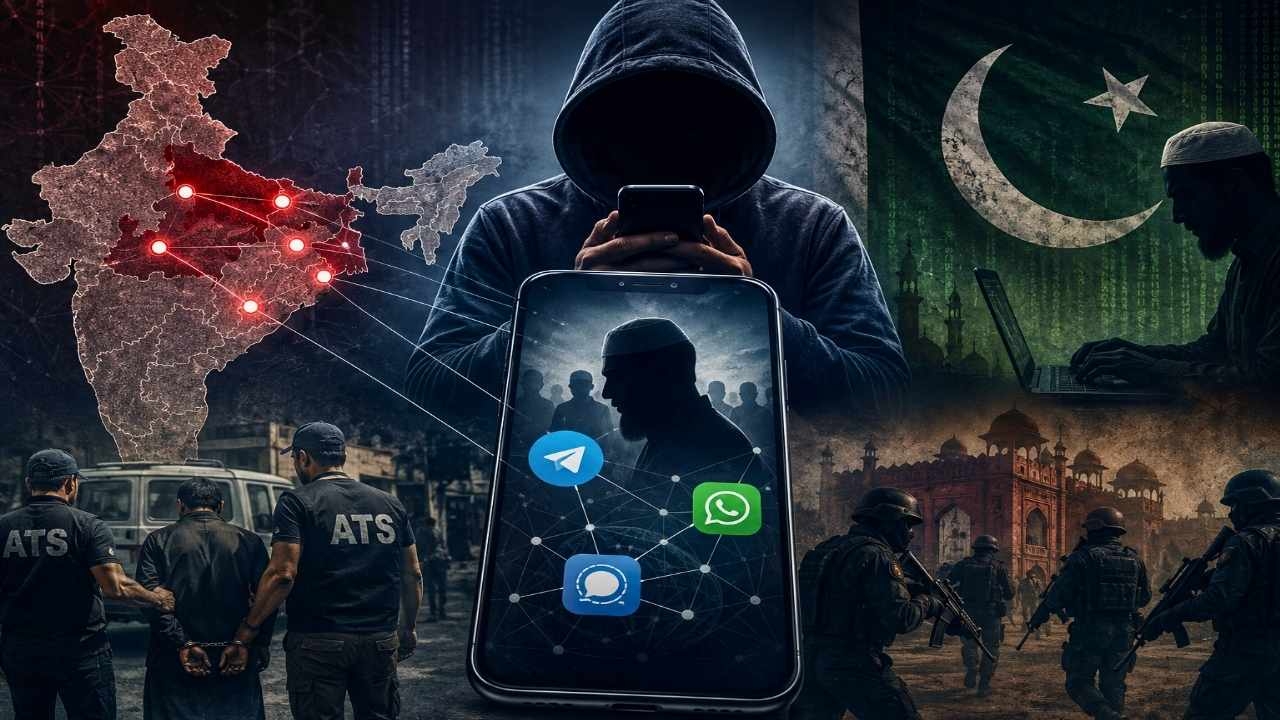
In what security agencies are describing as a significant breakthrough against emerging digital-era radicalisation networks, the Madhya Pradesh Anti-Terrorism Squad (ATS) has uncovered a multi-state module with links extending from Madhya Pradesh to Uttar Pradesh, Rajasthan, Haryana, and reportedly to handlers operating from Pakistan.
The investigation, which began with a targeted operation in Bhopal, has highlighted how the battlefield of modern terrorism has shifted from border infiltration routes to smartphones, encrypted messaging applications, and social media platforms.
The Expanding Trail
The ATS investigation commenced on 11 June, when Mohammad Faraz, also known as Khalid Saifullah, was detained from Bhopal's Kazi Camp area based on intelligence inputs. An examination of digital devices uncovered a network of contacts and communications that led investigators to Deoband in Uttar Pradesh and later to Alwar in Rajasthan.
According to agency sources, Naeem Abdullah of Deoband played a crucial role in maintaining communication channels and facilitating contacts within the network. Investigators suspect that social media platforms were being used to identify, influence, and recruit vulnerable youth.
Alwar Arrest Exposes Deeper Structure
The arrest of Shakir Mev from Rajasthan's Alwar district is being viewed as a major development in the case. Agencies allege that he functioned as a key operational coordinator responsible for recruitment and maintaining network activity.
It is being claimed that Shakir had been living as a religious preacher in a local mosque while assisting in the expansion of the network. Following his arrest, he was brought to Madhya Pradesh and placed in ATS custody for further interrogation.
Pakistan Handler Angle
Among the most significant revelations is the connection to Pakistan-based handlers. ATS officials claim that Mohammad Faraz had been assigned the alias "Shaheed Khalid Saifullah" through contacts linked to Pakistan.
Security analysts argue that such identity changes are often associated with ideological indoctrination and attempts to integrate recruits into larger transnational radical networks. Investigators are now examining the precise role played by foreign handlers and whether operational instructions were being transmitted through encrypted channels.
Nuh Connection
The investigation has also uncovered links to Haryana's Nuh district, a region that has previously attracted the attention of security agencies in connection with concerns over Islamic radicalisation.
Officials are examining whether the arrests represent only a small component of a broader network operating across several states. Intelligence agencies believe that additional individuals may have been involved in recruitment, coordination, and the dissemination of extremist content.
The New Face of Terrorism
Security experts increasingly warn that modern terror ecosystems are no longer dependent solely on physical training camps or cross-border infiltration. Instead, recruitment, ideological indoctrination, and operational planning are increasingly taking place online.
Encrypted messaging applications such as Telegram, anonymous digital identities, and foreign-based handlers have created a new challenge for law enforcement agencies. Radical narratives can now reach thousands of young users within minutes, making cyberspace a critical battleground in Bharat's fight against extremism.
The ATS investigation suggests that some of the accused individuals were exploring specialised training opportunities and foreign travel plans, prompting agencies to investigate potential long-term objectives.
As investigations continue, agencies are working to determine the full extent of the alleged module and whether additional operatives remain active. The findings could provide valuable insight into how extremist networks are adapting to the digital age and how Bharat must respond to meet that challenge.
Written by
Kewali Kabir Jain
Journalism Student, Makhanlal Chaturvedi National University of Journalism and Communication