Can Converted Christians Continue Claiming ST Status? IRS Officer Cites Supreme Court
Has JMM been pulled into a renewed row after IRS officer Nesha Oraon cited the Supreme Court on conversion and Scheduled Tribe status?
The Narrative World 17-Jul-2026
Total Views |


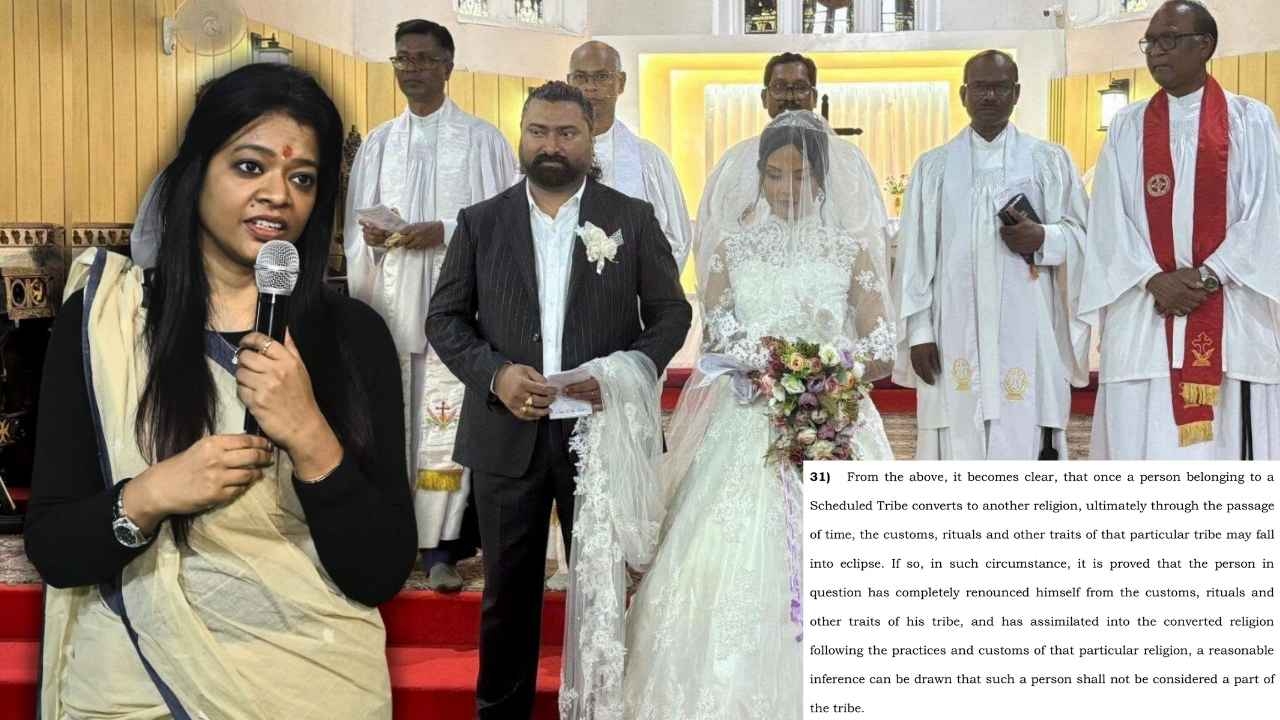
A fresh debate over the relationship between religious conversion and tribal identity has emerged in Jharkhand following the marriage of Jharkhand Mukti Morcha (JMM) MP Vijay Hansdak. The discussion has gained momentum after Indian Revenue Service (IRS) officer Nesha Oraon referred to a recent Supreme Court judgment to argue that Scheduled Tribe (ST) status is intrinsically linked to the customs, traditions and social practices of the concerned tribal community.
The remarks come amid a wider debate in Jharkhand over the identity of converted tribal communities, particularly Sarna tribals who have embraced Christianity.
IRS Officer Cites Supreme Court Judgment
Speaking on the issue, IRS officer Nesha Oraon said that "no one is a tribal merely by birth" and asserted that the Supreme Court has consistently held that a person's tribal identity depends upon continued adherence to the customs, traditions and distinctive characteristics of the Scheduled Tribe to which he or she belongs.
कोई जन्म से आदिवासी नहीं होता : आदिवासी के रीति रिवाज ही उसे आदिवासी बनाते हैं (सुप्रीम कोर्ट ) 👉🏽माननीय सुप्रीम कोर्ट के कई निर्णय ने स्थापित किया है कि आदिवासी के मूल रीति रिवाज ही उसे “अनुसूचित जनजाति” बनाते हैं
— Nesha Oraon 🇮🇳 (@OraonNesha) July 15, 2026
👉🏽 धर्मांतरण से जन्म / शादी / मृत्यु तथा कई अन्य संस्कार बदल… pic.twitter.com/CgHwqEK1VP
Referring to the Supreme Court's recent judgment in Criminal Appeal No. 1580 of 2026, she said that if a person abandons the customs, traditions and religious practices of the tribe and becomes fully assimilated into the practices of another religion, such a person may no longer qualify as a member of that Scheduled Tribe for legal purposes.
The Supreme Court observed that where an individual "has abandoned the customs, rituals, practices and other distinctive traits of the tribe and has assimilated into the practices and customs of the converted religion", such a person cannot automatically be treated as continuing to belong to the Scheduled Tribe.
"Conversion Changes Core Tribal Customs"
Explaining her position, Oraon said that conversion affects several important aspects of tribal life, including birth, marriage, death and other religious ceremonies.
She pointed out that among Sarna tribals, traditional rituals are performed by community priests such as the Pahan or Naike, whereas converted Christians follow church-administered sacraments conducted by priests or pastors.
According to her, Christian religious life includes baptism, confession, Holy Communion, church solemnisation of marriage, funeral rites and other sacraments, all of which differ fundamentally from traditional Sarna religious practices.
She argued that these differences demonstrate that converted tribals no longer follow the religious customs that traditionally define Sarna tribal identity.
Debate Over Continued ST Status
Oraon also claimed that, in some cases, converted tribals continue to observe certain traditional customs while simultaneously following Christian religious practices.
She alleged that some individuals continue to perform select tribal rituals in order to retain recognition under the Scheduled Tribe category. However, she argued that tribal customs derive their significance from the underlying indigenous faith and cannot be separated from their religious foundation.
"If the underlying religious belief itself has changed, merely performing a few customary rituals cannot, by itself, establish continuity of tribal identity," she said.
Conversion and Tribal Identity Remain a Contentious Issue
The issue of whether religious conversion affects Scheduled Tribe status has remained the subject of legal and political debate for several decades, particularly in states such as Jharkhand, Chhattisgarh and Odisha, where large sections of tribal communities follow the indigenous Sarna faith while others have converted to Christianity.
The Supreme Court has repeatedly held that the question cannot be decided solely on the basis of birth or conversion. Instead, it depends on whether the individual continues to be accepted by the tribal community and follows its distinctive customs, traditions and social practices.
The latest debate follows the marriage of JMM MP Vijay Hansdak, which has once again brought questions surrounding tribal customs, religious conversion and the constitutional recognition of Scheduled Tribe identity into the public discourse.

नैरेटिव डेस्क
नैरेटिव डेस्क