The Post-Mortem of CJP's Sansad Chalo Protest
Was the Sansad Chalo protest really about examination reforms, or did it expose a wider network of activists, political allies and external connections?
The Narrative World 20-Jul-2026
Total Views |


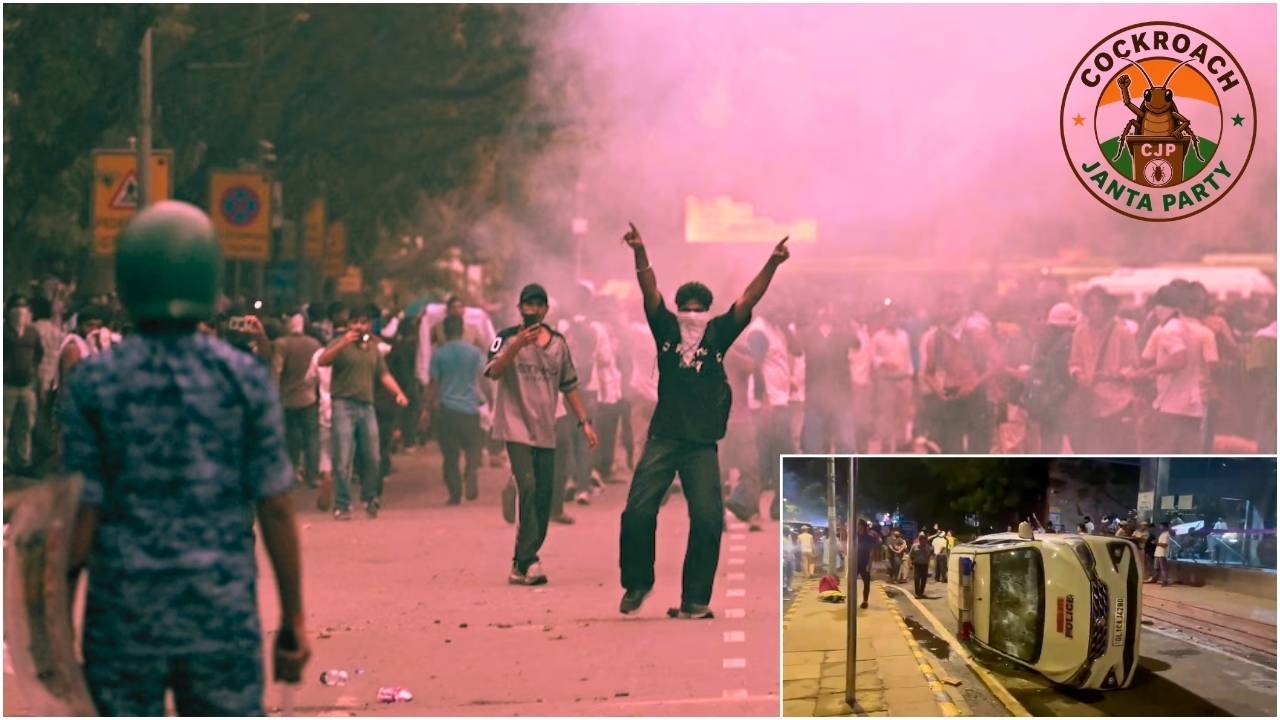
In the heart of the national capital, Bharat, on 20 July 2026, an untamed group of all the shades of the anti-Bharat notion were present together, just to bridge their dream of making "Hum Bharat Ko Nepal Bana Denge". This video was widely spread by internet users, including many who were misled by the hollow commitments of the CJP, which portrayed this protest as an independent student demonstration. The event which was billed as a spontaneous student outrage against the National Testing Agency (NTA) and Union Education Minister Dharmendra Pradhan, culminating in a "Sansad Chalo" march to Parliament and anchored by the agitation of Abhijeet Dipke, a former AAP PR faculty who returned from Boston, at Jantar Mantar. Far from a genuine grassroots eruption over paper leaks, it was a calculated attempt to fuse student discontent with industrial labour unrest, test the state's reaction time, and inject fresh momentum into a broader ecosystem of destabilising Bharat.
Intelligence assessments and ground reporting now allow a clear post-mortem. The event did not escalate into urban conflagration. Security measures, border hardening, Section 144 enforcement, metro surveillance, and preemptive checks on suspected transport from the Noida-Gurugram belts contained the mobilisation. Yet the exercise laid bare the inspiration, the pillars, and the external scaffolding behind it.
The Inspiration: Noida Template, Trojan Horse Convention, and Permanent Unrest Doctrine
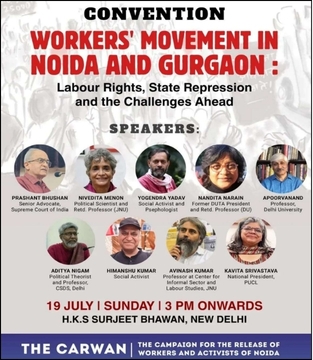
The ideological and tactical inspiration traces directly to the earlier Noida labour protests and violence. Organisers sought to replicate that friction model on a larger scale, merging battle-hardened industrial workers (with experience of barricades, sit-ins, and prolonged resistance) with ideologically charged student cadres skilled in narrative warfare and social media amplification. The 19 July "Convention on Workers' Movement in Noida and Gurgaon" at H.K.S. Surjeet Bhawan, organised by CARWAN, served as the explicit Trojan horse. Marketed as a seminar on labour rights and "state repression", it functioned as a logistics and ideological staging ground to funnel aggrieved workers from the NCR industrial belt into central Delhi just 24 hours before the Sansad Chalo.
This was not improvisation. Mini-protests staged across multiple cities (Raipur, Hyderabad, Kolkata, Patna, Allahabad, Kaithal, Narwana, and Pune) days earlier functioned as dry runs to gauge state response times and police deployment patterns. The playbook was consistent with the QR-code-driven registration for data harvesting and targeted mobilisation, Telegram and WhatsApp channel coordination, aggressive Instagram templates, and hunger strikes calibrated for maximum media sympathy.
The deeper inspiration lies in the long-standing left strategy of weaponising every grievance, piece of education, employment, health, and piece of land into a permanent anti-government mobilisation. The "Rojgar Samajik Adhikar Abhiyan" and similar fronts provided the overarching ideological umbrella, demanding everything from scrapping the NTA to taxing "corporate and super-rich" wealth. The immediate trigger (NTA leaks) was merely the spark; the target was institutional erosion and narrative dominance.
The Pillars: Student Left Ecosystem, Labour Bridge, and the CJP Anchor
The operational pillars were a classic confluence of student left organisations, activist NGOs, and political fellow travellers.
Student Left Core: SFI (Students' Federation of India, CPI-M affiliated) provided the central organisational muscle. Its CEC and Delhi unit drove the primary posters and mobilisation. Key faces included Adarsh M. Saji (All India President, also linked to DISHA Students' Organisation and the earlier Noida labour actions), Srijan Bhattacharyya (General Secretary), Aishe Ghosh (Joint Secretary), and S. Shilpa (Vice President). AISA (All India Students' Association) supplied the emotional theatre through indefinite hunger strikes. Its national president Neha (a JNU PhD scholar), Manish (UP president), and others like Aameen and Deepak saw serious health deterioration, turning personal risk into propaganda capital. Allied groups AISF, Krantikari Yuva Sangathan (KYS), Progressive Artists League, Progressive Democratic Students Union (PDSU), and DISHA swelled the ranks and provided street-level density.
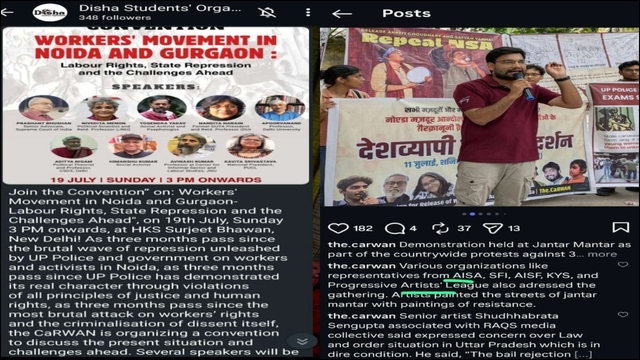
The labour-activist bridge: CARWAN (Campaign for the Release of Workers and Activists of Noida) was the critical connector. Formed in response to earlier Noida arrests, it organised the 19 July convention and actively courted factory workers. Its ideological parentage lies with Karwan e Mohabbat, the Harsh Mander-led network active across eight states. Mander's ecosystem has long specialised in framing state action as "witch-hunts" while building parallel structures of support and narrative. CARWAN's Facebook presence (withheld in India but accessible via VPN and operated from outside) and Instagram handle further illustrated the transnational character of the support network.
The CJP Anchor at Jantar Mantar
The Cockroach Janta Party (CJP) provided the high-visibility, sympathy-generating anchor, with Sonam Wangchuk emerging as the central face, his indefinite fast at Jantar Mantar drawing Bollywood influencers, social media attention, and political solidarity. Supporting figures included Abhijeet Dipke and independent fasters like Bahadhur Singh and Deepak Yadav. This created a two-front pressure of a "moral" hunger strike at Jantar Mantar and the attempted physical march to Parliament.
Political and Digital Enablers
Samajwadi Party MP Puspendra Saroj openly extended support. Funding appeals surfaced via UPI and bank accounts linked to Rajesh Sachan (Rojgar Samajik Adhikar Abhiyan) and others like Manmohan Mitruka. Change.org petitions and QR-code registration forms (tally.so) served dual purposes of mobilisation and data collection. Instagram template campaigns explicitly designed for influencers and celebrities amplified reach. Reports of targeted outreach to engineers for technological bolstering and offers to social media influencers added another layer.
The Political Backing of the Agitation
Rahul Gandhi recently stated, "Tear gassing and lathi-charging students is not India's way," expressing solidarity with individuals who openly spoke of vandalising the Parliament and threatened to assassinate Narendra Modi. Similarly, while exiting Parliament, Priyanka Gandhi defended these radical agitators by claiming, "These are our children." She extended her support to the exact same crowd calling for the dismemberment of India.
Chandrashekhar Azad Ravan, MP from Nagina, also threw his weight behind the movement, deploying his Azad Samaj Party's political machinery, often seen operating in anti-BJP protests, to aid the agitation.
This political backing extends far beyond them. Aam Aadmi Party leaders, including Arvind Kejriwal, Atishi Marlena, Sanjay Singh, and Manish Sisodia, have provided every possible form of political support to this CJP protest. Mahua Moitra was among the first Indian politicians to fan the flames of this agitation. Furthermore, Akhilesh Yadav has openly favoured the movement, while Shashi Tharoor tweeted his explicit support.
The glaring common thread among all these leaders is their anti-BJP stance. In their pursuit to oppose the ruling party, they have united to endorse a protest driven by an underlying international agenda. By backing this movement, these prominent political figures are openly supporting separatist elements who chant slogans demanding the separation of Kashmir and the breaking of India into pieces. Ultimately, under the guise of student activism, a dangerous anti-national narrative is being fuelled and shielded by the opposition.
The Foreign Shadow and Narrative Ecosystem
No post-mortem is complete without the external dimension. Sonam Wangchuk's SECMOL and HIAL entities have documented histories with foreign funding networks, including past FCRA issues and connections flagged in the broader Soros/Open Society ecosystem. More immediate was the optics of SFI leaders (including Adarsh M. Saji and Aishe Ghosh) meeting Chinese embassy officials alongside CPI(M) politburo members, an encounter that fed legitimate concerns about external interest in India's internal ferment.
International narrative-building efforts, including CJP-linked participation in forums like the World Expression Forum and coordinated press-freedom campaigns timed around high-level visits, fit a familiar pattern of external actors amplifying domestic fault lines. The report's documentation of anti-India content in certain regional Telegram groups (Odisha) and the broader use of diaspora or foreign-linked handles completed the picture of a hybrid information operation.
What Actually Unfolded on 20 July
Despite the sophisticated coordination precursor convention, pan-India testing protests, QR-driven logistics, hunger-strike theatre, and social media blitz, the day did not deliver the projected high-intensity urban unrest. Security forces, guided by precise threat assessments, implemented layered containment: multi-point barricading on Noida-Gurgaon corridors, rigorous vehicle checks, Section 144 around Parliament and minister residences, and heightened metro vigilance. Flash mob attempts via decentralised metro convergence were disrupted.
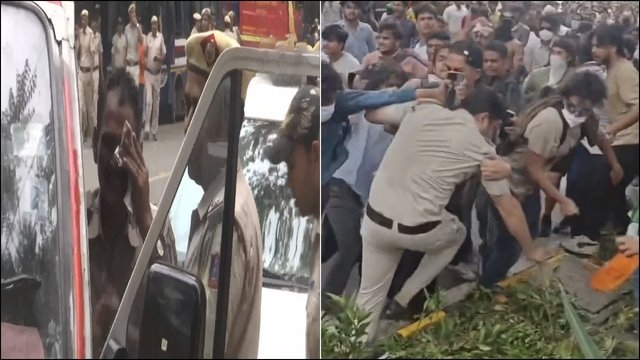
The much-advertised "siege" did appear, but how? with violence, with terror, with theft. And they all played along with the victim card.
The CJP protest was attended by individuals who raised anti-India "Azadi" (freedom) slogans. These protestors carried posters and wore clothing and t-shirts demanding the release of Umar Khalid and other terrorists; during the unrest, the police were brutally assaulted and pelted with stones.
Interestingly, the supposed face and spokesperson of this protest, Vijay Dahiya, was completely absent from the site; instead, he was found roaming around a metro station. Another key figure, Abhijeet Dipke, spent the entire duration safely standing on top of a truck, shouting slogans from there. When the protestors attacked the police and the authorities retaliated with a lathi charge, it only affected the people on the ground, while Dipke watched from above like a coward.
Furthermore, a truck loaded with stones arrived at Jantar Mantar in the morning, brought explicitly for stone-pelting. The agitators did not even spare young children. Infants were deliberately brought to the protest site so that the crowds could play the victim card and use the children as shields to get away with their actions.
Written by
Kewali Kabir Jain
Journalism Student, Makhanlal Chaturvedi National University of Journalism and Communication
नैरेटिव डेस्क
नैरेटिव डेस्क