Why Are Fast-Track Courts Being Opposed?
If Fast-Track Courts promise quicker justice for paper-leak cases, why are some Opposition groups calling the move a burden instead of backing stronger action?
The Narrative World 25-Jul-2026
Total Views |


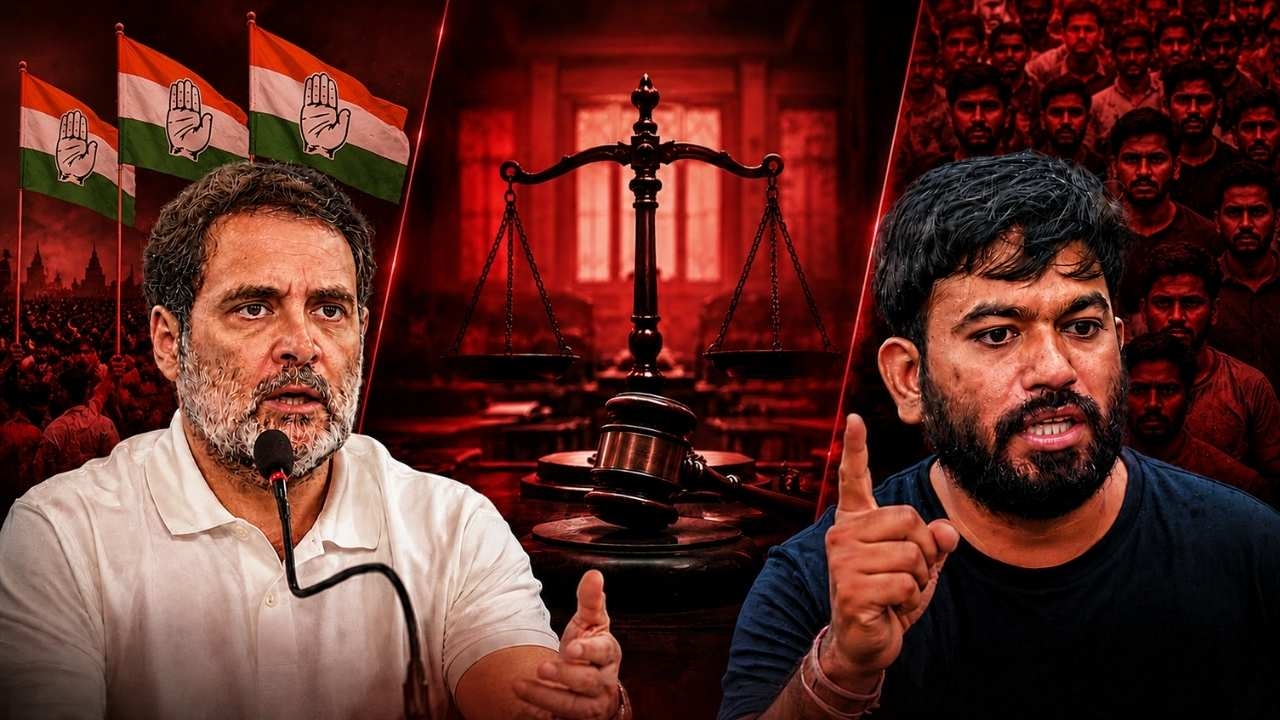
While the Congress-Left ecosystem and its proxies cry foul, the facts show CJP’s theatrics at Jantar Mantar have little to do with genuine student welfare and everything to do with manufacturing unrest in the national capital.
The Congress-Left ecosystem has once again revealed its true priorities. Following Prime Minister Narendra Modi’s announcement on 23 July 2026 of dedicated Fast-Track Courts to ensure swift and stringent punishment in paper-leak cases, the familiar narrative machinery has swung into action. The decision is being portrayed as a "burden on the judiciary".
More strict actions against paper leaks to come in tomorrow’s Cabinet! pic.twitter.com/NRysBukk5U
— Narendra Modi (@narendramodi) July 23, 2026
This is not a principled concern for judicial capacity. It is a political attempt to protect a culture of perpetual agitation while shielding the larger ecosystem that has long thrived on examination irregularities. A closer look at the facts exposes the hollowness of this charge and the real nature of the CJP’s manufactured agitation, which is being run in the name of students.
What Fast-Track Courts Actually Are and Why They Work
Firstly, Fast-Track Courts (FTCs) are not designed to overload the judicial system. They are specialised courts designated to hear specific categories of cases on a priority basis, with dedicated judges, exclusive case lists, and procedural focus aimed at reducing delays. The Eleventh Finance Commission first recommended them in 2000 to tackle the massive backlog in district and subordinate courts. The model has since been refined and expanded, particularly after the 2012 Nirbhaya case and for offences under the Protection of Children from Sexual Offences (POCSO) Act.
Key Features
- Cases are transferred to a designated court that hears them on a near-daily or priority basis.
- They operate within the existing judicial structure but with concentrated attention, often using retired or specially assigned judges.
- The objective is not to create a parallel justice system but to dispose of sensitive, high-impact cases more quickly so that regular courts are not further burdened by prolonged trials involving heinous or systemic crimes.
The historical record shows that the model delivers when political will and judicial focus align:
- The 2012 Delhi gang rape and murder trial concluded in less than nine months through a fast-track process, resulting in capital sentences and triggering the nationwide establishment of FTCs for sexual offences.
- Ajmal Kasab’s trial for the 26/11 Mumbai terrorist attacks, involving an 11,000-page chargesheet, resulted in a conviction within approximately 12 months in a specialised Fast-Track Sessions Court.
- The centrally sponsored Fast-Track Special Courts scheme for rape and POCSO cases has achieved disposal rates nearly three times faster than those of regular courts in recent years, with tens of thousands of cases cleared.
- More recent examples, such as the RG Kar Medical College case, have also proceeded through time-bound hearings under judicial direction.
Paper-leak offences under the Public Examinations (Prevention of Unfair Means) Act, 2024, fit the same logic. The Act already treats organised paper leaks as serious, cognisable, non-bailable offences, with imprisonment ranging from three to ten years and fines of up to ₹1 crore, with higher penalties for organised crime and institutional involvement. Designating Fast-Track Courts under this law simply ensures that these stringent provisions are applied without the usual multi-year delays that allow accused networks to regroup.
Claiming that this "burdens" the judiciary turns logic on its head. Allowing organised examination mafias to remain tied up in regular courts for years is the real burden on honest students, institutional credibility, and the justice system itself. Speedy trials in a limited category of high-stakes cases free up judicial capacity elsewhere while sending a clear deterrent message.
The CJP Theatre: Instability Without Solutions
While the government moved to institutionalise accountability, the Cockroach Janta Party (CJP) has kept the streets of the national capital on edge. Founded in May 2026 by Abhijeet Dipke, a former AAP social media volunteer and Boston University public relations graduate, as a satirical online response to remarks about unemployed youth, the CJP rapidly pivoted into organised street protests at Jantar Mantar over the NEET-UG paper-leak controversy.
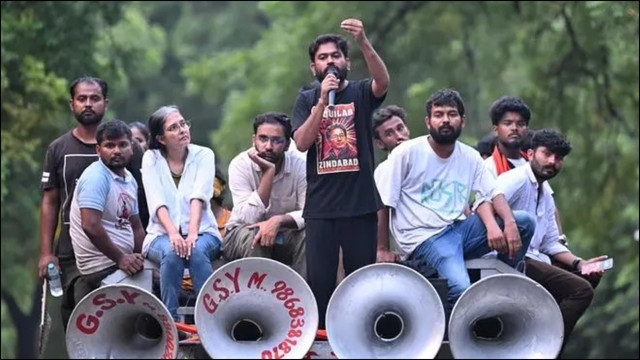
The pattern is familiar. Its demands focus less on systemic reforms or support for rigorous investigations and more on the non-negotiable resignation of Union Education Minister Dharmendra Pradhan, financial compensation packages, and the withdrawal of cases against protesters. The agitation has featured marches towards Parliament, clashes that reportedly left more than a hundred police personnel injured, and a sustained occupation that has disrupted the national capital. Reports have also highlighted internal contradictions, including leaked chats questioning resource management and the contrast with claims of genuine hunger strikes.
Students themselves have reacted differently. Many have publicly welcomed the Fast-Track Court decision because it promises consequences rather than endless inquiries and recurring protest cycles. Following the Prime Minister’s announcement, the Delhi High Court moved swiftly by designating the court of judicial officer Anu Grover Baliga at Rouse Avenue as a specially designated Fast-Track Court for offences under the Public Examinations (Prevention of Unfair Means) Act, 2024. Similar steps are now under way in other High Courts.
The Larger Pattern
Paper leaks are not a recent phenomenon or an invention of the current government. Rajasthan, under the previous Congress government, witnessed repeated recruitment examination scandals, including the REET episode that affected lakhs of aspirants. Across states and over the years, organised networks have exploited high-stakes examinations. The difference today is that a specific central law now exists, investigations are being pursued by agencies including the CBI, and dedicated courts are being activated to convert investigations into convictions.
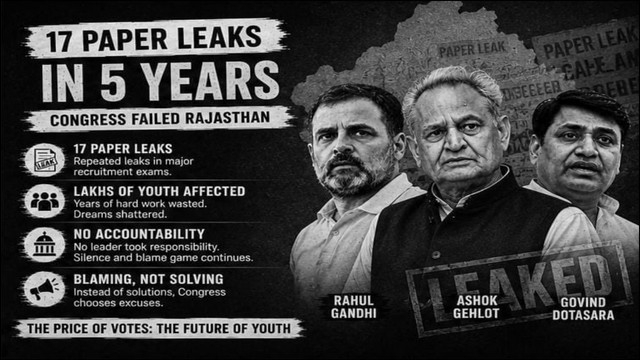
This week itself witnessed another paper leak in Punjab involving a pharmacy examination. Notably, however, it did not trigger any significant outrage from the CJP or the self-proclaimed "student-centric" Opposition.
Opposition's Parliamentary Sabotage
The Opposition has not participated in Parliament to discuss the paper-leak issue and has instead stalled proceedings through continuous disruptions. As a result, both Houses have been repeatedly adjourned without conducting any substantive business for several days. Their precondition, namely the resignation of the Union Education Minister before any debate can take place, exposes their real intent.
The government has offered a structured discussion and announced Fast-Track Courts under the Public Examinations (Prevention of Unfair Means) Act, 2024, to ensure swift trials and effective deterrence. Yet the Opposition appears to prefer parliamentary paralysis over constructive solutions.
Written by

Kewali Kabir Jain
Journalism Student, Makhanlal Chaturvedi National University of Journalism and Communication

नैरेटिव डेस्क
नैरेटिव डेस्क