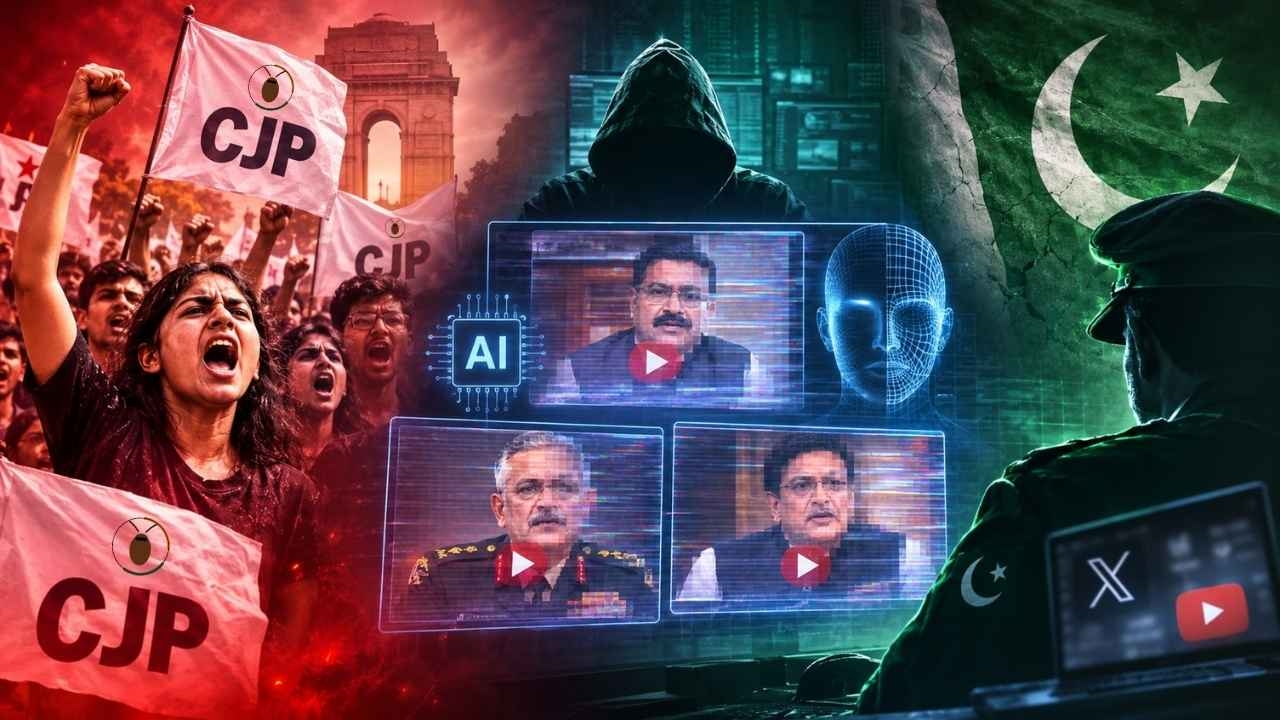
The Cockroach Janta Party (CJP) agitation, which began as a purported protest against the NEET paper leak, has rapidly descended into orchestrated violence and street confrontation in the national capital. What was projected as a student movement demanding accountability has instead revealed itself as a calculated attempt to manufacture chaos, injure more than a hundred police personnel, and press for the resignation of Education Minister Dharmendra Pradhan. The government has firmly rejected these demands while pointing to concrete remedial measures already underway for affected students.
What is far more revealing, however, is the enthusiastic amplification of this unrest by Pakistani influencers, celebrities, journalists, and digital creators. Their sudden "solidarity" with Indian students is neither organic nor humanitarian. It is a classic exercise in hybrid warfare that exploits internal fault lines while ignoring the far graver crises within their own borders.
The Diversion Programme of Pakistan
Pakistani rapper Talha Anjum, known for his long record of anti-Bharat invective, including abuse of Indian forces, mockery of Group Captain Abhinandan Varthaman, and endorsement of posts branding Prime Minister Narendra Modi a "terrorist", swiftly declared solidarity with the Jantar Mantar protesters. He accused the Indian media of being the Prime Minister's "bth" and claimed that the police were "murdering students". Journalist Mahwash Ajaz shared misleading videos of crowd sizes and openly wished for "actual alternatives to PM Modi". Digital creator Ahsan Mirza declared that Pakistani students were "spiritually present" at Jantar Mantar and warned Indian protesters not to "sacrifice themselves", while British-Pakistani writer Dan Qayyum hailed the agitation as "the bravest thing happening anywhere in the region".
These voices found common cause with CJP leaders, routinely amplifying their posts. The same ecosystem of the Islamic-Leftist caucus that glorifies terrorists operating against Bharat and treats Kashmiri women as potential "spoils of war" suddenly discovered compassion for Indian students while remaining conspicuously silent on the enforced disappearances, extrajudicial killings, and systematic repression in Balochistan and Pakistan-occupied Kashmir.
The Deepfake Escalation
The propaganda campaign has now entered a more dangerous phase. Pakistani accounts have begun circulating sophisticated AI-generated and digitally manipulated videos designed to inflame passions and create the impression of institutional collapse.
On 24 and 25 July 2026, the Press Information Bureau's Fact Check unit exposed three major fabrications:
A manipulated video purported to show Union Minister Dharmendra Pradhan announcing his resignation or making statements about his position. PIB Fact Check confirmed that the clip had been digitally altered and that the minister made no such announcement.
An AI-generated video of Chief of Defence Staff General NS Raja Subramani claimed that 30,000 Army jawans had resigned over the Jantar Mantar protests. Official channels released the original, unedited footage of the CDS speaking on an entirely different occasion to expose the forgery.
Another AI-generated clip alleged that Union Minister Piyush Goyal had made threatening remarks against protesting students. Once again, the original video, which showed the minister speaking about the government's commitment to justice and the need for dialogue, was released to debunk the false claim.
These deepfakes were deliberately crafted and amplified by Pakistani propaganda handles to suggest that the government and the armed forces were either collapsing or turning against the people.
Pakistan's military-intelligence establishment has long treated internal unrest in Bharat as an opportunity. The CJP agitation fits neatly into a broader pattern of hybrid warfare that seeks to bleed Bharat through a thousand cuts by fuelling economic disruption, social polarisation, and narrative warfare. The same actors who remain silent when their own military dictators overthrow elected governments, or when residents of Balochistan and Pakistan-occupied Kashmir demand basic rights, suddenly discover the language of democracy and human rights when the target is the Modi government.
Written by
Kewali Kabir Jain
Journalism Student, Makhanlal Chaturvedi National University of Journalism and Communication