Nanoor Massacre: CPM's Forgotten Crime Against the Landless
A devastating tragedy that was covered up thereafter; CPM"s bloody actions led to the deaths of 11 landless labourers.
The Narrative World 29-Jul-2026
Total Views |


After almost two and a half decades, the silence surrounding the Nanoor Massacre remains as telling as the crime itself. On 27 July 2000, in the Birbhum district of West Bengal, functionaries of the CPM hacked to death 11 landless labourers belonging to the minority and Scheduled Caste communities. The killers belonged to the ruling Left Front. The subsequent attempts to erase the episode from public memory, and to invert responsibility for it, reveal the actual character of Communist political culture in Bengal.
The barbarity at Nanoor was a calculated act of political elimination carried out in one of the most disturbed districts of the state at the time. The 11 men were attacked by a mob led by local CPM leaders and cut down with sharp weapons. More than a decade later, Additional District and Sessions Judge Biswanath Konar convicted 44 CPM supporters and local leaders, awarding them life sentences on charges of murder, rioting and unlawful assembly.
Among those convicted were Nitya Narayan Chatterjee, a former Zila Parishad member accused of leading the attack, and Ramprasad Ghosh of the party's district committee. Other well-known local figures, including Golam Seikh, Golam Sarwar, Kalo Sekh, Harai Sekh, Subash Chandra Dey and Gopal Ghosh, also received life sentences.
The judicial outcome did not deter the party's machinery. One of the key witnesses, Abdul Khalek, was attacked by CPM goons in May 2005 and left severely injured. The families of the victims were subjected to sustained intimidation aimed at forcing them to abandon their pursuit of justice. The pattern was familiar: eliminate the inconvenient, then intimidate those who might testify.
Nevertheless, the CPM refused to accept responsibility. Instead, its leaders constructed an elaborate narrative of class conflict. Imtiaz Ali, then a zonal committee member in Keshpur, claimed that the violence was a clash between landless labourers and landlords desperate to reclaim land distributed under the Left Front's earlier reforms. He further alleged that these landlords were funded by the Trinamool Congress (TMC) and had found an ally in Mamata Banerjee. According to the Left's propaganda, the Nanoor killings were simply the inevitable outcome of agrarian tension.
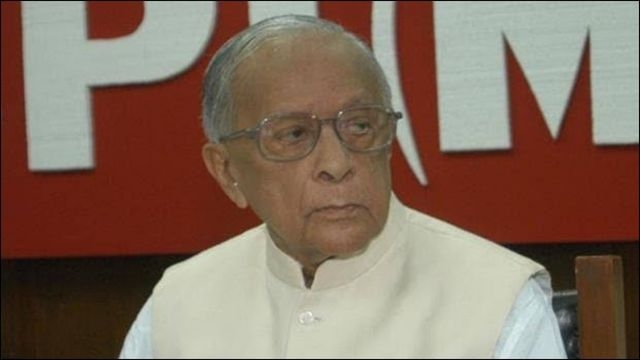
Then Chief Minister Jyoti Basu adopted a parallel line of deflection. A month after the massacre, he asserted that at least 800 Left Front workers had been murdered by the TMC during the same period. He counselled restraint while simultaneously claiming the right to self-defence. The effect was a complete inversion of reality, in which the perpetrators of a massacre presented themselves as the primary victims of political violence.
This inversion has been a consistent method of the Left Front whenever its cadres have been accused of committing atrocities. The same pattern was visible in the Sainbari killings, the lynching of Ananda Margis, and the violence that accompanied the land acquisition struggles at Singur and Nandigram. Each incident was followed by denial, blame-shifting and eventual silence once the courts had spoken.
Written by
Kewali Kabir Jain
Journalism Student, Makhanlal Chaturvedi National University of Journalism and Communication

नैरेटिव डेस्क
नैरेटिव डेस्क