FCRA Bill : NGOs Can Also Serve As Instruments Of Foreign Policy, Says India-Italy Relations Analyst Carlo Lombardi
The India-Italy relations analyst says stronger scrutiny of foreign funding is necessary to balance civil-society work with transparency, sovereignty and national security
Total Views |


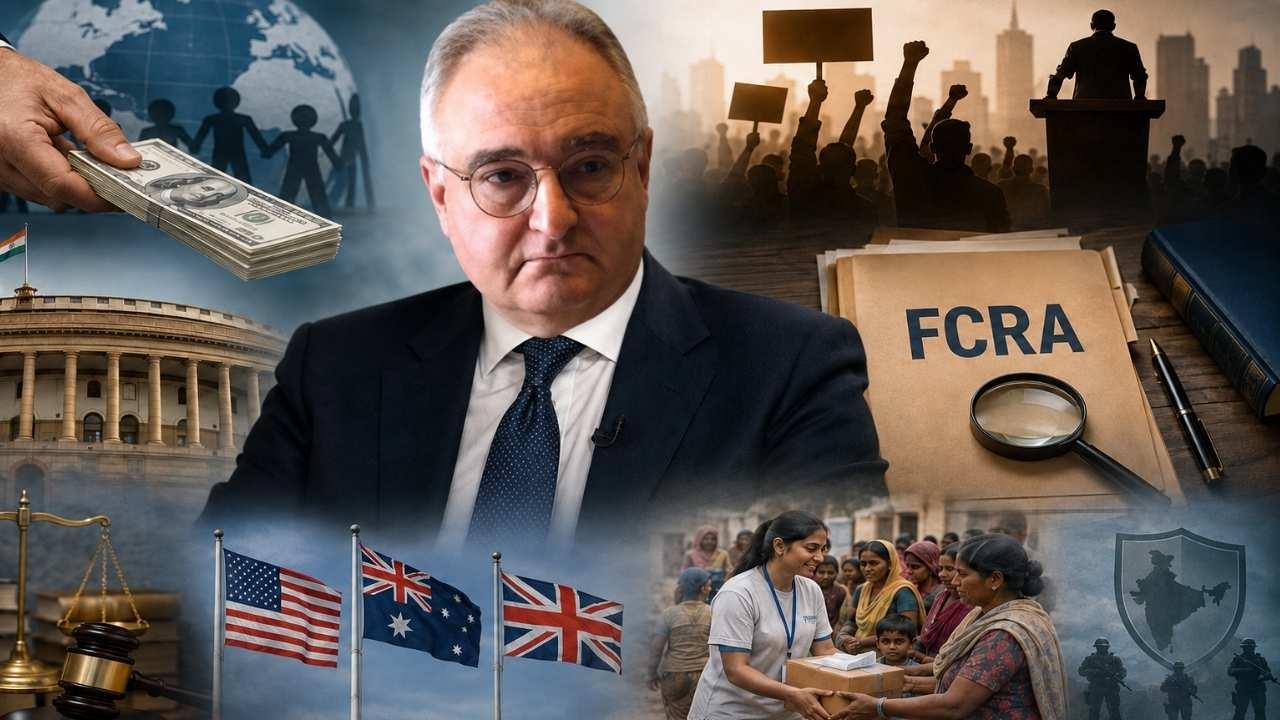
The debate over the proposed Foreign Contribution (Regulation) Amendment Bill has intensified, with India-Italy relations analyst and adviser Carlo Lombardi backing tighter regulation of foreign-funded organisations and arguing that non-governmental organisations, while performing important humanitarian functions, can also become instruments through which foreign-policy interests are advanced.
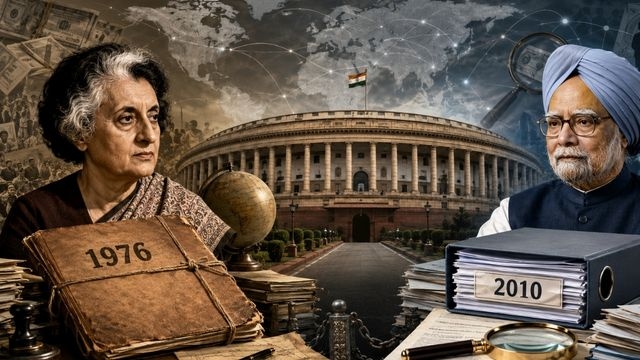
Lombardi placed India's current FCRA debate in a historical and international context. He pointed out that India's first FCRA was enacted in 1976, during the government of Prime Minister – Indira Gandhi, and that the framework was subsequently replaced and strengthened through the FCRA, 2010, under the Manmohan Singh government.
Business Today reported, his remarks on August 12, quoting him as saying that NGOs "do a lot of good work for humanity" but are "also an instrument of foreign policy."
Foreign funding and foreign-policy influence
Lombardi's central argument is that the presence of a humanitarian or charitable objective does not automatically eliminate the possibility of wider political or strategic influence. According to his remarks, governments therefore have a legitimate interest in knowing how foreign money entering a country is ultimately used.

He gave a hypothetical example in which funds entering an organisation for educational purposes could subsequently be used for political protests or activities pursuing a political agenda. His argument is that the regulatory question should focus not merely on the identity of an NGO but on the purpose, source, destination and actual utilisation of foreign funds.
The argument comes as the Government seeks to further strengthen India's regulatory framework for foreign contributions. The official FCRA portal states that the legislation is intended to ensure that associations function consistently with the values of a sovereign democratic republic and that foreign contributions are not used for activities detrimental to the national interest.
FCRA has a long history of regulation
Lombardi also stressed that regulation of foreign contributions did not begin with the present government.
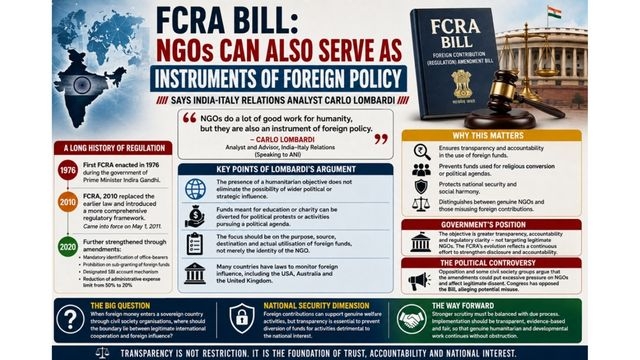
The first FCRA was enacted in 1976. The FCRA, 2010 subsequently replaced the earlier legislation and introduced a more detailed compliance framework. According to the Ministry of Home Affairs, the 2010 Act came into force on May 1, 2011.

The regulatory framework was further strengthened through amendments in subsequent years. The Government's recent explanation of the legislative history notes that the 2020 amendments introduced measures including mandatory identification requirements for office-bearers, restrictions on sub-granting foreign contributions, a designated SBI account mechanism and a reduction in the permissible administrative-expense ceiling from 50% to 20%.
Thus, the present FCRA debate represents another stage in a regulatory process that has continued across successive governments.
“NGOs are great but they can also be instruments of foreign policy”
The most politically significant aspect of Lombardi's intervention is his assertion that NGOs cannot always be viewed exclusively through the lens of charitable activity.
Internationally, governments have established mechanisms to monitor foreign influence. Lombardi referred to the United States' Foreign Agents Registration Act, Australia's Foreign Influence Transparency Scheme, and the UK's Foreign Influence Registration Scheme as examples of regulatory approaches aimed at increasing transparency around foreign influence.
His argument, therefore, is that India's attempt to regulate foreign-funded organisations should be viewed within a wider international context rather than as an entirely unusual development.
National security dimension
The FCRA debate also has a national-security dimension. Foreign contributions can support legitimate humanitarian, educational, medical and social-development programmes. At the same time, regulators argue that financial transparency is necessary where foreign money may potentially be diverted from its declared purpose.
The official FCRA framework specifically refers to preventing the use of foreign contributions for activities detrimental to the national interest.
This makes financial traceability particularly important: regulators need to establish whether funds received for a declared charitable purpose are actually being spent on that purpose.
The political controversy

The proposed amendments have nevertheless attracted strong criticism from sections of the political opposition and civil society. Critics argue that expanded regulatory powers could place excessive pressure on NGOs and potentially affect legitimate dissent and civil-society activities. Congress has publicly opposed the proposed legislation, alleging that it could be used to target NGOs.
The Government's position is substantially different. It maintains that the objective is greater transparency, accountability and regulatory clarity rather than targeting legitimate organisations. A recent government explanation described the evolution of the FCRA as a continuing effort to strengthen disclosure and accountability.
Why Lombardi's remarks matter
Lombardi's intervention adds an international-relations perspective to what has traditionally been viewed primarily as a domestic NGO-regulation issue. His argument raises a broader question: when foreign money enters a sovereign country through civil-society organisations, where should the boundary lie between legitimate international cooperation and foreign influence?
The answer is politically sensitive. NGOs perform indispensable humanitarian and developmental functions, particularly in areas where government services may be limited. At the same time, transparency regarding foreign funding is a legitimate public-interest concern.
MUST READ - India Draws The Line : Bharat Counters China’s Cartographic Aggression In Arunachal Pradesh
The challenge for policymakers is therefore to distinguish between legitimate charitable activity and demonstrable misuse of foreign contributions, rather than treating all foreign-funded organisations as either beneficial or threatening.
Carlo Lombardi's remarks have brought the FCRA debate into a broader geopolitical frame. His central contention is that NGOs can simultaneously perform valuable humanitarian work and, in some circumstances, function as channels of foreign-policy influence, which highlights why governments seek transparency over foreign funding.
India's FCRA framework has existed since 1976 and has been repeatedly strengthened by governments of different political periods. The proposed amendments should therefore be examined not simply as a confrontation between the Government and NGOs, but as part of a larger debate over foreign funding, sovereignty, transparency, national security and the independence of civil society.
The crucial test will be implementation. Stronger scrutiny can help prevent diversion or misuse of foreign funds, but enforcement must also remain transparent, evidence-based and subject to due process so that genuine humanitarian, educational, medical and social-service organisations can continue their lawful work without unnecessary obstruction.