National Federation of Churches in India: A Strategic Religious Consolidation or a Defensive Response?
Does the National Federation of Churches signal a genuine defence of religious freedom, or the emergence of a coordinated pressure group seeking greater influence over public policy?
The Narrative World 02-Aug-2026
Total Views |


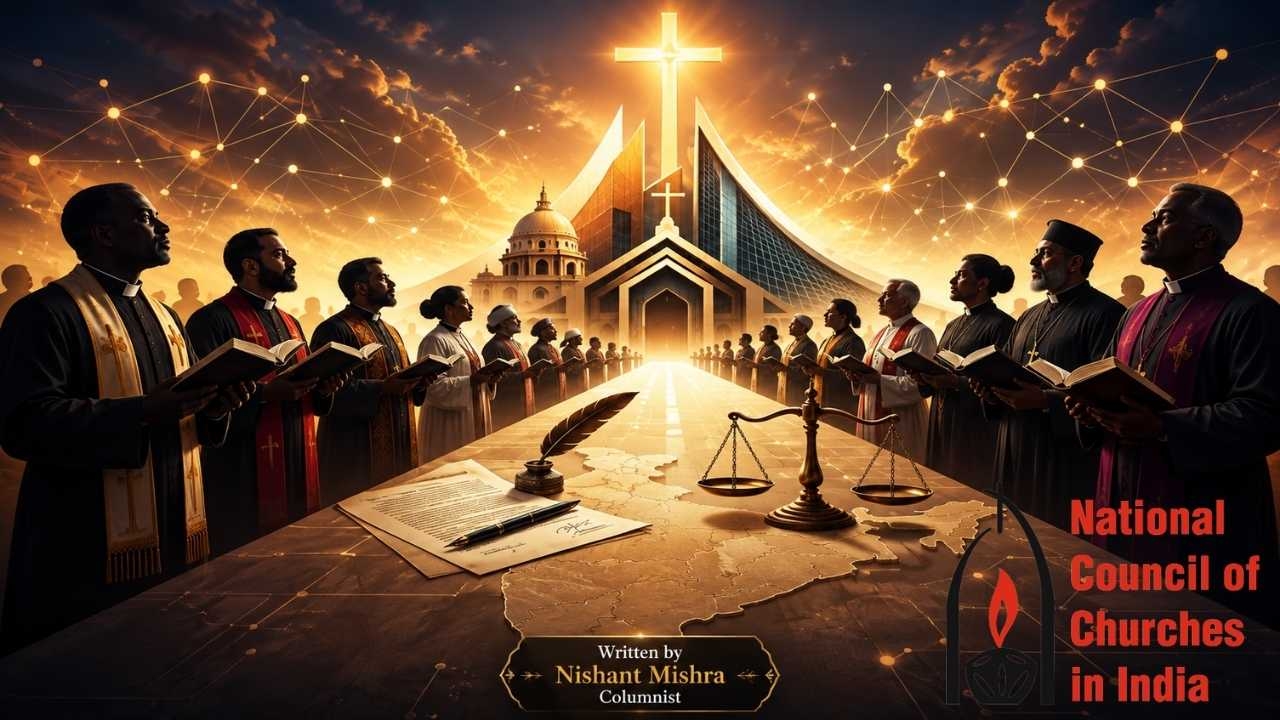
The launch of the National Federation of Churches in India (NFCI) in Bengaluru on 8 May 2026 marks one of the most significant organisational developments in Indian Christianity in recent decades. Bringing together Catholic, Protestant, Evangelical, Pentecostal, and other denominations under a single umbrella, the federation describes itself as a platform to address attacks on Christians, anti-conversion laws, government oversight of church properties, and restrictions relating to foreign funding.
While church leaders portray the initiative as a necessary response to increasing legal and social challenges, it also raises broader questions about the political and institutional direction of organised Christianity in India.
From Spiritual Fellowship to a National Pressure Group
For centuries, India's Christian denominations functioned independently, with theological, cultural, and administrative differences. The creation of the NFCI attempts to transcend these differences and establish what church leaders themselves describe as "a single voice of the Christian community".
This shift is significant. Rather than merely promoting ecumenical cooperation, the federation appears designed to coordinate legal advocacy, policy engagement, public communication, and institutional strategy at the national level. Such centralisation resembles the evolution of many organised interest groups that seek greater influence over legislation and public policy.
Opposition to Regulatory Measures
The federation's formation was explicitly linked to concerns regarding:
- Anti-conversion legislation enacted in several states.
- Increased scrutiny of foreign funding under the Foreign Contribution Regulation Act (FCRA).
- Proposed government oversight of church properties.
- Alleged attacks on Christian institutions and clergy.
Supporters argue that these measures threaten religious freedom. Critics, however, argue that government oversight of foreign funding and charitable institutions is not unique to Christian organisations but forms part of broader regulatory mechanisms intended to improve transparency and accountability.
The disagreement, therefore, extends beyond religious freedom into differing interpretations of the appropriate relationship between religious institutions and state regulation.
A Unified Political Voice
One notable aspect of the NFCI is its emphasis on presenting Christianity through a unified national leadership structure.
This represents a transition from fragmented denominational representation towards coordinated institutional engagement with the government, the courts, the media, and civil society.
Such consolidation can strengthen advocacy, but it may also transform churches from primarily pastoral institutions into increasingly organised political stakeholders. Like any large umbrella organisation, greater coordination may increase its influence in public debates while also attracting greater public scrutiny.
FCRA and Institutional Transparency
Foreign funding remains one of the most sensitive issues surrounding religious organisations in India.
Church representatives argue that tighter FCRA regulations affect humanitarian, educational, and charitable work.
Government agencies, on the other hand, maintain that financial oversight seeks to ensure compliance with Indian law and prevent the misuse of foreign contributions across all NGOs, irrespective of religion.
Consequently, the debate is less about whether regulation should exist and more about whether existing enforcement strikes an appropriate balance between transparency and religious autonomy.
Conversion Laws Remain the Core Dispute
Perhaps the most contentious issue is the federation's opposition to state anti-conversion laws. Church organisations frequently argue that these laws restrict the constitutional right to profess and propagate religion.
Supporters of the laws contend that they are intended to prevent conversions achieved through fraud, coercion, or inducement while permitting voluntary religious choice.
This legal and constitutional debate continues in several states and courts, making it one of the defining issues shaping relations between church organisations and the Indian state.
The Emergence of Organised Christian Advocacy
The establishment of the NFCI reflects a broader institutional evolution. Rather than responding individually to legal or administrative developments, India's churches now possess a centralised mechanism capable of coordinating litigation, public messaging, policy engagement, and inter-denominational cooperation.
Whether viewed as a legitimate exercise of democratic organisation or as the emergence of a powerful religious pressure group depends largely on one's perspective. The federation's future influence will likely depend on how it balances advocacy with transparency and how it engages with India's constitutional framework and regulatory institutions.
Concluding Remarks
The National Federation of Churches in India represents far more than an ecumenical initiative. It signals the consolidation of diverse Christian denominations into a coordinated national institution capable of collective legal, social, and policy engagement. According to its founders, the federation was created in response to anti-conversion laws, FCRA-related concerns, alleged attacks on Christians, and proposals affecting church governance.
Its creation will inevitably intensify debates over religious freedom, state regulation, foreign funding, and the constitutional limits of organised religious advocacy. The long-term significance of the NFCI will depend not only on its ability to represent Christian interests but also on its commitment to transparency, compliance with Indian law, and constructive engagement within India's democratic institutions.
Written by
Nishant Mishra
Columnist

नैरेटिव डेस्क
नैरेटिव डेस्क