The Christianisation of Nagaland
How did missionary-led education and mass conversions transform Naga society, and what was lost as Christianity gradually replaced indigenous faith and customs?
The Narrative World 02-Aug-2026
Total Views |


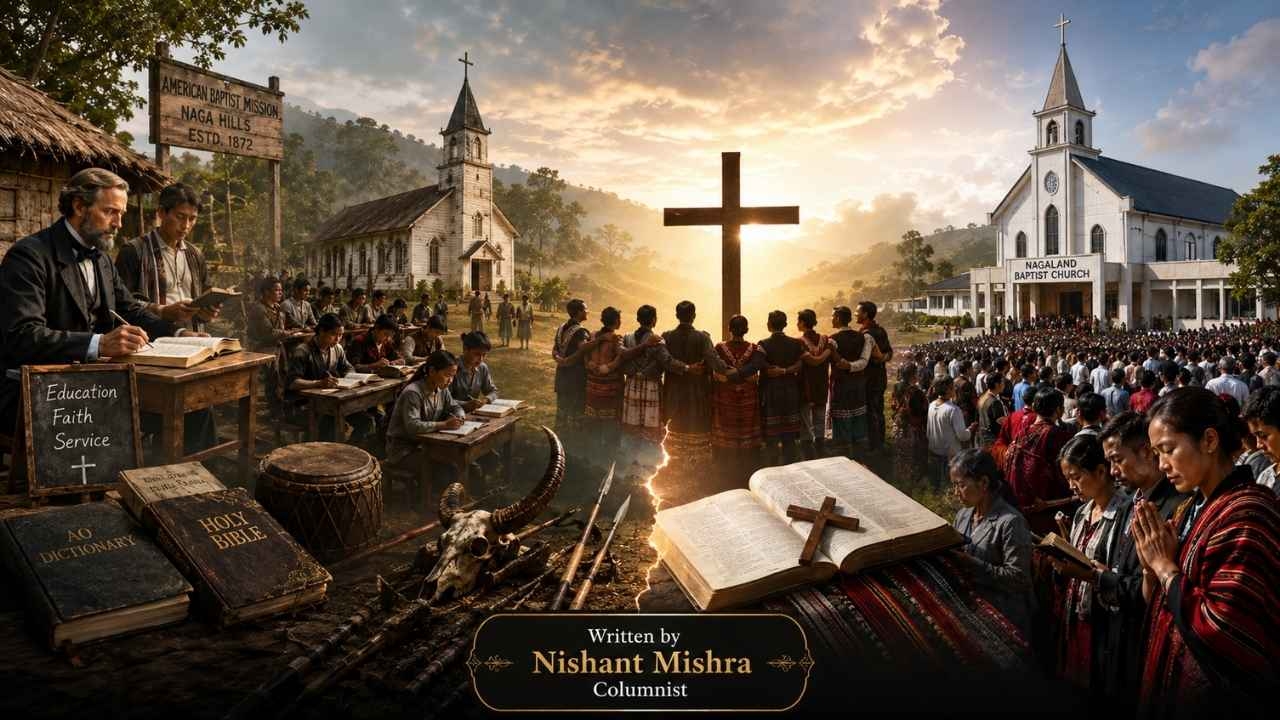
The American Baptist Mission (ABM) brought the message of Christ to the Naga Hills when the Nagas were still animists. From roughly 1842 to 1852, an American missionary named Rev. Miles Bronson laboured among the Nagas alongside Godhula, an Assamese. After teaching them Christianity and the craft of tea cultivation, Bronson established a school in Namsang, in the Konyak region near the Assamese border. Sadly, Bronson's health crisis forced him to leave the Naga Hills after only a few months.
After Bronson left the Naga Hills, another missionary, Rev. E. W. Clark, arrived in Nagaland in 1872 and settled in a Naga village near Amguri. Within a couple of months, he was able to influence the people and the surrounding communities. On 12 September 1847, Hube, a Konyak Naga, was baptised as the first Naga convert. However, he died shortly after his baptism on 10 October 1847. A few years later, Longjanglepzük, the first Ao Naga convert from Merangkong village, was baptised on 7 September 1851 by Rev. S. W. Whitting.
Missionaries continued to spread the Gospel in the surrounding villages, and in April 1872 around nine Aos embraced the new faith and publicly testified to their conversion. A few months after Clark's arrival, he began compiling an Ao dictionary, a catechism, and a hymn book, while also translating the Gospels of Matthew and John into the Ao language.
The foreign missionaries also adopted a new strategy by establishing schools in several places to educate the Nagas while simultaneously teaching the Bible. In these schools, the Bible served as the primary textbook. Over time, a large number of Nagas accepted Christianity and began new lives. Rev. King established a school and a church, and later Rev. S. W. Rivenburg took over the Angami Mission in 1886. He also worked among the Rengmas, the Zeliangs, Kukis, and the Sumis.
In 1894, Rev. Clark established the American Baptist Missionary Society at Impur. Impur became an important centre not only for the Ao tribe but also for the Sumis, Lothas, Changs, Phoms, Konyaks, and the Khiamniungans.
Early Converts and the Spread of Christianity
One of the major milestones of Clark's missionary work was the conversion of the first Ao Naga individuals to Christianity. The first converts included Supongmeren, Imli, and Longkongtoshi, whose conversions marked the beginning of Christianity's spread among the Ao Naga people.
Over time, other villagers also embraced the Christian faith, which was viewed as offering hope, peace, and moral guidance in contrast to their earlier animistic beliefs. Clark's ability to speak the Ao language, which he gradually learned, and his understanding of local customs enabled him to communicate effectively with the Naga people. He did not merely preach. He immersed himself in their daily lives, shared in their joys and sorrows, and built strong personal relationships within the community. His sincerity and commitment earned the respect of the people, and many were drawn to the new faith he introduced.
As the Christian community expanded, Clark and his converts worked together to establish churches and schools. Clark also played a central role in translating Christian texts into the Ao language and helped develop a written form of the language, which had previously existed only as an oral tradition. This effort greatly facilitated the spread of literacy and Christian teachings throughout the region.
While Rev. E. W. Clark is primarily remembered for his missionary work, his influence extended far beyond religious conversion. He played a pioneering role in introducing education and literacy to the Naga people, who had no formal schooling system before his arrival. Clark helped establish the first schools in Nagaland, where both children and adults were taught reading, writing, and basic arithmetic.
In addition to education, Clark's missionary work brought moral and social reforms to the Naga tribes. Christianity, with its emphasis on peace, charity, and brotherhood, contributed to reducing tribal conflicts and fostering more cohesive community life. Naga society, which had long been organised around tribal clans and was often characterised by inter-tribal warfare, gradually experienced social transformation through Christian teachings that emphasised non-violence, love, and reconciliation.
Clark's influence also extended to introducing modern healthcare and social welfare initiatives, which contributed to improving living conditions in Nagaland. Although primitive by today's standards, the initial efforts of Clark and his fellow missionaries helped alleviate suffering in a region that had long remained isolated from mainstream Indian society.
The Progress of Christianity
The nineteenth century witnessed a slow progression of Christianity because the Nagas were initially hostile towards the missionaries. Those who converted to Christianity were often persecuted by their clans and, in some cases, by entire villages. However, the missionaries' activities extended far beyond religious conversion. They introduced medical care and formal education alongside their evangelical work.
As the concept of one God was introduced to the Nagas, who had previously believed in numerous spirits and practised a religion centred on elaborate rituals, many responded positively to the simplicity and perceived logic of Christianity. The prestige once associated with headhunting gradually gave way to a spirit of service to humanity.
Christianity can indeed be regarded as one of the most dynamic forces in the modernisation of Naga society. It opened the door for the Nagas to think within a broader global context and brought them into the fold of a wider world community. The Nagas, once widely known for their headhunting practices, gradually transformed into a modern society. Christianity influenced the mental, spiritual, and physical aspects of Naga life.
The seeds of Christianity had been planted by foreign missionaries. As the Nagas gained a deeper understanding of the Christian faith, churches were rapidly established among every tribe. During the early stages, some churches were built beneath trees, while others gathered in private homes for fellowship.
As the Holy Spirit was believed to move among the churches, early Naga Christians experienced what they regarded as a profound spiritual awakening. Prior to this, they had been ordinary believers, but the revival movement brought renewed religious enthusiasm. Among the Nagas, the Holy Spirit was believed to work in a powerful and active manner. The spiritual revival transformed many individuals and communities, with large numbers embracing Christianity during this period.
By 1950, all the Naga tribes had experienced a significant mass awakening. Churches were filled daily with people fasting and praying continuously. With high levels of church attendance in both rural and urban areas, the number of Naga Christians continued to grow rapidly.
Many churches were subsequently expanded and rebuilt to accommodate conferences, spiritual revivals, and other religious gatherings. As a result, many villages experienced greater social harmony. Families that had been divided were reunited as religious revival spread throughout Naga society. Relationships that had been damaged were restored, and friendships were rekindled.
Nagaland gradually became recognised as a predominantly Christian state. However, this period was also marked by political conflict, as the Nagas were engaged in their struggle for self-determination. Following a prolonged period of unrest, Naga leaders met in Kohima in June 1982 to reaffirm their commitment to cooperating with the Church and respecting both God and the Church.
The Rapid Growth of Churches
With the Impur Mission, Kohima Mission, and Vankhosung Mission serving as the principal centres, the light of the Gospel spread rapidly among the Nagas. From these centres, the Aos, Angamis, and Lothas began evangelising neighbouring villages and tribes. Thereafter, the spread of Christianity continued throughout the Naga-inhabited areas, particularly in present-day Nagaland.
Within a relatively short period, churches were established in nearly every village. The once headhunting Nagas became known as soul-winning Christians. People embraced a new way of life that transformed both individuals and society. Traditional values gradually declined, while Christian values took root and became increasingly influential among the various tribes.
With churches serving as organisational centres, missionaries expanded their evangelistic work among the various Naga tribes. The rapid establishment of churches also created new administrative challenges. Mission leaders had to develop systems to supervise church activities while nurturing the spiritual growth of new believers.
Recognising the diversity of Naga dialects, missionary leaders organised churches according to linguistic groups for more effective supervision and communication. These groupings eventually evolved into various tribal church associations and councils. The establishment of churches had far-reaching consequences for the social fabric of Naga society, replacing many traditional values and transforming the structure and character of the community.
Baptist Church
The majority of Nagas belong to the Baptist tradition because American Baptist missionaries first preached the Gospel of Jesus Christ in the Naga Hills. Baptist churches later united to form the Nagaland Baptist Church Council (NBCC), which serves as the principal Baptist organisation in the state. The NBCC comprises Baptist associations representing different Naga tribes.
Following the widespread revival in the Naga Hills, many religious and social changes occurred as believers experienced renewed spiritual commitment. In 1960, the Home Mission Board was established as the missionary and evangelistic arm of the Nagaland Baptist Church Council. In 1979, the Home Mission Board was renamed the Nagaland Mission Movement (NMM).
The NMM functions as an indigenous missionary organisation, with the majority of its resources and support provided by local church associations and congregations. In the name of Christ, the NMM expanded its work to strengthen weaker churches, reach unreached communities, and offer hope to those in need.
Roman Catholic Church
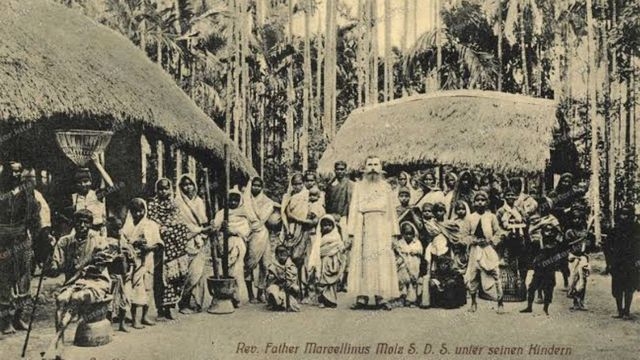
Fr. Marcellinus Molz, a German missionary from Bondashil, was the first Catholic missionary to arrive in Nagaland. He reached Tamlu in the Phom area of present-day Longleng District in 1908. He spent time familiarising himself with the Ao people and exploring the possibility of introducing Catholic missionary work.
However, because the British administration prohibited the entry of Christian denominations other than the Baptists into the Naga Hills, he was unable to continue his missionary activities. The presence of Catholic missionaries was also viewed unfavourably by many Baptists.
The Catholic Church was able to establish a permanent presence only after India gained independence. On 31 December 1948, Sisters Margarita Cifre and Guadalupe arrived in Kohima with a Naga child named John, who had studied in Shillong. Bars also became Nagaland's first resident Catholic priest.
The Catholic Church began expanding in Nagaland after 1948. The first Catholic church was established in Kohima among the Angamis, followed by another in Wokha among the Lothas. Catholic institutions also established numerous educational establishments that contributed to the development of a new public culture and educational philosophy. Today, Catholics constitute a significant proportion of the population in the urban centres of Kohima and Dimapur, as well as in parts of Wokha and Kohima districts.
Revival Church
The Holy Spirit continued to work among the Nagas even after the departure of the foreign missionaries from the Naga Hills. During the great revival of the 1950s and 1960s, Christianity spread rapidly, and Nagaland became a predominantly Christian state.
Alongside the Baptist and Catholic traditions, new Christian denominations also emerged. The Nagaland Christian Revival Church was established in 1962 during the early phase of the revival movement. It originated in a village in Kohima District when what became known as "The Great Awakening" began in 1962.
The revival strongly emphasised personal encounters with Christ, miraculous signs and healings, and missionary outreach to non-believers as well as nominal Christians. The movement placed particular importance on spiritual renewal and evangelism.
The Legacy of Christianity in Nagaland
The history of Christianity in Nagaland is closely linked to the arrival of foreign missionaries, whose efforts initiated profound religious, social, and cultural transformations among the Naga people. The introduction of Christianity began in 1872 with the arrival of Rev. Dr. Edward Winter Clark, an American Baptist missionary, who entered the Naga Hills with the assistance of Godhula Brown, an Assamese Christian evangelist. Clark's mission among the Ao Naga tribe at Molungkimong village marked the first sustained foreign missionary presence in Nagaland.
Prior to this period, the Nagas practised indigenous animistic religions centred on nature worship, ancestral spirits, and traditional rituals. Clark's missionary approach emphasised cultural accommodation, language learning, and community engagement, gradually reducing resistance and laying the foundation for the acceptance of Christianity among the Nagas.
The role of the early converts was equally crucial in the spread of Christianity throughout the Naga Hills. The first Ao Naga converts, Supongmeren, Imli, and Longkongtoshi, became key agents in transmitting Christian teachings within their communities. These indigenous converts functioned as cultural mediators, enabling Christianity to be communicated in ways that resonated with local traditions and social structures.
The expansion of Christianity followed a gradual, village-centred pattern, relying heavily on interpersonal relationships, indigenous leadership, and community networks rather than coercive or large-scale conversion efforts. Missionary-led education and literacy initiatives further facilitated the spread of Christianity, allowing Christian teachings to reach wider sections of Naga society. Over time, Christianity extended beyond the Ao Nagas to other tribes, including the Angami, Sema (Sumi), Lotha, Tangkhul, Zeliangrong, and many others.
As Christianity progressed among the Nagas, its influence extended beyond religion to reshape social and cultural life. Missionary activities contributed to the introduction of formal education, healthcare, and social reforms, which played a significant role in the modernisation of Naga society. Christian ethics promoted peace, moral discipline, and communal harmony, contributing to the gradual decline of practices such as inter-tribal warfare and headhunting.
Churches emerged as central institutions within Naga communities, serving not only as places of worship but also as centres for leadership development, social organisation, and community decision-making. Christianity also fostered a stronger sense of shared identity among the diverse Naga tribes while allowing each tribe to retain its distinct cultural identity.
The growth of Christianity in Nagaland is reflected in the prominence of Christian churches, particularly the Baptist Church, which remains the most influential denomination in the state. The Nagaland Baptist Church Council (NBCC) represents the majority of Christians and continues to play a major role in religious, social, and public life.
Alongside the Baptist Church, other denominations such as the Catholic Church, Revival and Pentecostal churches, Seventh-day Adventists, and the Salvation Army also operate throughout Nagaland, contributing to the religious diversity within Christianity. The widespread presence and influence of these churches underscore the central role of Christianity in shaping everyday life in Nagaland.
Today, Nagaland stands out as one of the most Christian-majority regions in India, a reality that can be directly traced to the early missionary efforts, the active participation of indigenous converts, and the sustained institutional growth of Christian churches.
Written by

Nishant Mishra
Nishant Mishra
Columnist

नैरेटिव डेस्क
नैरेटिव डेस्क