From Guns To Brainwashing: The Changing War of Naxalism
As the Maoist insurgency loses its forest strongholds, the battle is shifting to cities, campuses, and the ideological space where narratives can shape minds.
Total Views |



As India’s armed Naxal insurgency loses its forest strongholds, a new ideological battle is emerging in urban spaces, where Maoist narratives, psychological influence, and radical networks continue seeking to shape minds and challenge democracy.
For nearly six decades, Naxalism has remained one of India’s most persistent internal security threats. What began as a violent peasant uprising in a remote West Bengal village of Naxalbari evolved into a full-blown Maoist insurgency that spilled blood across the Red Corridor. Notably, by 2026, the guns in the forest had largely fallen silent. Yet the war has not ended yet, as the armed cadres remain defeated, but the Dimagi Naxals in the cities or the overprivileged Urban Naxals continue their campaign of “brainwashing”.
From Naxalbari to the Red Corridor
On 25 May 1967, in Naxalbari village of Darjeeling district, a local peasant revolt against landlords was quickly hijacked by radical communists inspired by Mao Zedong’s doctrine of protracted people’s war.

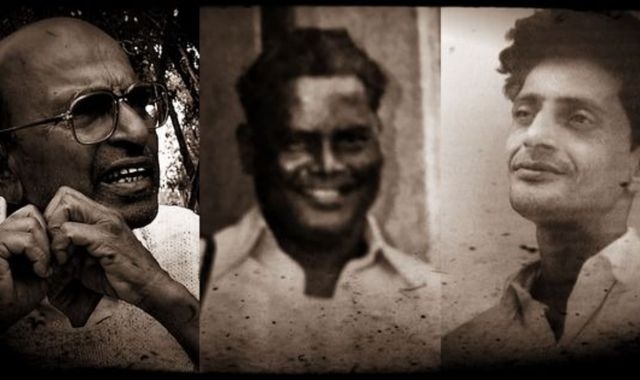
Maoist leaders like Charu Majumdar, Kanu Sanyal, and Jangal Santhal turned genuine agrarian grievances into a call for “class annihilation.” In 1969 the Communist Party of India (Marxist-Leninist) was formed with the explicit goal of seizing power through armed struggle.
The movement waxed and waned over the decades. Its most dangerous phase began after the 2004 merger of the People’s War Group and the Maoist Communist Centre into the Communist Party of India (Maoist). The newly unified outfit established the infamous Red Corridor stretching across Chhattisgarh, Jharkhand, Odisha, Bihar, Maharashtra and parts of Andhra Pradesh.
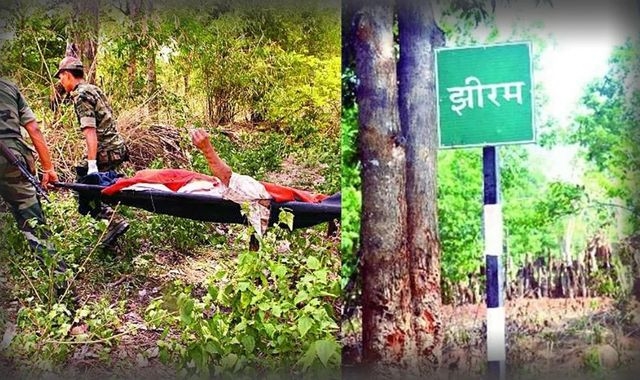
Brutal ambushes in Dantewada in 2010 that killed 76 security personnel, the Jeeram Ghati attack in 2013, and countless massacres claimed the lives of thousands of Jawans, civilians, and tribals who refused to toe the Maoist line.
Maoist documents dreamt of building base areas in the countryside where the state is weak, then they used urban networks for logistics, funds, propaganda and eventual capture of the cities.
The Turning of the Tide
After a decade, a coherent, multi-pronged strategy finally broke the back of the insurgency. Coordinated intelligence-based operations, better road connectivity into previously inaccessible forests, modernization of central and state forces, aggressive development schemes, and an attractive surrender-and-rehabilitation policy produced decisive results.
Between 2024 and early 2026, hundreds of Maoists were neutralized, more than two thousand Maoists were arrested, and nearly five thousand Maoists surrendered. Top leadership, which even included successive general secretaries and Politburo members was either eliminated or forced to give up.
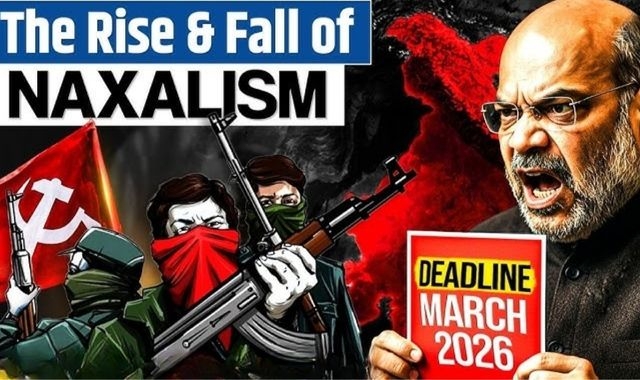
By March 2026 the number of Left-Wing Extremism-affected districts had fallen from a peak of over 120 to zero. On 31 March 2026, Home Minister Amit Shah declared in Parliament that India has effectively become Naxal-free. The guns in the forest have been silenced.
The Urban Perspective: The Strategy That Never Died
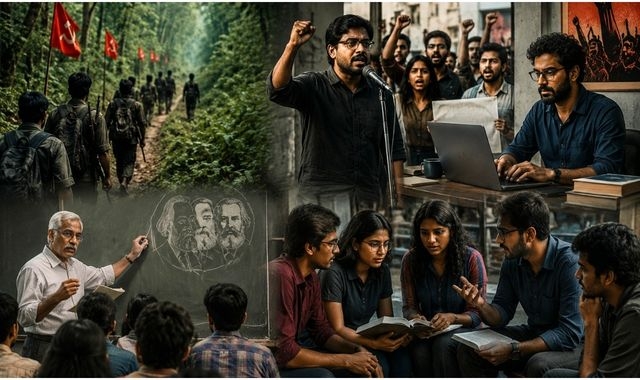
Even as their rural cadres were being dismantled, the Maoists had long prepared a parallel front. The 2007 CPI (Maoist) document “Urban Perspective: Our Work in Urban Areas” and the earlier “Strategy and Tactics of Indian Revolution” laid out a plan to create secret cells and front organizations in cities that may penetrate universities, media, legal circles, NGOs, and cultural spaces along with raising funds, providing legal defense and, most importantly, wage psychological and ideological warfare in academic and intellectual circles.
The physically fit Naxali were sent to the forests. The educated and articulate were retained in the cities known as “Urban Naxals”, to organize protests, write sympathetic articles, romanticise “revolution,” and systematically brainwash impressionable students. School teachers and college professors identified sensitive, idealistic students and slowly introduced them first to mainstream communist ideas and then to the necessity of violent overthrow of the Indian state.
Dimagi Naxalism: The New Battlefield
With the armed wing shattered, the ideological wing has become the primary threat. On 15 August 2026, speaking from the Red Fort, Prime Minister Narendra Modi explicitly warned that while the Naxals with guns had been defeated, the “Dimagi Naxals”, those carrying the Naxal mindset were still looking for opportunities to push the country towards violence and anarchy.
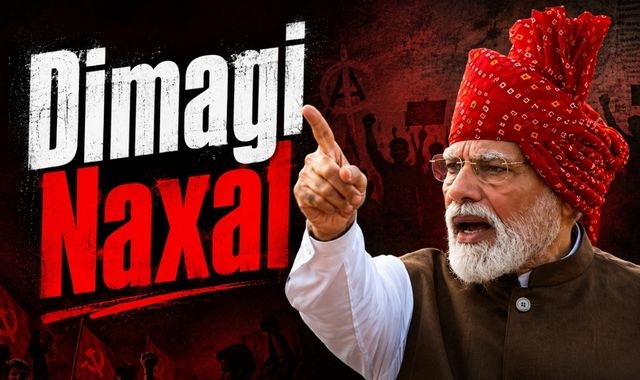
These are the intellectuals, activists, journalists, lawyers and academics who may never fire a bullet yet work tirelessly to legitimize the same ideology that once justified the murder of landlords, policemen and “class enemies.” They portray security forces as oppressors, paint Maoist violence as a legitimate response to injustice, and systematically undermine public faith in democratic institutions and the Constitution.
Former intelligence officers and surrendered Maoists have repeatedly pointed to the role of certain urban professionals in channelling funds, providing safe houses, and shaping narratives. And their goal remains the same as it was in 1967, to convince a section of India’s youth that parliamentary democracy is a fraud and that only revolutionary violence can deliver justice.
Naxalism was never merely a socio-economic problem of poverty or land rights. It was an imported Maoist ideology that rejected the Bhartiya Constitution, elections and the democratic process itself. Tribal communities were cynically used as cannon fodder while the real strategists sat in relative comfort in cities, writing tracts and organizing “civil society” campaigns.
The battlefield may have shifted from forests to cities, but the objective remains unchanged: weakening faith in India’s democratic system. Defeating Naxalism, therefore, requires not only eliminating armed cadres but also confronting the ideology and narratives that sustain it.
Written by
Kewali Kabir Jain
Journalism Student, Makhanlal Chaturvedi National University of Journalism and Communication