From Red Terror to Green Growth: How Coconuts Fuel Rural Prosperity in Bastar
How coconut-based multi-tier farming and government schemes are transforming livelihoods in Chhattisgarh’s former conflict zone
Total Views |


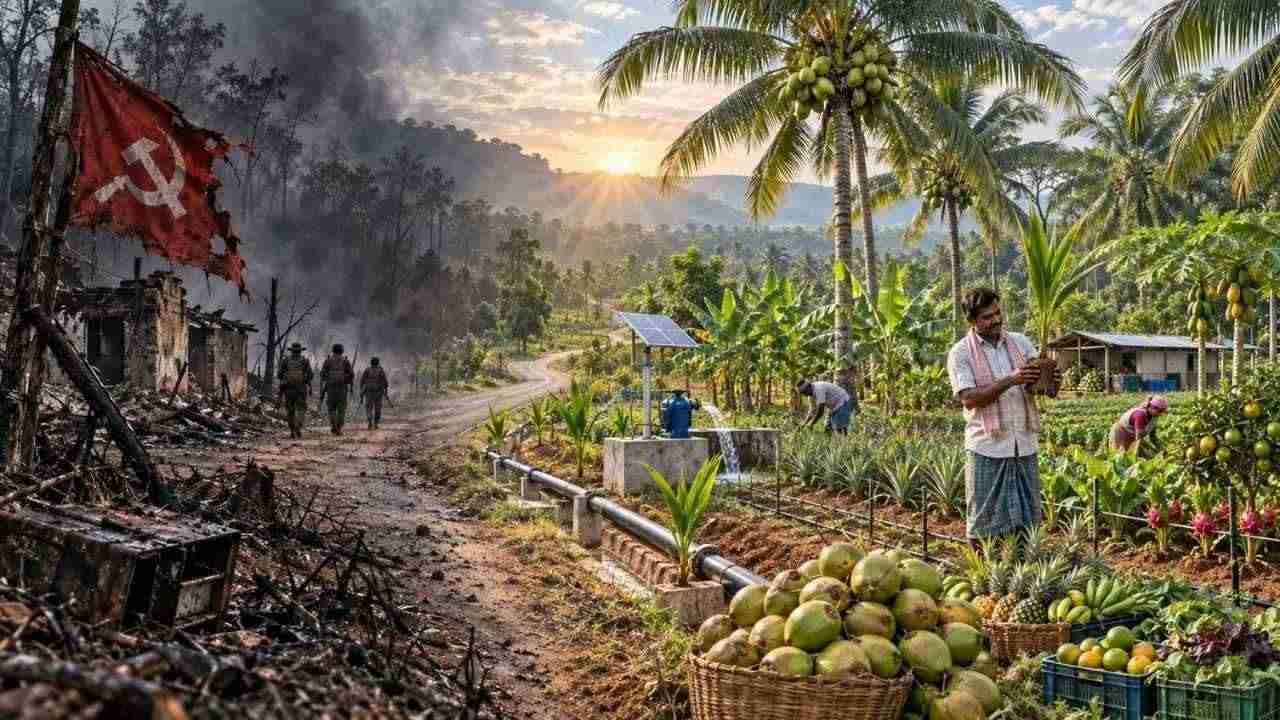
Once known mainly for Maoist violence, Bastar is finding new hope in coconut farming. With government support, farmers are growing fruits and vegetables beneath the palms, improving productivity, diversifying incomes and building more secure rural livelihoods.
For centuries Indians have called the coconut palm Kalpavriksha, the wish-fulfilling tree that supplies food, drink, medicine, fibre, timber and fuel from a single plant. That ancient respect is now matched by hard economic weight. Roughly 30 million people, including about 10 million farmers with most of them smallholders depend on the crop for their livelihood. Strengthening the coconut economy therefore delivers gains first to those with the least land, consistent with the principle of reaching the last person.
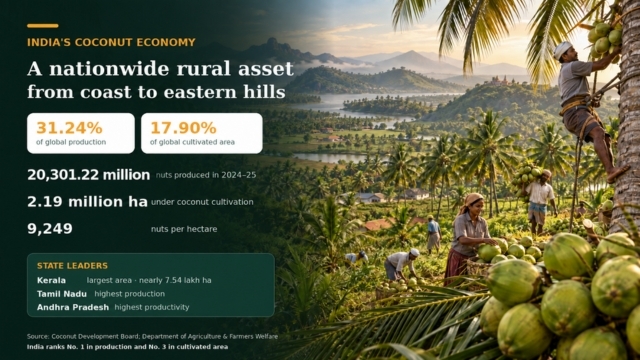
India today leads the world in coconut production and ranks third in cultivated area, contributing 31.24 per cent of global output and 17.90 per cent of global acreage. Official figures for 2024-25 record 20,301.22 million nuts harvested from 2.19 million hectares, averaging 9,249 nuts per hectare. Kerala still accounts for the largest area at nearly 7.54 lakh hectares, Tamil Nadu tops absolute production, and Andhra Pradesh posts the highest yields.
Cultivation has spread well beyond the traditional coastal belt into Odisha, Gujarat, Assam and Arunachal Pradesh, converting a regional crop into a nationwide rural asset.
The most unexpected success story is unfolding on the Bastar plateau of Chhattisgarh. Long associated with insurgency and low-value cereal farming, the region has begun adopting coconut under the guidance of the Coconut Development Board’s demonstration farm at Kondagaon. Growers learn to fill the spaces between young palms with short-duration intercrops, securing income while the trees mature.
One clear illustration is Eshansh Singh Rathore, a 36-year-old management graduate from Bakawand block. After corporate work he returned to his family land and, with Board support, planted 2,500 palms, mainly dwarf types. About 500 are already bearing. Beneath them he has established 4,000 pineapple plants, 800 dragon-fruit plants, 1,000 mango trees, 600 citrus trees and a mix of banana, guava, papaya, litchi, coffee, strawberry and vegetables. Coconut alone brings in ₹5-6 lakh a year; the intercrops add roughly ₹10 lakh. Neighbouring farmers now view his multi-tier system as a practical model that can lift a once-marginal district into high-value horticulture.
National trade figures confirm the same upward movement. Coconut-product exports climbed to ₹7,038.35 crore (USD 794.70 million) in 2025-26, a 62 per cent rise over the previous year. Two decades earlier the figure was only ₹25.3 crore and consisted mainly of shell charcoal and crude oil.
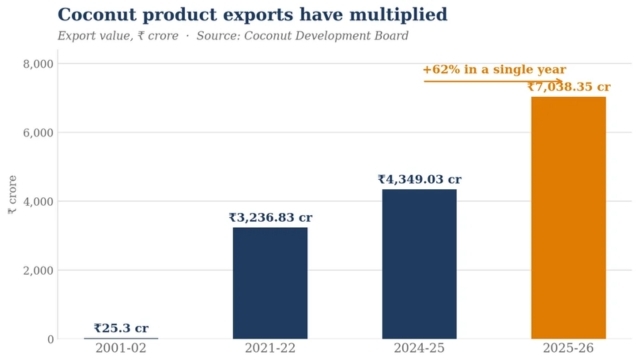
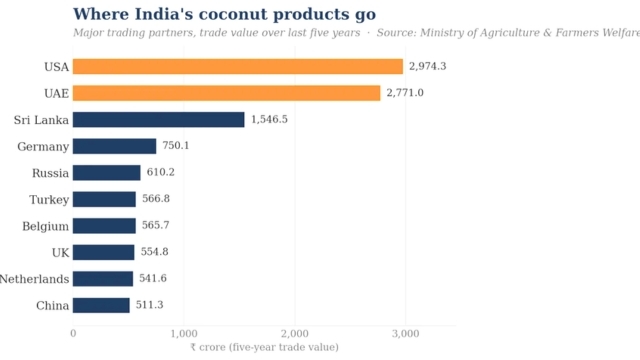
The export basket has diversified sharply: virgin coconut oil, coconut milk, coconut water, activated carbon and desiccated coconut now dominate. Markets have expanded from the Middle East to the United States, Europe, Australia, Russia and Turkey. The transition from bulk commodity to processed, branded goods advances the national goal of self-reliance and supports the longer-term export targets of USD 2 trillion by 2030 and USD 21 trillion by 2047.
The institutional driver is the Coconut Development Board, created on 12 January 1981 under the Ministry of Agriculture and Farmers Welfare and based in Kochi. It works across 22 States and Union Territories on planting material, area expansion, productivity, pest control and product diversification. In 2025-26 it received ₹147.21 crore. As the designated export-promotion body for coconut products other than husk and fibre, the Board has registered more than 8,700 exporters and organised extensive trade-fair and buyer-seller activity.
Price stability remains the most direct support for growers. Copra is one of the 22 crops covered by the Minimum Support Price system. For the 2026 season the Cabinet set milling copra at ₹12,027 per quintal and ball copra at ₹12,500 rises of ₹445 and ₹400 over the previous year and both 50 per cent above production cost. NAFED and NCCF act as central procurement agencies.
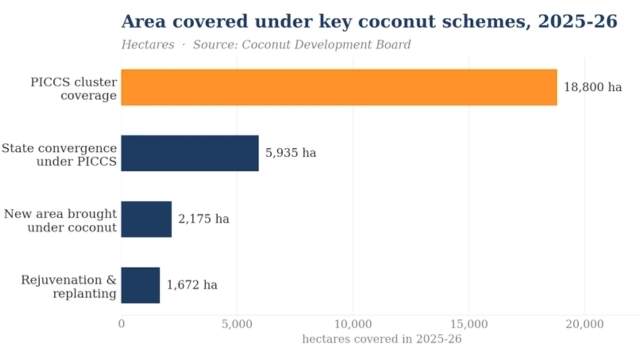
Complementary programmes keep the production base healthy. Demonstration farms and seed gardens produced 2.41 lakh quality seedlings in 2025-26. Area-expansion assistance of ₹56,000 per hectare has brought several thousand additional hectares under the crop, including non-traditional zones. The coconut-based cropping-system scheme, offering a full subsidy of ₹42,000 per hectare, covered 18,800 hectares last year and continues to expand. Replanting of aged plantations, water-resource development, organic practices and mechanisation run in parallel.
Skills and enterprise receive equal attention. Training in mechanical climbing, plant protection and basic business has created a pool of local youth; organised climber groups under the Cocomitra initiative now operate with modern equipment. Handicraft centres focused on shell, wood and fibre products are being set up, and specialised programmes teach scientific tapping of Neera, the unfermented coconut sap. Accident insurance covers climbers, technicians and other field workers.
The Union Budget 2026-27 added the Coconut Promotion Scheme within a larger ₹350 crore package for high-value crops that also includes cashew and cocoa. The scheme tackles pest pressure, root-wilt disease and senile plantations through large-scale seedling production, geographic expansion, systematic replanting, integrated health management and processing units oriented toward value addition and exports. Its aim is to make India a leading global supplier of coconut and coir products by 2030 while raising farmer incomes.
Export earnings have multiplied more than 270-fold in a generation with which the crop map now stretches from the southern coast to the eastern hills and a former conflict zone is earning steady returns from coconut-based multi-tier farming. The ancient Kalpavriksha continues to deliver both livelihood and hope and growth.
Written by

Kewali Kabir Jain
Journalism Student, Makhanlal Chaturvedi National University of Journalism and Communication