Indian Express’s ‘Hindu Taliban’ Label for VHP Draws Criticism
Media’s selective outrage reveals the enduring double standard: Hindu festivals must remain open and diluted, while community organizations face charges of majoritarianism for asserting their religious character
Total Views |


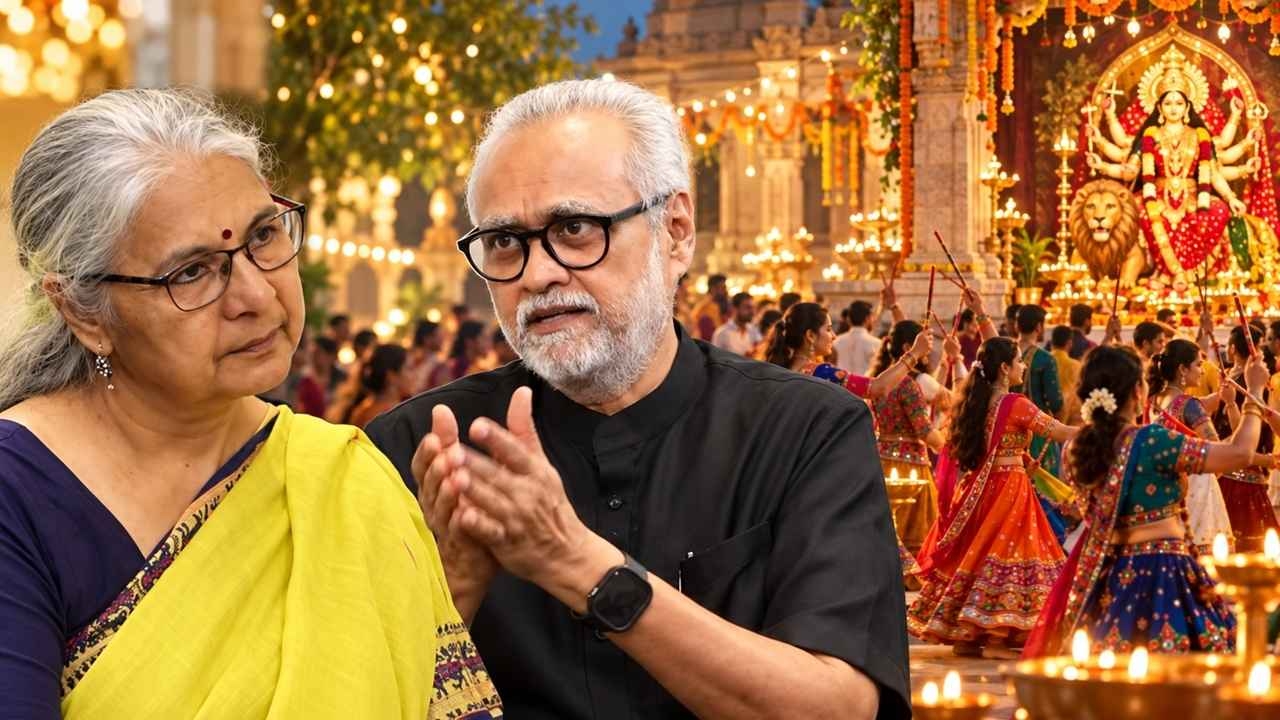
The Vishva Hindu Parishad’s appeal to restrict Muslim participation in Navaratri and Garba celebrations has once again triggered predictable outrage from sections of the media.
On 22 September, The Indian Express aired an interview between Shubhangi Khapre and author-journalist Girish Kuber in which both speakers freely deployed the terms “Hindu Taliban” and “fatwa” against the VHP. The exchange revealed not merely disagreement with a community organisation’s internal guidelines but a deeper insistence that Hindus must dilute the religious essence of their festivals to satisfy a selective notion of inclusivity.
Khapre described Navaratri events as having become “commercialised” spectacles involving professional performers and ticketed crowds. On that basis she questioned the legitimacy of any restriction on entry. Kuber went further, declaring the very idea “horrible” and asking whether the VHP was turning into a “Hindu Taliban.”
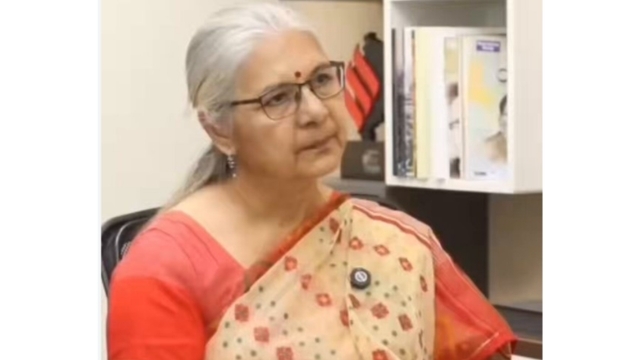
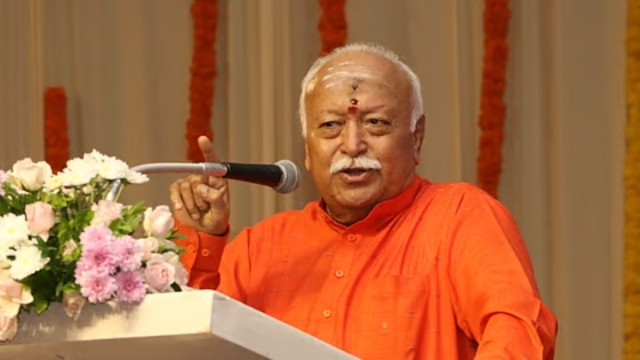
He contrasted the organisation’s stance with statements by RSS Sarsanghchalak Mohan Bhagwat on unity and diversity, and suggested that if Hindus wished to keep the festival exclusive they should confine it to their homes. Christmas, he claimed, had become a secular festival; Navaratri, though rooted in Hindu tradition, had similarly evolved into a social and recreational occasion and should therefore remain open.
Devotional practices such as Raas Garba and Dandiya are presented as mere entertainment, while the worship of Goddess Durga or Ambika is treated as secondary or optional. The same logic has been applied elsewhere: Onam is reduced to a harvest festival, Makar Sankranti or Pongal to a regional cultural event. In each case the scriptural and theological core is sidelined so that the festival can be recast as a public, non-denominational gathering. The demand that follows is, either open the event to all or retreat into private observance.
The comparison with Christmas is instructive precisely because it is incomplete. No serious commentator insists that Christmas must be stripped of its Christian character or that churches must abandon liturgical distinctiveness. The expectation of openness does not extend to rewriting the festival’s religious identity. Yet that is precisely what is demanded of Hindus. The same voices that treat Iftar gatherings as unproblematic political and social events react with alarm the moment Hindu organizations assert control over the character of their own observances.
_202609241028249774_H@@IGHT_360_W@@IDTH_640.jpg "IMAGE 3 (1)")
Equally striking is the selective vocabulary. “Fatwa” and “Taliban” are invoked against a Hindu body with casual ease. The same language is carefully avoided when discussing groups that have historically issued binding religious edicts or enforced social exclusion through intimidation. The imbalance is not accidental; it reflects an awareness of differential consequences.
Meanwhile, practical concerns raised by organisers past incidents of disruption, stone-pelting during processions, and the documented pattern of predatory behaviour targeting young women at large public events are dismissed as evidence of a “majority complex.” The insecurity is located exclusively among Hindus; the record of aggression against Hindu processions and pandals is left unexamined.
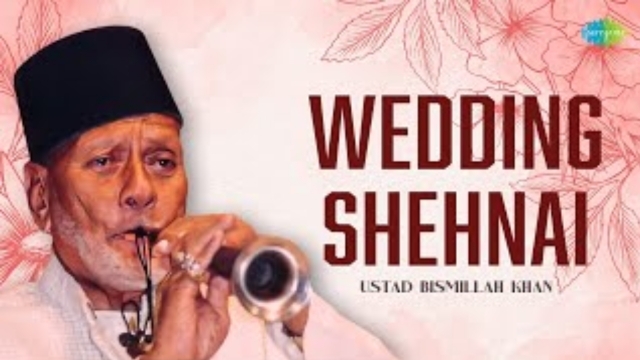
Kuber’s invocation of Ustad Bismillah Khan’s shehnai at Hindu weddings and of Mohammed Rafi’s bhajans further confuses categories. A wedding is a private sacrament; a film song is a commercial product. Neither is a collective act of worship directed toward a deity whose celebration is explicitly theological. Navaratri events organised by temples or community bodies are not government programmes or open-access public goods.
They are religious observances whose form and participation remain the prerogative of those who sustain them. To demand state intervention by the Maharashtra government, as the interview did, is to convert a community decision into a political contest.
The broader narrative advanced in the discussion is that assertive Hindu politics amounts to a British-style “divide and rule,” that Diwali is becoming “universal” like Christmas, and that any restriction signals an impending ban on Muslim artists reveals the same underlying premise. Hindu festivals are acceptable only when they function as open platforms whose religious content can be negotiated by outsiders. The moment the community draws a boundary, the charge of majoritarianism follows. This is not secularism as equal respect for all faiths; it is a hierarchy in which Hindu self-definition is perpetually provisional.
Navaratri remains a festival of devotion to the Goddess. Musical and dance forms associated with it are expressions of that devotion, not free-floating entertainment. Organisations such as the VHP are entitled to decide the terms on which their events are conducted. Those who object are free to organise their own gatherings. What they are not entitled to do is redefine the festival for others, police its religious character, or demand that Hindus either accept unlimited entry or abandon public celebration.
The language of “Hindu Taliban” and “fatwa” deployed in the Indian Express interview does not illuminate the issue as it merely illustrates the double standard that continues to shape commentary on Hindu religious life.
Written by
Kewali Kabir Jain
Journalism Student, Makhanlal Chaturvedi National University of Journalism and Communication