From Bharat to the World: RSS' Message of Oneness Goes Global
Through global community engagement and Panch Parivartan, RSS brings its century-old vision of social harmony, civic responsibility and human unity to the world.
Total Views |


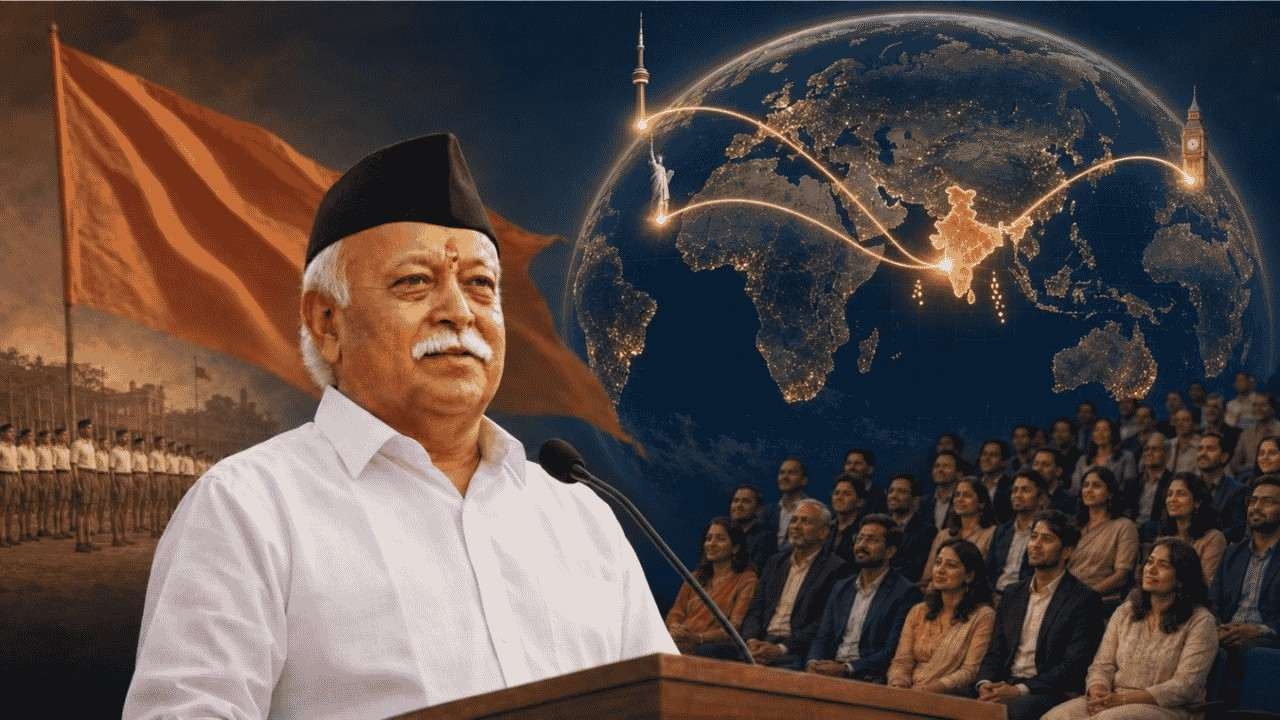
RSS Sarsanghchalak Mohan Bhagwat tours US, Canada and UK from 25 August in RSS centenary year to deepen diaspora ties and present its century-tested model of harmony.
On 25 August 2026, Dr Mohan Bhagwat, the Sarsanghchalak of the Rashtriya Swayamsevak Sangh, began a three-nation visit to the United States, Canada and the United Kingdom. The journey falls squarely inside the RSS’s centenary year and is a civilisational dialogue. Its aims to deepen people-to-people ties between Bharat and the Indian-origin communities abroad, communicating the idea of Vasudhaiva Kutumbakam the world is one family, and to place the practical lessons of a hundred years of voluntary service before societies facing many of the same questions of cohesion, family, environment and civic duty.
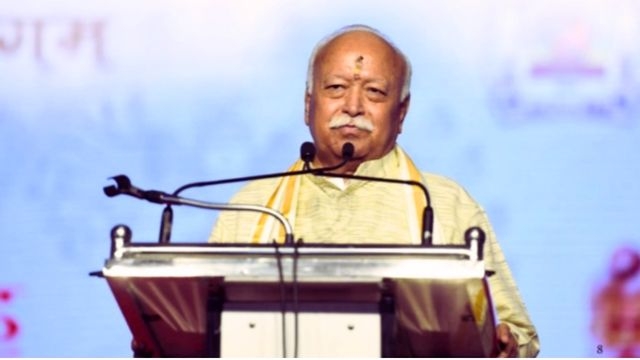
The visit is significant because the Sarsanghchalak has traditionally avoided personal publicity and overseas speaking tours. His addresses to public audiences in Manhattan, Toronto and London therefore signal a deliberate effort to expand the organisation’s global outreach and dialogue beyond India.
A Century Built on Daily Practice
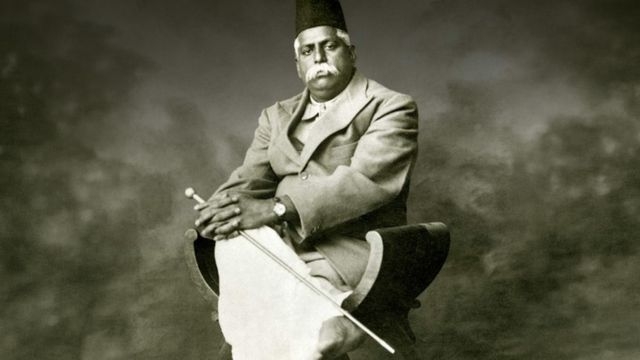
The RSS was founded in Nagpur on Vijayadashami in 1925 by Dr Keshav Baliram Hedgewar.
Its basic unit remains the “Shakha” : a roughly one-hour neighbourhood gathering that combines physical exercise, yoga, games, discussion, song and prayer. Two founding decisions still define it. The saffron flag, the Bhagwa Dhwaj, was designated the guru of the movement rather than any living person, so that ideals would stand above personalities. Funding has come solely through Guru Dakshina which was the voluntary offerings by volunteers themselves keeping the organisation independent of government and external patrons for a full century.
Today RSS conducts about 88,949 shakhas daily, 32,606 weekly milans and 13,211 monthly mandals, and is present in roughly 55,683 localities across India. It records more than 1,52,000 service projects in education, healthcare, self-reliance and social welfare with over 20,000 schools serving and parenting students. There is no membership form and no subscription fee. A person becomes a swayamsevak simply by attending and continuing to attend.
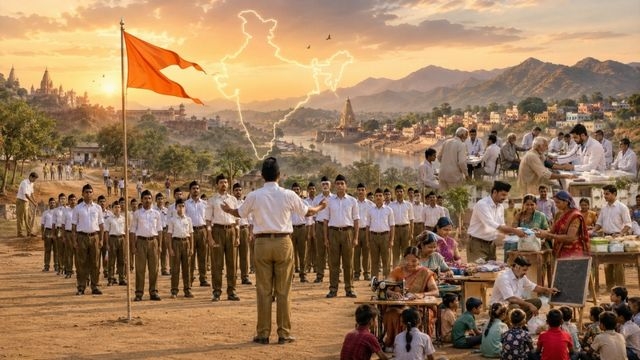
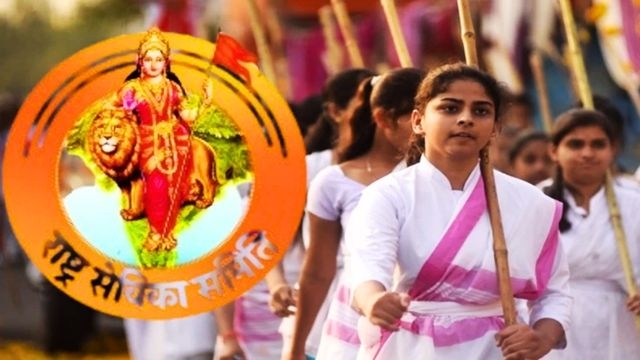
Responsibility is shared between ordinary householders and pracharaks, the full-time lifelong volunteers who draw no salary. Women organise through the Rashtra Sevika Samiti, founded in 1936. Decisions are reached by consensus. Notably, across six Sarsanghchalaks and one hundred years the movement has seen no organisational split.
Service for Unity
The most concrete expression of the RSS’s national work has been ‘seva’ selfless service especially in moments of crisis. After Partition in 1947, swayamsevaks organised and ran three thousand relief camps across northern India. In Calcutta alone, the Vastuhara Sahayata Samiti provided food to 80,000 people and clothing to 1.5 lakh people.
The same pattern continued through the wars of 1962, 1965 and 1971, the Bihar drought of 1966, the Andhra cyclone of 1977, the Morbi dam burst, Bhopal, the Odisha super-cyclone, Bhuj, the 2004 tsunami, the Kosi floods and Kedarnath. During the 2020 pandemic more than 342,000 swayamsevaks worked at 67,000 locations, distributing ration kits to over five million families, organising more than thirty million meal packets and 4.4 million face masks, and running service centres in forty-three cities. Yet much of this work never reached national headlines.
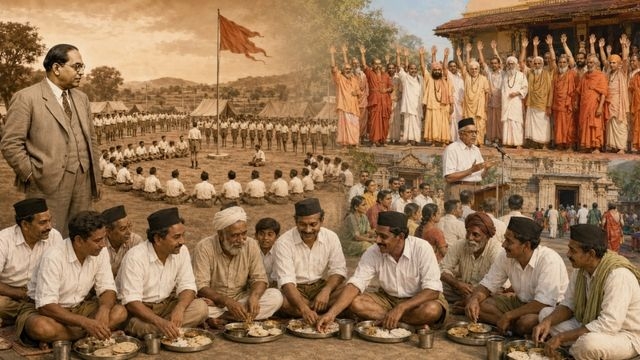
A parallel thread has been the patient reduction of social distance. From the earliest shakhas, volunteers exercised, prayed and ate together at a time when many institutions remained exclusive. When Dr. B. R. Ambedkar visited an RSS camp in 1939 he noted an equality in which no one appeared conscious of difference. In 1969 the Udupi Sants Sammelan, facilitated by the then leadership, saw Hindu religious heads from every tradition declare that untouchability has no sanction in Hindutva. In 1974 Balasaheb Deoras stated that if untouchability is not wrong then nothing in the world is wrong, and directed practical steps on shared meals, temple entry and inter-caste marriage.
Dr Bhagwat has reiterated in successive addresses that discrimination by varna and jaati should be discarded. The work continues through the annual Social Harmony Fortnight and the principle of “Ek Mandir, Ek Kuan, Ek Smashaan – One temple, One well, One cremation ground shared by all. Roughly forty autonomous institutions have grown from individual swayamsevaks working in student affairs, labour, farming, education, tribal welfare, science, sport, classical arts, Sanskrit and veterans’ welfare. The RSS neither owns, governs nor funds them, they operate with full autonomy and are coordinated lightly through a Samanvay committee. What they share is a set of values rather than a chain of command.
From National Habit to Global Conversation
For decades the international dimension of this work was carried quietly by the diaspora itself, temples in unfamiliar cities, weekend language classes, food banks, blood drives and disaster collections. In April 2026 Dattatreya Hosabale, the Sarkaryavah, travelled to the United Kingdom, the United States and Germany, speaking at academic and policy forums including a Stanford Summit and a Hudson Institute event. Dr Bhagwat’s visit raises the level of visibility at a moment when the third generation of Indian-origin communities in North America and Britain is professionally established and is asking what of its inheritance it wishes to carry forward and how to explain it to neighbours.
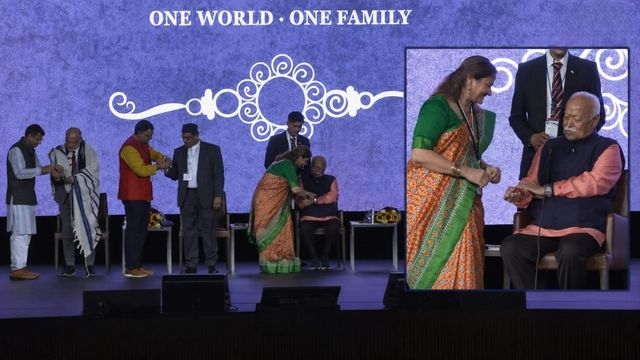
The centerpiece of the American leg is the Universal Oneness Celebrations in Manhattan, New York on Saturday 29 August 2026 Raksha Bandhan convened by the AHEAD Forum together with more than two hundred partner organisations. The doors open at 1:00 pm and the programme runs from 2:00 pm to 5:30 pm Eastern Time. Dr Bhagwat delivers the keynote alongside voices from multiple faith traditions and a cultural programme.
The coalition is deliberately broad as organisations with roots in India, Nepal, Sri Lanka, the Caribbean and East Africa, bringing together Gujarati, Tamil, Bengali, Nepali, Telugu and Malayali communities as well as families whose journeys ran through Trinidad, Fiji and Kenya. No single organisation sits at the head table. Participants include physicians, teachers, engineers, students, veterans, artists and volunteers from temples, yoga groups, educational bodies, service organisations and interfaith networks across the country.
Canada follows on 31 August-1 September with community leadership programmes in Toronto, the first official visit by a serving Sarsanghchalak. The United Kingdom leg in early September continues the pattern of diaspora engagement, dialogue with mainstream institutions and local outreach established in the April visits to London and Rugby.
The close interaction with Indian-origin communities and cultural associations; projection of the values of global harmony, civic responsibility and Vasudhaiva Kutumbakam and conversation with host-society institutions about the history and worldview of the RSS and of Hindu society more broadly.
Five Transformations Offered Outward
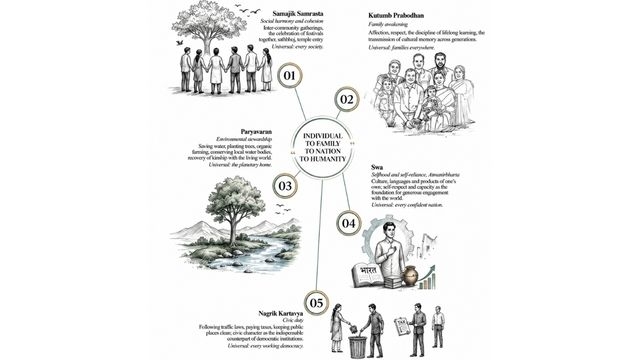
The centenary framework brings the movement’s long-standing work together under Panch Parivartan, or the Five Transformations. Each transformation begins with the individual, moves through the family, and ultimately extends to the nation and humanity. Change is understood as a process that begins within households and spreads through personal example, rather than being imposed from above.
Samajik Samrasta (social harmony): Treating every member of society as kin through shared gatherings, festivals and daily life until inherited barriers thin.
Kutumb Prabodhan (family awakening): Affection, respect, lifelong learning and the transmission of cultural memory across generations.
Paryavaran (environmental stewardship): Practical steps, saving water, planting trees, organic farming, restoring local water bodies, rooted in a sense of kinship with the living world.
Swa (selfhood and self-reliance): Preserving cultural languages, indigenous products and collective memory so that engagement with others is rooted in dignity rather than dependence.
Nagrik Kartavya (civic duty): Treating ordinary practices of citizenship, traffic rules, taxes, public cleanliness as duties.
Beneath these five lies the philosophical contribution the movement regards as distinctive: Pandit Deendayal Upadhyaya’s Ekatma Manav Darshan (Integral Humanism) of 1965, which holds body, mind, intellect and soul must advance together, and the related idea of Antyodaya, the rise of the last person. In an age of material plenty and searching for meaning, the question whether existing systems give a full enough account of the human person has regained force.
Why ‘Dialogue’ ?
Relations between India and the West have long been conducted in the language of states, trade, defence, technology, visas. That conversation remains necessary. The visit seeks India as a civilisation and with the ideas and practices that people carry across generations and oceans. The diaspora is no longer only a recipient of transmission from India – it is an active participant in the public life of its own societies and brings its own decades of service including food banks, tutoring, blood drives, relief work to the table.
The questions themselves maintain social harmony across differences, how families hold together under modern pressures, how ordinary citizens relate to the natural world, how cultural rootedness is sustained among children raised far from their grandparents’ homes, and how civic character underpins democratic institutions. These are open questions in the United States, Canada and Britain as much as in India. That is what makes the encounter a dialogue.
The principles collected under “Panch Parivartan” are not presented as particular to Bharat. They are offered as practical, tested approaches available to any society asking the same questions.
A century of quiet, voluntary organisation at neighbourhood scale in India is now being placed, deliberately and without compulsion, into a wider civilisational conversation about unity that begins with the individual and extends to the world.
Written by
Kewali Kabir Jain
Journalism Student, Makhanlal Chaturvedi National University of Journalism and Communication