Building a Future-Ready Education System: Bharat’s Reforms Under NEP Framework
From early childhood foundations and teacher training to digital access, flexible pathways, and research infrastructure – India’s education reforms are shifting focus from rote exams to lifelong skills and opportunity.
Total Views |


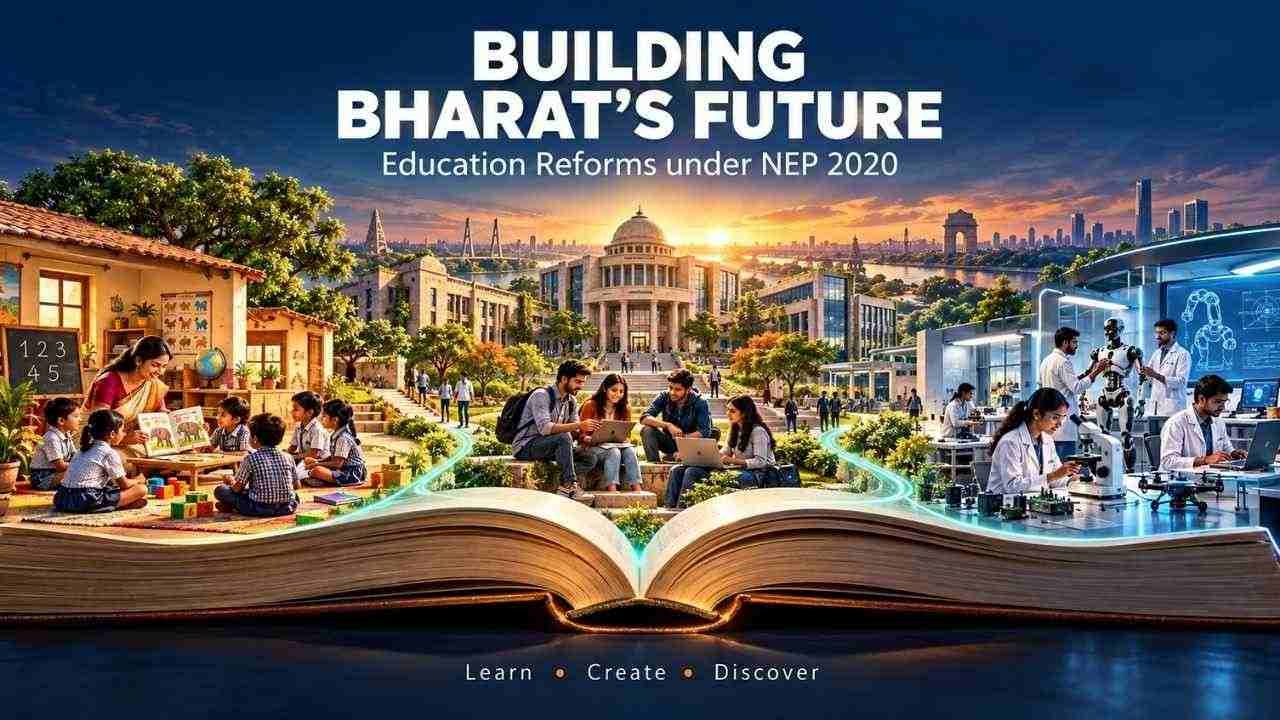
India is undergoing a structural shift. No longer confined to rote memorisation, examinations, and fixed pathways, the system is being reshaped to prioritise foundational skills, flexible learning, teacher capacity, digital access, research, and linguistic inclusion. These changes, accelerated since 2014 and guided by the National Education Policy (NEP) 2020, aim to prepare students for a rapidly evolving economy and society while addressing long-standing gaps in quality and equity.
Foundational Learning as the Starting Point
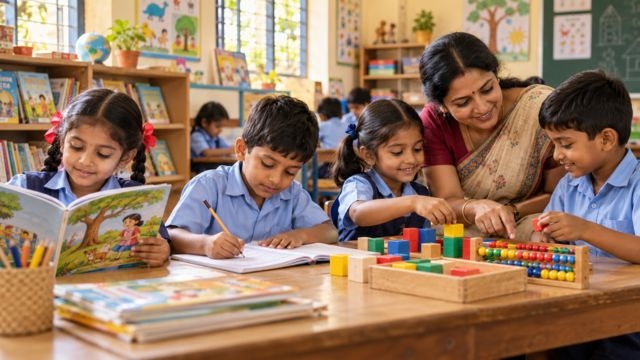
A central reform is the recognition that meaningful education begins well before formal primary schooling. Early childhood development now receives explicit policy attention. Vidya Pravesh offers a three-month play-based preparation module for children entering Class 1, easing the transition into structured schooling.
Jadui Pitara supplies activity-oriented teaching-learning materials for children aged 3 to 8. The NIPUN Bharat Mission targets foundational literacy and numeracy so that every child acquires basic reading, writing, and arithmetic skills by the end of Class 3.
From Rigid Curricula to Flexible, Skill-Oriented Pathways
The National Curriculum Framework for school education promotes activity-based, experiential, and multidisciplinary learning over pure content absorption. Vocational and pre-vocational education has been integrated into the school system under Samagra Shiksha Scheme for Classes 6 to 12. Students can also pursue skill courses aligned with the National Skills Qualifications Framework. The result is an education process increasingly linked to practical capability of what a student can do with knowledge rather than examination performance alone.
Strengthening the Teaching Profession
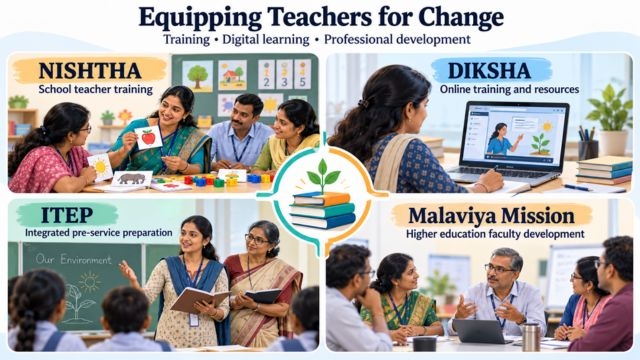
Curriculum change requires teachers equipped to deliver it. The National Initiative for School Heads’ and Teachers’ Holistic Advancement (NISHTHA) has expanded training across stages, including foundational literacy, and was shifted online via the DIKSHA platform during the pandemic. The Integrated Teacher Education Programme (ITEP) seeks greater coherence in pre-service preparation, while the Malaviya Mission focuses on continuous professional development for higher-education faculty.
Expanding Digital Access and Academic Continuity
The pandemic exposed both the potential and the limitations of digital learning. Platforms such as DIKSHA (a national repository for school resources), PM e-VIDYA (which combines online and television-based delivery), and the National Digital Education Architecture provide multiple routes for students to access material.
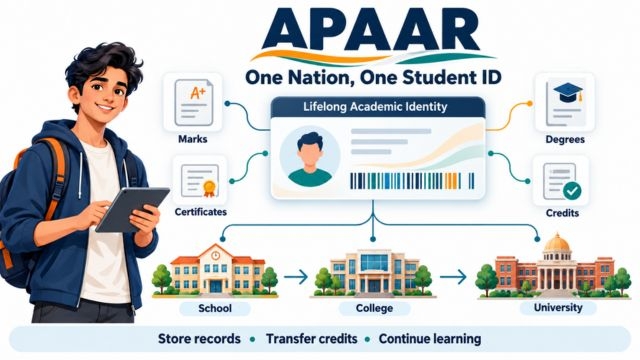
Parallel to content delivery, the Automated Permanent Academic Account Registry (APAAR) creates a lifelong digital academic identity. Under the “One Nation, One Student ID” concept, marks, certificates, degrees, and credits can be stored and transferred more seamlessly as students move between institutions and stages of education.
Flexibility and Affordability in Higher Education
NEP 2020 has introduced multiple entry and exit options, multidisciplinary programmes, and credit mobility. The National Credit Framework and Academic Bank of Credits allow students to accumulate and transfer credits across institutions and learning modes, supporting non-linear educational journeys.
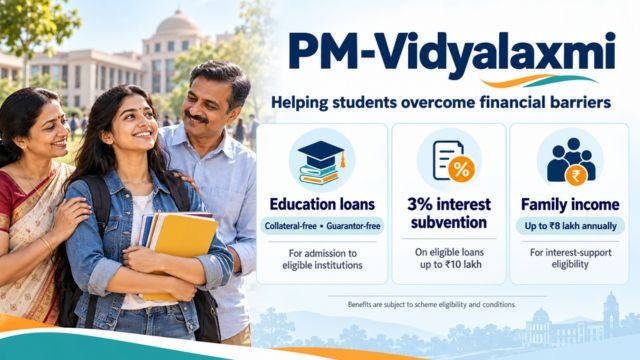
To address financial barriers, the PM-Vidyalaxmi scheme, approved in late 2024, offers collateral-free and guarantor-free education loans for students admitted to eligible institutions. Families with annual incomes up to ₹8 lakh may receive interest support of 3 percent on loans upto ₹10 lakh, subject to scheme conditions.
Research Infrastructure and Language Inclusion
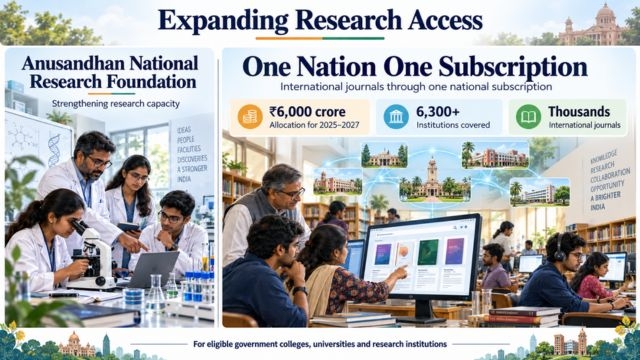
Research capacity is being strengthened through the Anusandhan National Research Foundation. The One Nation One Subscription initiative provides eligible government colleges, universities, and research institutions access to thousands of international journals under a single national subscription, with an allocation of ₹6,000 crore for 2025-2027 covering more than 6,300 institutions. This expands access particularly for students and faculty outside major metropolitan centres.
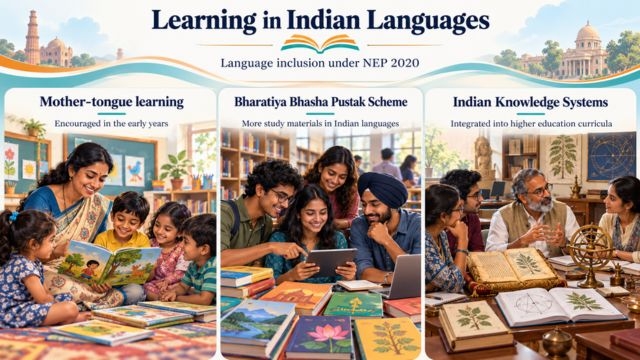
Language policy has also shifted. NEP 2020 encourages the use of mother tongue or Indian languages in the early years. Initiatives such as the Bharatiya Bhasha Pustak Scheme work to increase the availability of study materials in Indian languages, while higher education is incorporating Indian Knowledge Systems into curricula.
Assessment and Emerging Challenges
The national assessment centre PARAKH is intended to develop common standards focused on understanding and competencies rather than marks alone. Education systems are now also preparing for the integration of artificial intelligence into teaching and learning.
Significant challenges remain: variations across states, the digital divide, teacher capacity gaps, and infrastructure shortfalls. Nevertheless, the policy direction is consistent from early foundational skills and flexible pathways to digital records, research access, and linguistic inclusion.
The overarching objective is to equip young Indians with the ability to learn continuously, apply skills, and adapt to change in support of a developed India.
Written by

Kewali Kabir Jain
Journalism Student, Makhanlal Chaturvedi National University of Journalism and Communication