Tamil Nadu Under Vijay : TN in Debt, Religion-Specific Freebies on the Rise?
Is Tamil Nadu Overburdened by the Religion-Specific Benefits of the Vijay Government for Muslim Girls and Waqf Properties?
Total Views |


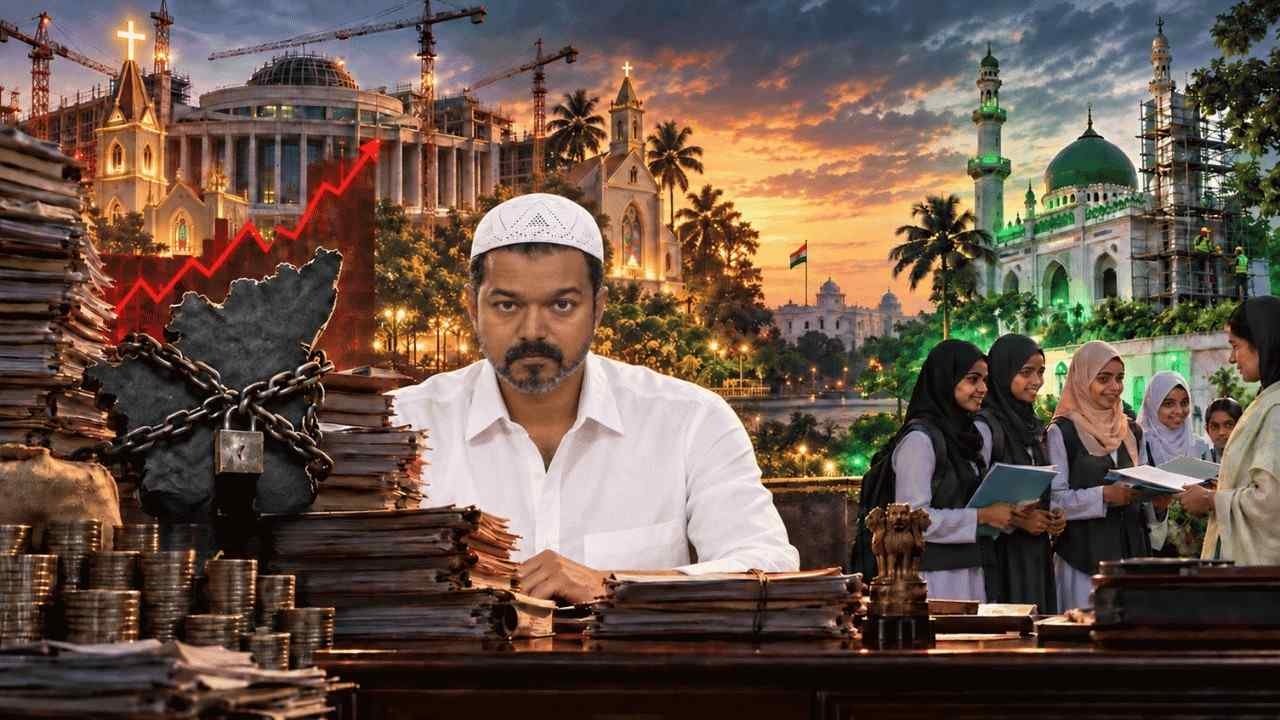
Tamil Nadu’s TVK government has expanded minority-focused welfare measures while the state faces ₹13.18 lakh crore in total liabilities, raising questions over fiscal priorities and allocation of taxpayer funds.
In September 2026, Tamil Nadu Chief Minister C. Joseph Vijay of the Tamilaga Vettri Kazhagam (TVK) announced a ₹1,200 crore plan for a new integrated Secretariat and Legislative Assembly complex in Chennai. The proposed facility, spanning 20 lakh square feet, is intended to house all state government departments in a modern, eco-friendly campus with fire safety systems, disability access, parking, conference halls, and public service centres. The historic Fort St. George, where the current Secretariat operates under severe space constraints (with most of the 107-acre campus controlled by the Defence Ministry and Archaeological Survey of India), is to be preserved as heritage.
Alongside this, the government has rolled out or expanded several schemes targeted specifically at religious minorities particularly Muslims and Waqf-linked properties meanwhile the state’s overall financial position remains under significant strain.
Minority-Focused Schemes:
In late August 2026, Minorities Welfare Minister A.M. Shahjahan announced a package of measures in the Assembly.
Full coverage of undergraduate tuition fees for female Muslim students admitted under the government quota in government, government-aided, and self-financing colleges (arts, science, engineering, medicine, agriculture, law, etc.), with an initial allocation of ₹20 crore.
Extension of the Tamil Nadu Waqf Board scholarship for Muslim girls from classes 1-8 to classes 9-10 at 2,000 crore rupees per year, expected to benefit 41,384 students at a cost of 8.28 crore rupees.
Establishment of a new minorities women’s arts and science college in Chennai through the Waqf Board, with an initial grant of ₹2.45 crore.
A ₹100 crore interest-free revolving fund for loans to develop income-generating assets (such as commercial complexes and marriage halls) on Muslim Waqf and Christian religious properties.
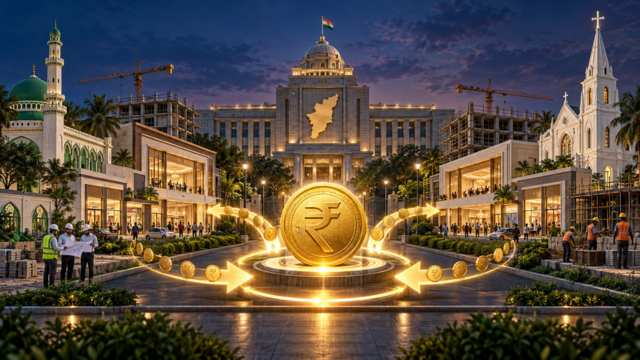
Construction of a new headquarters for the Tamil Nadu Waqf Board at an estimated ₹40 crore, plus an increase in the Board’s administrative grant to ₹5 crore.
These are muslim specific benefits funded by the state exchequer. Parallel announcements have included broader freebies such as three free LPG cylinders annually for families with income below ₹2.5 lakh (estimated annual cost over ₹4,000 crore under the Annapoorni Super Six scheme), gold rings for babies born in government hospitals (Thaimaman Thanga Mothiram scheme), and allowances plus vehicles for all 234 MLAs.
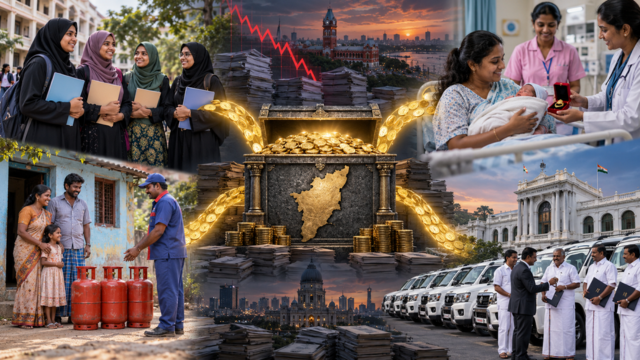
A White Paper released by the TVK government itself in June 2026 stated that Tamil Nadu’s total financial liabilities, including public sector undertaking debts and guarantees, stood at approximately ₹13.18 lakh crore. Direct state debt had nearly doubled over the previous five years to around ₹10 lakh crore. Per capita liability was reported near ₹1.28 -1.29 lakh. Revenue deficits had widened, interest payments consumed a substantial share of revenues, and the fiscal position constrained space for new capital expenditure.
Vijay’s Christian roots and IUML minister drive selective minority freebies:
Indian states routinely run minority welfare programmes, scholarships, and institutional support under constitutional provisions for the protection of minorities. Tamil Nadu has a long history of such schemes under successive governments. But the government of Vijay looks totally devoted to muslims. Full tuition fee specifically for Muslim girls under the government quota, Waqf Board scholarships to Muslim girls, a college routed through the Waqf Board, and a large revolving fund primarily for Waqf and Christian properties while the state’s Hindu majority and other communities receive benefits largely through universal or caste-based programmes rather than parallel religion-specific ones of comparable scale in the recent announcements.
_202609051224207172_H@@IGHT_360_W@@IDTH_640.png "tamil nadu image 4 (1)")
The government seems to be practising selective allocation of taxpayer funds on religious lines. Vijay’s own Christian background and the inclusion of IUML’s A.M. Shahjahan as Minorities Welfare Minister has shaped outreach to both Muslim and Christian organisations.
Taxpayer Money for Muslims and Christians Amid ₹13.18 Lakh Crore Debt
The TVK government in Tamil Nadu has clearly prioritised religion-specific benefits for Muslim and Christian communities in its recent schemes. In August 2026, Minorities Welfare Minister A.M. Shahjahan announced that the state will fully cover undergraduate tuition fees for Muslim girls admitted under the government quota (₹20 crore).
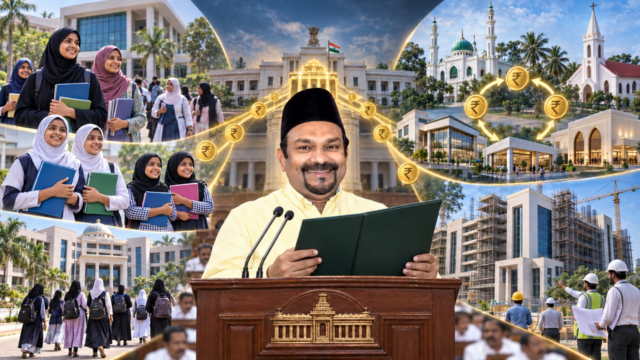
The Waqf Board scholarship for Muslim girls was extended to classes 9-10, benefiting 41,384 students at a cost of ₹8.28 crore. A new minorities women’s college is being set up through the Waqf Board with an initial grant of ₹2.45 crore. An interest-free revolving fund of ₹100 crore has been created for income-generating projects on Muslim Waqf and Christian religious properties, while ₹40 crore has been allocated for a new Waqf Board headquarters.
These figures cover only the recent announcements. Tamil Nadu’s total debt and liabilities have already reached ₹13.18 lakh crore. While universal freebies such as gold rings for newborns and free LPG cylinders also continue, crores of taxpayer money are being channelled into these religion-targeted schemes.
This pattern is placing an additional burden on the state’s limited resources. With the revenue deficit already high and a large share of revenue going toward interest payments, benefits directed at select communities are diverting funds away from other needy sections and essential infrastructure.
Allocating public money on the basis of religion rather than need or equality is increasing pressure on both the state’s financial health and social cohesion.
The larger question is whether welfare should be determined primarily by religious identity or by economic need and equal access?
Written by
Kewali Kabir Jain
Journalism Student, Makhanlal Chaturvedi National University of Journalism and Communication