Communist Terrorism : Naxalbari to National Security
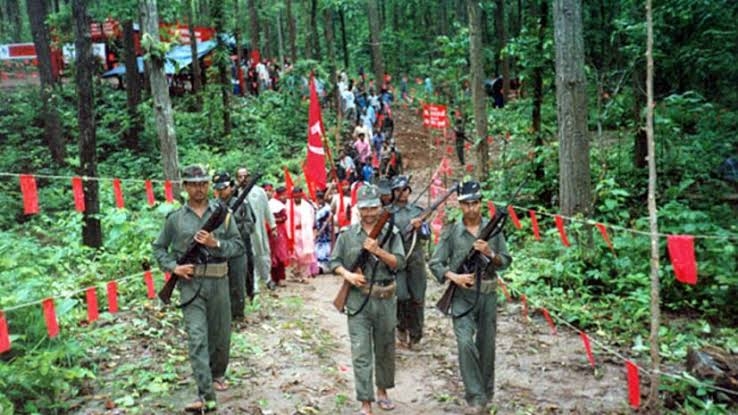
In India, Naxalism, which was considered merely a socio-economic problem in the early 70s, is today known as communist terrorism or Maoism. According to a report in the year 2007, at that time about 126 districts of India were badly affected by Naxalism. And if we look at the government report of 2019, we find that 58 of these districts are still suffering from this internal problem partially or completely.
Naxalism is like a cancer in the Indian Republic. It is running a vicious cycle of slowly destroying India's sovereignty, unity and integrity through Indians themselves. After destroying the sovereignty of Nepal, the only Hindu nation in the world, now the evil eye of Maoism is completely focused towards India. Perhaps this is the reason why in 2006, the then Prime Minister of India, Dr. Manmohan Singh had described Maoism or communist terrorism as the biggest threat to India's internal security.
According to reports in April 2019, Naxalism in India was prevalent in 11 states like Andhra Pradesh, Bihar, Jharkhand, Chhattisgarh, Odisha, Telangana and Maharashtra. In the year 2007, more than 300 communist terrorists together killed 55 policemen in Bastar region of Chhattisgarh. In the year 2010, due to damage to the railway track by Naxalites, 13 coaches of Gyaneshwari Express going from Shalimar in Kolkata to Mumbai LTT derailed. More than a hundred civilians were killed in this major massacre.
In 2010 itself, more than 76 CRPF soldiers were sacrificed in a Naxalite attack in Dantewada. In the year 2013, Naxalites attacked a group of Congress leaders in Sukma district of Chhattisgarh. In this attack, 23 top level leaders of Chhattisgarh Congress were gunned down.
In this way, this series of murders has been going on for the last five decades, in which communist terrorism has taken more than 10 thousand lives. The problem becomes more serious when during the retaliatory action by the military and police forces, these terrorists use the common villagers as a shield and hide in their own houses. The tribals who do not support them are called traitors and their entire families are publicly murdered.
In early March 1967, Naxalism was born in the very small village of Naxalbari located in Darjeeling district of West Bengal, bordering Nepal. From here it got the name Naxalism. Most of the farmer families here belonged to the Santhal tribe. When the police, following the orders of the landlord, harassed the farmer's family.
In such a situation, the communist leaders of West Bengal Charu Majumdar, Kanu Sanyal and Jangal Santhal started a violent movement by turning an ordinary farmer's movement in India into a violent one. In this, a campaign was launched to selectively kill landlords, people of police administration working in the government system and those who were against them.
Later, people associated with this violent movement separated from CPIM and formed their own separate party CPIML in 1977, which was completely inspired by Maoist ideas.
Its first impact was visible in the form of the departure of the Congress government in West Bengal. When the movement turned violent, the then Prime Minister Indira Gandhi understood the seriousness of the problem and dismissed the West Bengal government and put all the Maoist leaders in jail. During this period in the year 1972, Charu Majumdar died in police custody. Due to this the edge of the movement weakened.
Maoism is the extremist/totalitarian communist ideology of Chinese dictator Mao, who established his power in China through violence. Mao Zedong called this insurgency “revolution”.
Maoism or Naxalism in India is not an ideological movement. Maoists are poisoning the minds of the tribes against democracy by keeping them untouched by democracy and development.
Their main objective is to establish themselves in politics and take control of natural resources in the name of 'establishing Maoist power' by declaring the country's governments to be the power of the rich or capitalists (bourgeoisie) on the strength of guns.
In the beginning they have to create their base and acceptance among the public and in the end they have to reach the pinnacle of politics, this is their method. They mainly attack infrastructure like tehsils, development blocks, primary health centres, Anganwadi centres, police, rail, and roads and try to eliminate the state presence.
Naxalites have used propaganda to spread their ideology in urban areas, in which they have achieved success to a great extent. Efforts are being made by their agents sitting in the city to promote their objectives among the educated and enlightened class, students and working people. These are called urban Naxals.
Urban Naxalites serve their wrong objectives in the form of propaganda in colleges, universities and society and try to provide as much financial and ideological help as possible to the Naxalites. People sitting in social media and big organizations are tricked into working against the democratic government.
Politburo has the highest position in Naxalism. Under this, Central Committee, Special Area Committee, Regional Committees etc. work. The People's Liberation Guerrilla Army (PLGA) is their armed unit.
The PLGA has three types of troops, the first being the Basic Army; Its job is to obtain military secret information. Usually 40 to 50% of these are women. Second, the secondary force, which consists of the area committee and guerrilla squads.
The most prominent in this is the main force, which consists of battalions like the armed forces, which carry out Maoist terrorist attacks on the basis of secret information. According to a report, their number is said to be between 8000 and 9000. They also mislead common villagers and use them to help themselves. Such people are called militia. And their number is said to be more than 20 thousand.
The financial needs of Naxalites are met through extortion from government and private companies working in the areas under their influence. They call it ‘protection money’ and ‘revolutionary tax’. They also raise money through terrorism by kidnapping government officials and their relatives. Urban Naxalites also help them financially.
Communist terrorism is mainly spread in areas rich in natural resources where there is abundance of coal, bauxite, manganese, and copper etc. Odisha and Jharkhand alone have more than half of the country's coal reserves and it is here that the Naxal problem is most prevalent.
People associated with Naxalite ideology pretend as if Naxalites are fighting for the rights of poor people and want to establish a people's government. Whereas the facts present a completely different story.