Higher Education, Finally Speaking Indian
11 Jan 2026 11:26:28
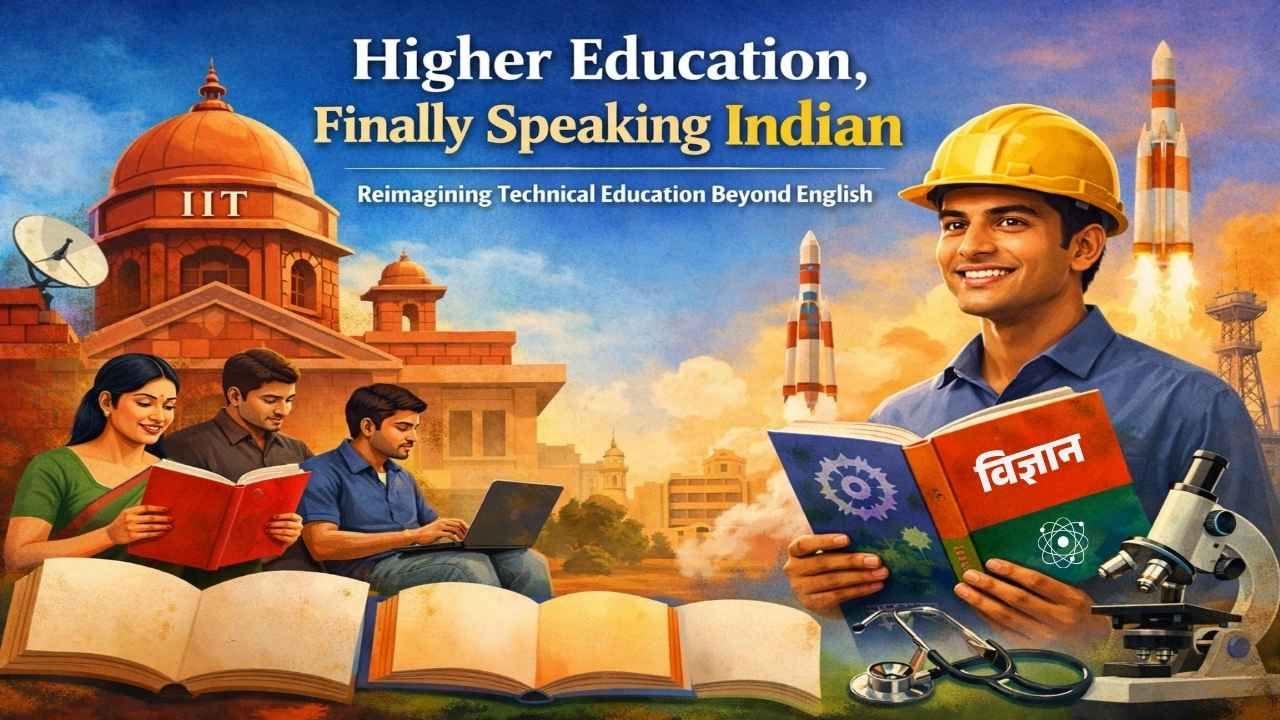
For decades after Independence, Bharat’s higher education ecosystem remained constrained by a colonial linguistic framework in which English functioned simultaneously as a gatekeeper and a barrier. The National Education Policy 2020 decisively challenged this imbalance by reaffirming a civilisational principle that education becomes most empowering when delivered in one’s mother tongue.
Reimagining Technical Education Beyond English
A landmark moment occurred on January 6, 2026, when IIT Indore formally advanced Hindi as a functional language of science and technology through Abhyuday-3, a National Technical Hindi Seminar. Organised in collaboration with IIT Jodhpur and CSIR–NIScPR, the initiative sought to strengthen the use of technical Hindi across classrooms, research, and administrative processes. It specifically aimed to benefit students from Hindi-medium backgrounds who have traditionally faced linguistic barriers in technical education.
Earlier, IIT Jodhpur had already created history by becoming the first Indian Institute of Technology to offer BTech first-year instruction in Hindi in September 2025. This bold step dismantled the long-standing assumption that engineering excellence remains inseparable from the English language.
Indian Languages Gain Global and National Footing
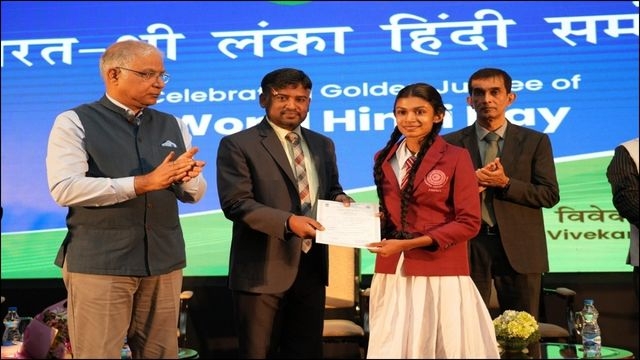
The influence of the NEP extended beyond Bharat’s borders. In July 2025, Sri Lanka’s Kotelawala Defence University launched a Hindi language programme in partnership with the Swami Vivekananda Cultural Centre. This initiative strengthened Bharat–Sri Lanka civilisational ties by positioning education as a medium of cultural and linguistic exchange.
Within Bharat, IGNOU, through a memorandum of understanding with the Odisha government, began offering all academic programmes in Odia, ranging from undergraduate degrees to certificate courses. This move demonstrated how multilingual higher education can directly support tribal, rural, and first-generation learners by aligning academic delivery with linguistic familiarity.
AICTE as the Driving Force
The All India Council for Technical Education emerged as a central institutional pillar in this transformation. As early as October 2021, AICTE approved BTech programmes in Hindi and supported them through AI-assisted translation of engineering textbooks.
By April 2025, AICTE announced plans to provide engineering textbooks in 12 Indian languages. More than 600 books became available, with several others under preparation. At the same time, regional-language engineering programmes expanded across 22 colleges, collectively offering 2,580 seats nationwide.
Medicine and Technology in the Mother Tongue
The medical education sector also witnessed a significant shift. Rajasthan and Chhattisgarh introduced Hindi-medium MBBS courses from the 2024–25 academic session, primarily to support rural and Hindi-medium students. These initiatives reflected Prime Minister Narendra Modi’s repeated emphasis on eliminating linguistic discrimination in professional education.
In the digital learning domain, IIT Madras, through NPTEL, expanded access by offering Python programming and data structures courses in Tamil. Alongside this, institutions translated thousands of hours of technical content into multiple Indian languages, broadening participation in technology-driven education.
Outcomes: From Policy Vision to Ground Reality
The outcomes of these initiatives have moved beyond theory into measurable reality. At IIT Jodhpur, enrolment in Hindi-medium engineering rose steadily, with 116 students in the first batch and 96 in the subsequent batch. This trend confirmed sustained demand. Students reported improved confidence and comprehension during their foundational year, which enabled a smoother transition to English-medium instruction in later semesters.
Similarly, IIT-BHU’s move towards Hindi-medium instruction in the first year is expected to reduce linguistic inequality at one of Bharat’s most prestigious institutions.
Regional-Language Graduates Prove Their Worth
A decisive rebuttal to scepticism emerged from Pimpri Chinchwad College of Engineering in Pune, where the first batch of Marathi-medium engineers entered the workforce in 2025. With 60 percent placements and salary packages reaching up to ₹10 lakh per annum, these graduates demonstrated parity with their English-medium peers in both competence and employability.
Medical Education Finds a Balanced Model
States such as Madhya Pradesh, which pioneered Hindi-medium MBBS education, reported that nearly 30 percent of students opted for Hindi instruction, citing better conceptual understanding and reduced academic anxiety. Over time, institutions adopted a hybrid Hindi-English model that emerged as a practical and flexible solution, reflecting adaptability rather than rigidity.
Rising Enrolments and Cultural Confidence
Across the country, engineering admissions in regional languages recorded a sharp decline in vacant seats, falling from 80 percent in 2021–22 to 53 percent in 2022–23. Tamil Nadu, Andhra Pradesh, and Uttar Pradesh emerged as leading states in embracing this model.
Beyond numerical indicators, these initiatives strengthened Bharat’s linguistic self-confidence. In Sri Lanka, Hindi education reinforced cultural diplomacy, while in Odisha and Tamil Nadu, local languages gained large-scale academic legitimacy. Collectively, these developments signal that NEP 2020 has begun translating its vision into a durable transformation of Bharat’s higher education landscape.
Article by
Kewali Kabir Jain
Journalism Student, Makhanlal Chaturvedi National University of Journalism and Communication