Religious Intrusions in Educational Spaces: A Pattern of Controversies Across Bharat
15 Jan 2026 18:17:44

A fresh controversy at IIMT University in Meerut has once again drawn attention to recurring allegations of religious assertion and coercion within educational institutions across Bharat. The incident adds to a growing list of cases from schools, colleges, and universities where concerns are being raised about institutional neutrality, consent, and adherence to constitutional values.
IIMT University, Meerut: The Trigger Point
On 16 March 2025, a video showing a student offering namaz in an open area of the IIMT University campus during Holi celebrations went viral on social media. Following the circulation of the video, the student, identified as Khalid Pradhan, was arrested. The incident triggered protests by Hindu organisations within and around the campus. University authorities stated that the video was uploaded with the intention of disturbing communal harmony. The matter remains under investigation.
Earlier Incidents: Schools Under Scrutiny
What nonsense is this? Razakar rule in Telangana is turning normal schools into madrasas.😳🤷🏻♂️
— Tathvam-asi (@tathvamasi6) November 24, 2024
Krishnaveni school, Asif Nagar, Hyderabad.
Keeping Hindu names to fool schools. Teachers and management all are Mlechas and teaching this to your children. pic.twitter.com/Oe2HpT8s2u
This episode is not an isolated one. In November 2024, allegations surfaced against Krishnaveni School in Hyderabad, Telangana. Despite its Hindu name, the institution was accused of gradually promoting Islamic teachings and allegedly misleading parents. A video cited by complainants circulated widely on social media, prompting demands for an official inquiry.
In September 2024, a government senior secondary school in Sonipat, Haryana, faced backlash after a school programme allegedly involved a Hindu girl being made to wear a hijab and burqa as part of a play depicting Eid greetings. Parents and local groups questioned both the appropriateness of the portrayal and the absence of parental consent.
Allegations of Coercion and Indoctrination
More serious allegations emerged in July 2024 from Delhi’s Subhash Palace area. A Hindu father filed an FIR against three teachers at a coaching centre, alleging that his 13-year-old son was pressured to read the Quran and recite Islamic declarations. He also claimed that Hindu beliefs were criticised during classes. Similar concerns were raised in Vadodara, Gujarat, where an anganwadi centre was accused of compelling Hindu children to participate in namaz and Eid celebrations.
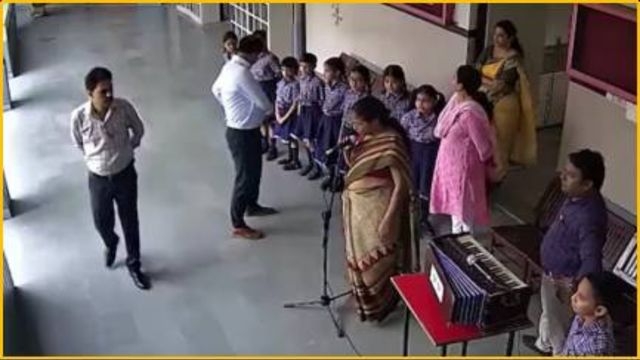
In several other cases reported from Dehradun in April 2023, Hathras in April 2023, Kutch in June 2023, and Khandwa in June 2023, schools were accused of making non-Muslim students enact Islamic prayers or recite religious verses during school events. Videos from some of these programmes went viral, leading to protests, administrative inquiries, suspensions, and in certain instances, the registration of FIRs.
Curriculum and Cultural Bias Allegations
Concerns have also been raised regarding curriculum content and cultural representation. In Rajkot, Gujarat, in June 2023, parents alleged that a private school selectively taught Mughal history while omitting lessons on Hindu rulers such as Maharana Pratap. Teachers were accused of distorting historical facts and presenting a biased narrative.
In Bihar’s Kishanganj district and in Uttarakhand’s Dehradun, complaints emerged about unofficial Friday holidays being granted to accommodate Juma prayers. In these cases, Sunday classes were reportedly held in place of Fridays without formal administrative orders, raising questions about procedural transparency and equality.
Universities and Teacher Conduct
The pattern extends to higher education institutions as well. In July 2025, students at the Central University of Karnataka alleged that a faculty member pressured female students to wear hijabs during academic field trips to Islamic heritage sites. A legal rights forum formally submitted a complaint to the Vice Chancellor, seeking action in the matter.
In another grave allegation from Ujjain, Madhya Pradesh, in July 2025, a government school teacher was accused of destroying Hindu religious images and attempting to desecrate the national flag. The complaint also included claims that students were forced to read the Quran and visit a mosque. The incident provoked strong reactions from parents and local communities.
A Persistent Question of Neutrality
From Mevat Model School in Haryana in 2017 to an incident in Prayagraj in 2022, where a principal was booked for allegedly pressuring students to wear Eid attire in exchange for academic incentives, such controversies span nearly a decade. While authorities have often ordered probes and, in some cases, initiated disciplinary action, critics argue that systemic safeguards remain weak and inconsistently enforced.
Taken together, these incidents raise fundamental questions about religious neutrality in educational institutions, the protection of minors, parental consent, and the constitutional principle of equality. They also underscore the need for clearer guidelines and stricter oversight to ensure that educational spaces remain free from religious coercion and ideological influence.
Article by
Kewali Kabir Jain
Journalism Student, Makhanlal Chaturvedi National University of Journalism and Communication