World Bank Confirms India’s Historic Poverty Breakthrough: 49.6 Crore Lifted Out as Modi’s Antyodaya Model Delivers
The World Bank’s October 2026 Poverty and Equity Brief has documented one of the fastest and most comprehensive reductions in poverty anywhere in the world over the past decade.
Total Views |


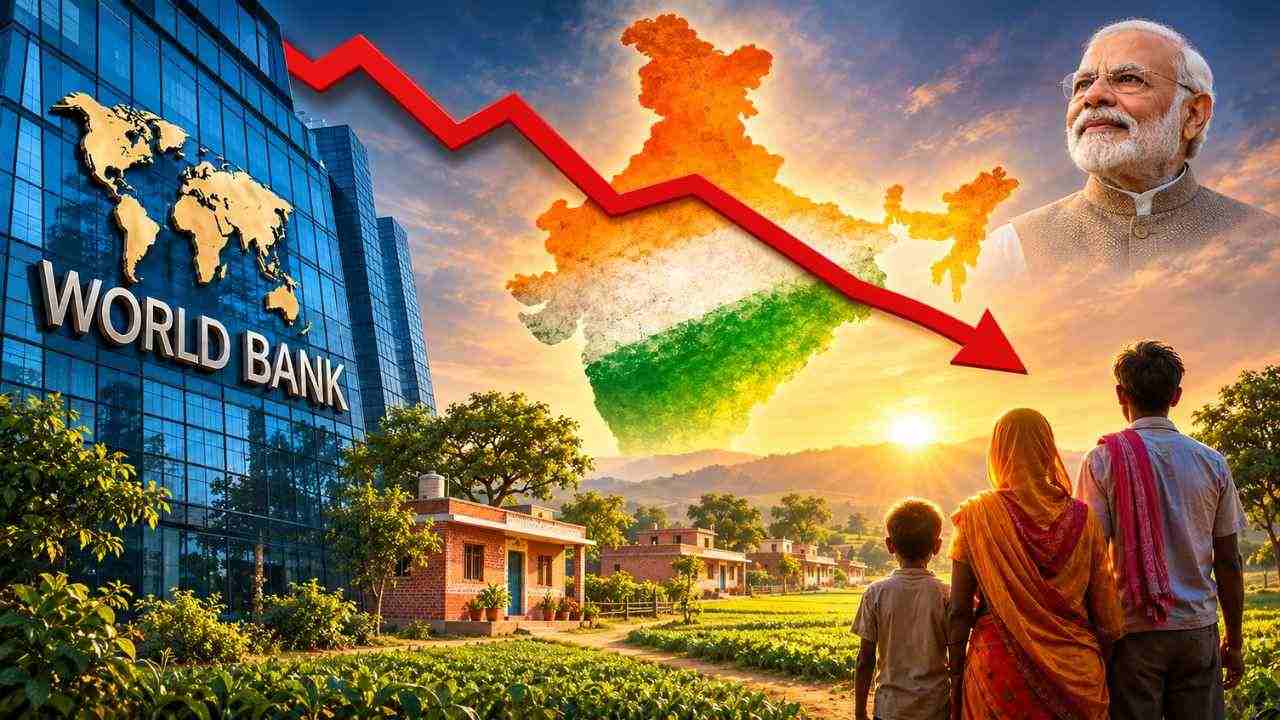
Between 2011 and 2023, an estimated 49.6 crore fewer Indians lived below the World Bank’s lower-middle-income poverty line of $4.20 a day. The share of the population below this threshold fell from 57.7 per cent to 16.1 per cent. Over the same period, the extreme poverty rate, measured at $3.00 a day, dropped from 27.1 per cent to 2.6 per cent. Both thresholds are expressed in 2021 purchasing power parity (PPP) terms.
The numbers are unambiguous. India’s consumption Gini index tightened from 28.8 in 2011-12 to 23.0 in 2023, indicating that the gains were broad-based rather than concentrated at the top. Multidimensional poverty, measured by the Oxford initiative, plunged from 53.8 per cent in 2005-06 to 16.4 per cent by 2019-21, with the World Bank’s own MPI reading 15.5 per cent in 2022-23. Projections suggest the $4.20-a-day rate will continue easing, from an estimated 14.2 per cent in 2026 to 12.1 per cent by 2028.
The World Bank itself attributes the transformation primarily to three forces: strong consumption growth, rising employment especially among women and expanded social transfers, including food subsidies. Between 2017 and 2023, India added roughly 134 million workers, with rural women accounting for a substantial share of the expansion. Targeted food security through the National Food Security Act and PMGKAY, combined with Direct Benefit Transfers and rural employment programmes, cushioned households against external shocks. Domestic demand and the shift toward rural non-farm activity sustained household spending.
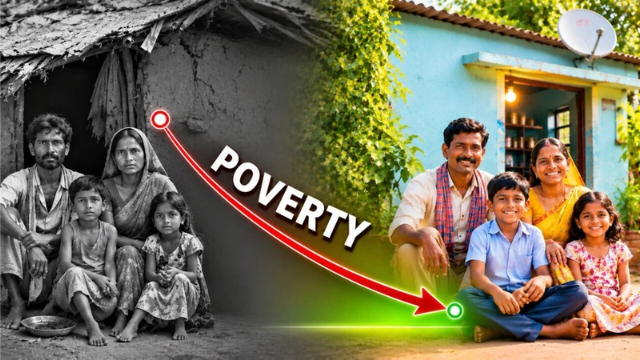
What the data alone does not fully capture is the deliberate philosophical and administrative architecture behind these outcomes. The post-2014 approach marked a decisive break from earlier models of discretionary handouts and fragmented entitlements. Drawing on Pandit Deendayal Upadhyaya’s Integral Humanism and the ideal of Antyodaya the uplift of the last person the government treated basic physical necessities as an indivisible package, sanitation, piped water, electricity, clean cooking fuel, and pucca housing.
Schemes such as Swachh Bharat, Jal Jeevan Mission, Saubhagya, Ujjwala and Pradhan Mantri Awas Yojana pursued saturation rather than selective targeting. The goal was near-universal coverage of entire clusters so that no household remained excluded. Parallel to this physical infrastructure push, the JAM trinity Jan Dhan accounts, Aadhaar and mobile connectivity replaced leaky, multi-layered distribution systems with Direct Benefit Transfers. Biometric de-duplication weeded out ghost beneficiaries across LPG, PDS and MGNREGS, generating cumulative estimated savings of more than ₹3.48 lakh crore. Every rupee saved was a rupee that reached an actual poor household.
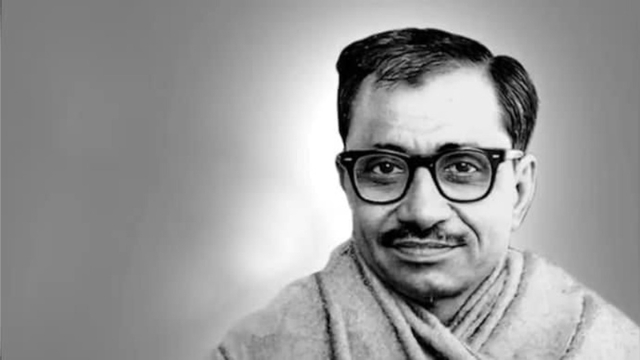
This combination of asset saturation and leakage-proof delivery translated Upadhyaya’s insistence on dignity and self-reliance into measurable results. Poverty alleviation was never reduced to cash doles. It was framed as securing the material conditions that allow a person to stand with Atmasamman self-respect and move toward productive self-dependence. NITI Aayog’s Multidimensional Poverty Index confirms that the dismantling of basic infrastructural deprivations has been central to the sharp contraction in consumption-based extreme poverty.
The World Bank’s endorsement is an external recognition of a governance model that prioritised the bottom rung of the ladder and treated the poor as stakeholders rather than permanent dependents. India’s recent record demonstrates that when policy is anchored in the lived condition of the most vulnerable and executed with saturation intent and digital precision, large-scale poverty reduction is achievable. The World Bank’s numbers now stand as public evidence of that proposition.
Written by
Kewali Kabir Jain
Journalism Student, Makhanlal Chaturvedi National Journalism and Communication University