From “Hindu Terror” to Temple Slurs: Congress’s Selective Secularism
Neha Bora’s remarks about temple priests revive questions about Congress’s record, from “Hindu terror” rhetoric to Rahul Gandhi’s meeting with Pastor George Ponnaiah.
Total Views |


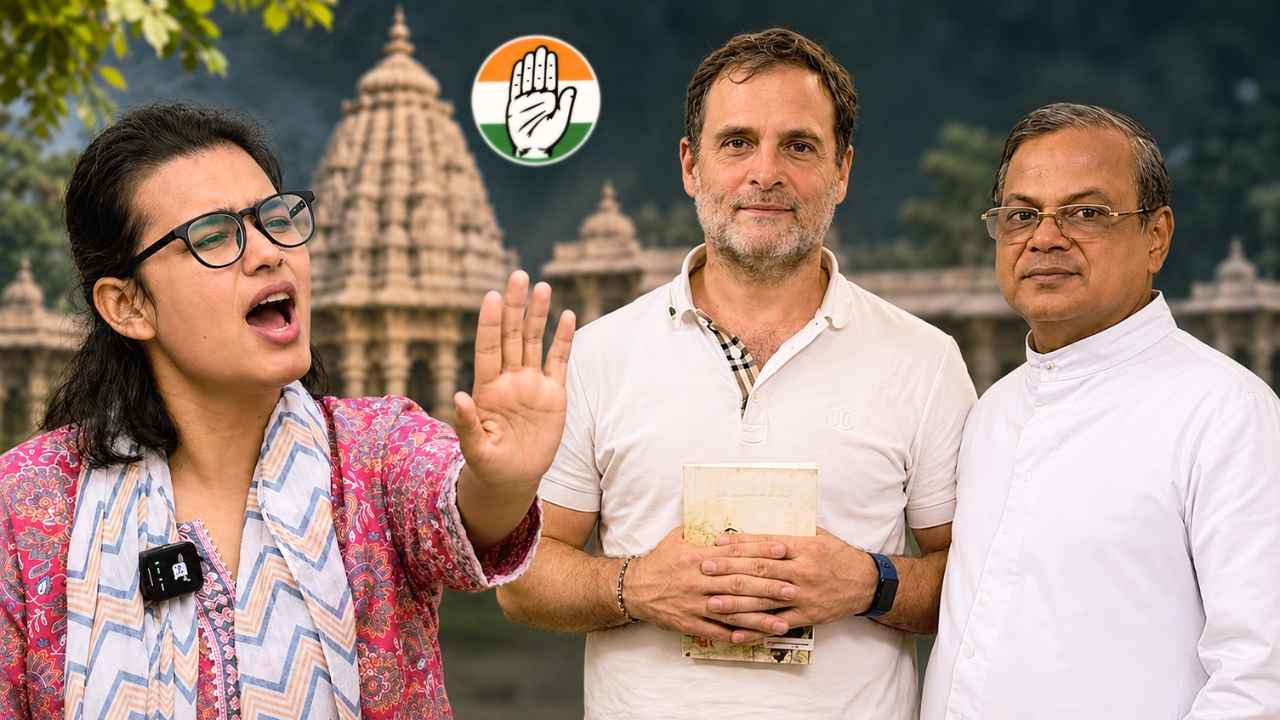
For ordinary Hindus, the temple is not a political prop. It is the living centre of faith, community and civilizational memory. When that space is casually branded a site of systematic predation, the offence goes personal on the sentiments of crores of Hindus, beginning their day by visiting their nearby temple. Neha Bora’s recent public claim that priests commit rape inside temples, delivered with the air of settled fact, belongs to this category of deliberate provocation. Notably this remark sits within a longer pattern of language and political association that the Congress ecosystem has normalised over years.
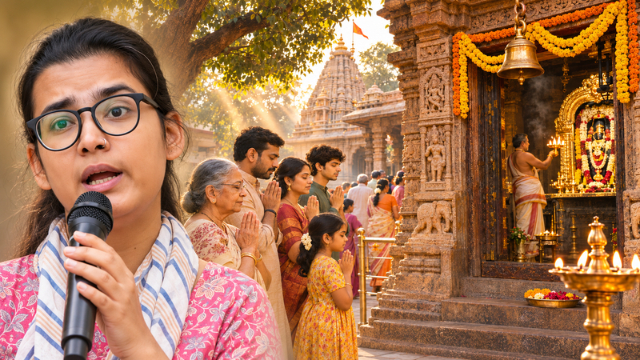
Bora, president of the All India Students’ Association (AISA), has been repeatedly photographed and platformed alongside senior Congress leaders, including Rahul Gandhi and Priyanka Gandhi Vadra. And her proximity is the product of an ideological climate in which sweeping denunciations of Hindu religious institutions are treated as progressive currency. In the same conversation she invoked a selective and distorted reading of traditional texts, translating “taadan” as chastisement while ignoring its primary sense of care and protection.
First she misrepresented the tradition, then used the misrepresentation to brand the temple and its functionaries as inherently unsafe for women, including Brahmin women, under what she called the “Brahmanical system.”

Rahul Gandhi’s Earlier Framing
Rahul Gandhi too has previously spoken of temples as places where “girls are molested,” drawing a direct equivalence between the act of worship and sexual violence. In the aftermath of a horrific gang rape in Delhi in 2014, he offered a formulation that placed temple-goers who revere the goddess on the same moral plane as those who assault women on public transport. Defenders insist this was merely a critique of patriarchy. Patriarchy exists across communities and institutions. What was absent was any comparable sweeping characterisation of other religious spaces. Madrasas have faced documented cases of sexual abuse of students. Christian clergy scandals involving the molestation of children have surfaced repeatedly across continents. Neither produced equivalent generalisations from the same political quarter about mosques, churches or their functionaries. The selectivity reveals the animus.
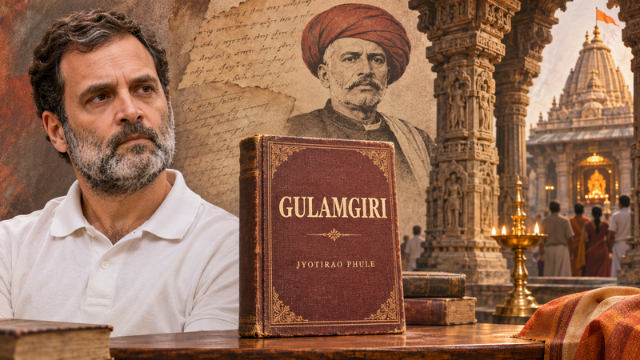
Gandhi has also publicly endorsed “Gulamgiri”, a text that subjects Hindu deities, including Brahma and Saraswati, to highly derogatory and sexually charged misrepresentations. Presenting such material as necessary “deconstruction” while remaining silent on parallel critiques of other faiths is not secularism. It is the selective recycling of colonial-era tropes that portrayed Hindu worship as degraded and Hindu men as uniquely predatory.
The Ponniah Episode
The Bharat Jodo Yatra supplied a further illustration. In Kanyakumari, Gandhi met Pastor George Ponniah, a figure with a prior record of anti-Hindu statements and an earlier arrest linked to hate speech. On camera the pastor declared that Jesus is the real God “not like Shakti,” and had previously spoken of wearing shoes so that the “impurities of Bharat Mata” would not contaminate him. Gandhi’s decision to engage him as a legitimate interlocutor in a yatra marketed as national healing sent a clear signal that Hindu sentiment could be subordinated to the requirements of political optics.
Those who defended the meeting dismissed the controversy as manufactured. The video was not fabricated. The pastor’s words were not ambiguous. A leader seeking genuine reconciliation does not platform a figure whose public record rests on denigrating the faith of the majority community.
The Longer Record: “Hindu Terror”
The deepest institutional expression of this attitude remains the sustained attempt, during the UPA years, to construct and mainstream the category of “Hindu terror” or “saffron terror.” Senior Congress leaders, including P. Chidambaram and Sushilkumar Shinde, gave the terminology official currency. After the 26/11 Mumbai attacks, Digvijaya Singh publicly floated the suggestion that the RSS might have been involved, an assertion so detached from evidence that it later drew sharp parliamentary rebuke.
Former Mumbai Police Commissioner Rakesh Maria has recorded that Lashkar-e-Taiba itself sought to plant the narrative of a ‘Hindu Conspiracy’. The Malegaon investigation followed a similar political logic, with the investigative focus trained on RSS-linked individuals in a manner that many observers regarded as predetermined.
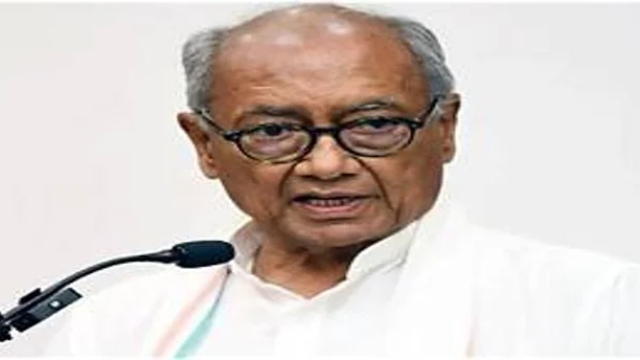
A political formation that spent years equating the Sangh, the temple and the saffron flag with terrorism created the soil in which remarks like Bora’s could take root and be treated as unremarkable. The continuum is an earlier campaign that supplied the intellectual scaffolding; the later rhetoric supplies the public expression.
Temples remain the everyday institutions of Hindu civilisational life. To reduce them, without evidence and by sweeping generalisation, to dens of predation is an attack on the dignity of a community’s most intimate spaces of faith. When such language is platformed, amplified and left unreprimanded by a major national party, the claim of neutrality collapses.
Neha Bora’s statement is a logical outgrowth of a political culture that has long treated Hindu religious institutions as fair game for collective defamation. The record from the “Hindu terror” years, through the temple-molestation framing, the Ponniah meeting, and the current proxy rhetoric is the identity of politics that congress plays and the introduction of policies, congress would implement once settled in power.
Written by

Kewali Kabir Jain
Journalism Student, Makhanlal Chaturvedi National University of Journalism and Communication