From "Disturbed Areas" to Development Zones: How Northeast Bharat Reclaimed Peace and Purpose
Once scarred by insurgency and emergency rule, the Northeast now reflects measured security reforms, falling violence and sustained economic integration.
Total Views |


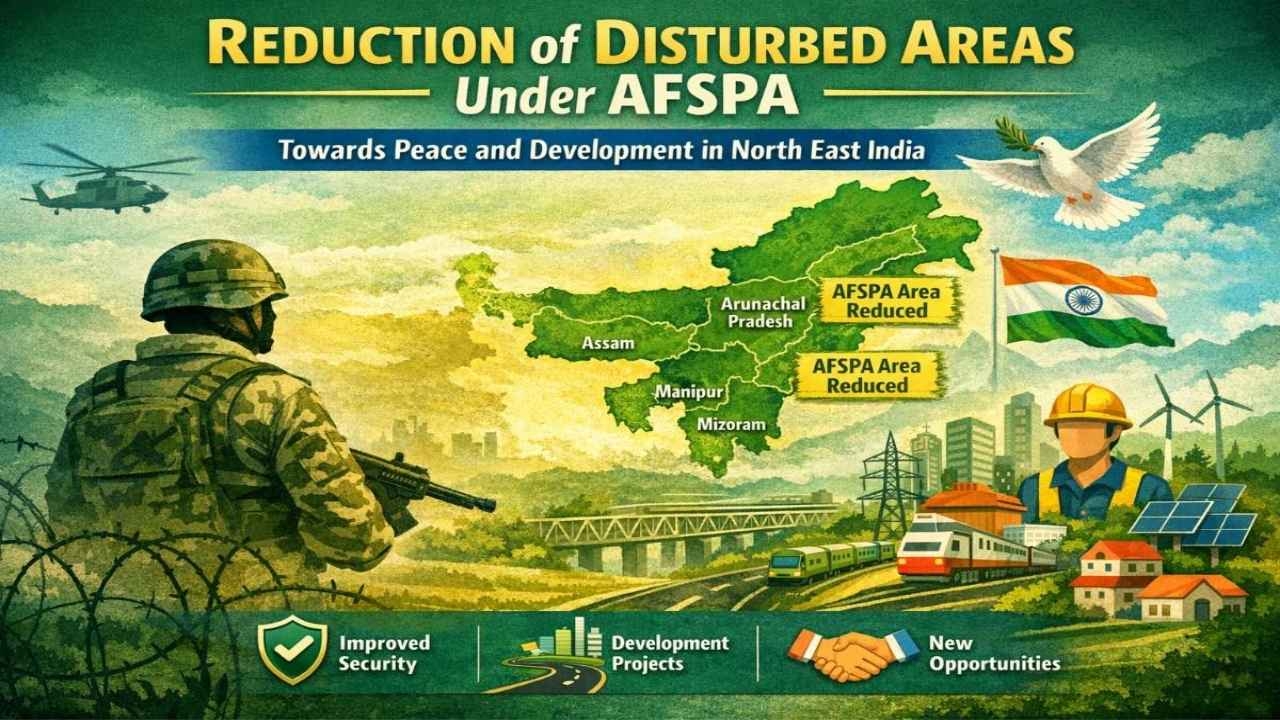
For decades, the Northeast, often referred to as Ashta Lakshmi in Bharatiya culture, symbolising the eight forms of prosperity, faced fragmentation driven by ethnic separatism, cross-border militancy and porous international frontiers. Organisations such as the NSCN, ULFA and UNLF exploited historical grievances, disputes over resources and the strategic vulnerability of the Siliguri Corridor, commonly known as the Chicken's Neck, to challenge Bharat's unity.
Between 2014 and 2026, however, this narrative underwent a decisive transformation. What was once managed primarily through counter-insurgency operations has steadily evolved into a model of security anchored in development, democratic consolidation and national integration.
AFSPA: From Blanket Control to Review-Based Necessity
The Armed Forces Special Powers Act, enacted in 1958 for the Northeast, was designed as an emergency response to extraordinary security threats. Rooted in a colonial-era ordinance used during the Quit India Movement, the Act granted sweeping powers to the armed forces in areas officially notified as "disturbed".
For decades, these notifications were routinely extended with little differentiation between peaceful and conflict-prone zones.
The period after 2014 marks a clear departure from this inertia. Rather than political grandstanding or abrupt withdrawals, the rollback of AFSPA followed measured, review-based security assessments. The guiding principle remained firm: where violence receded and institutions stabilised, extraordinary legal provisions would retreat.
As a result:
- AFSPA was fully withdrawn from Tripura in 2015 and Meghalaya in 2018.
- Assam, Nagaland, Arunachal Pradesh and Manipur witnessed phased, district-wise and police station-level removals from 2022 onwards.
- By late 2025, AFSPA remained applicable only in strategically sensitive pockets and was subject to six-monthly review instead of functioning as a permanent condition.
The Collapse of Insurgency: Evidence in the Data
The most compelling evidence of the Northeast's transformation lies in measurable indicators.
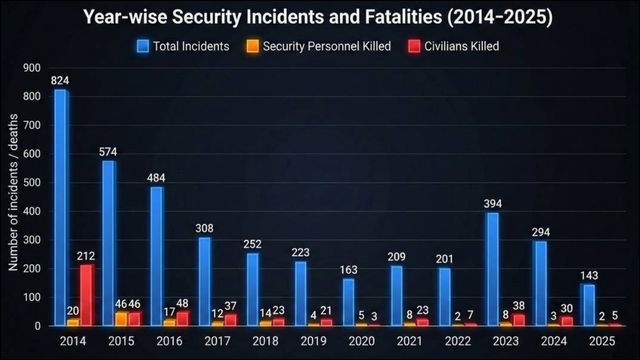
Between 2014 and 2025:
- Insurgency-related incidents fell by more than 70 per cent.
- Civilian fatalities declined by 85 to 97 per cent.
- Security force fatalities dropped by 70 to 90 per cent.
From 2014 to 2022 alone, extremist incidents decreased by 76 per cent. States such as Assam and Tripura reached near-zero levels of violence. After 2023, residual incidents were largely concentrated in Manipur, underscoring that security challenges had become localised rather than regional in character.
This sustained decline created the objective conditions necessary for scaling back AFSPA, conditions that had remained absent for decades.
Peace Accords: Ending Armed Movements Structurally
A cornerstone of this transformation has been a series of peace agreements signed between 2020 and 2023, formally closing chapters on several long-running insurgencies.
Key accords include:
- Bodo Peace Accord (2020), which brought an end to a 50-year movement, with more than 1,600 cadres surrendering arms.
- Karbi Accord (2021) and Adivasi Accord (2022), which addressed ethnic and socio-economic grievances in Assam.
- ULFA Agreement (2023), a watershed moment in which one of Bharat's most prominent separatist groups formally renounced violence and accepted the Constitution.
- UNLF (2023) in Manipur and DNLA (2023) in Dima Hasao, integrating both valley and hill-based insurgencies into the democratic mainstream.
Unlike earlier ceasefire arrangements that merely paused hostilities, these settlements focused on disbandment, surrender, rehabilitation and constitutional integration. Insurgency therefore concluded structurally rather than tactically.
Act East Policy: Development as a Security Strategy
Security normalisation in the Northeast has been inseparable from infrastructure expansion under the Act East Policy, launched in 2014. This policy reimagined the region not as a frontier challenge but as Bharat's gateway to Southeast Asia, structured around the three pillars of commerce, connectivity and culture.
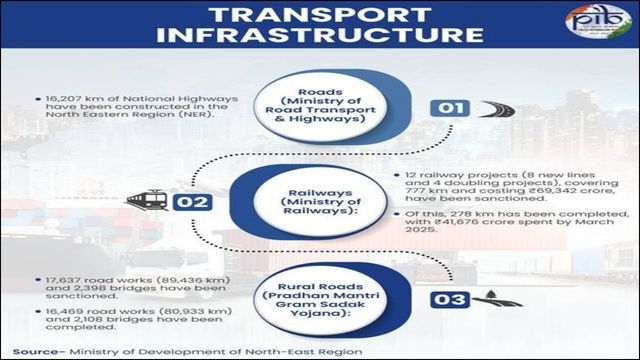
Key outcomes include:
- National Highways expanded from 10,905 km in 2014 to 16,207 km in 2025.
- 278 km of new railway lines were commissioned under PM Gati Shakti.
- Aviation connectivity increased significantly, with the number of operational airports nationwide rising from 74 in 2014 to around 160 by 2024–25, with substantial gains for the Northeast under the UDAN scheme.
- Budgetary allocations for the region rose from ₹36,108 crore in 2014 to ₹94,680 crore in 2023–24.
This physical integration dismantled the logistical isolation that had once sustained insurgent ecosystems and reinforced alienation.
Strategic Geography and Stabilised Borders
The Northeast's security environment has always been shaped by geography. The Siliguri Corridor, or Chicken's Neck, and more than 5,400 km of international borders with China, Myanmar, Bangladesh, Nepal and Bhutan historically amplified vulnerabilities.
In recent years, however, progress has also been made in resolving inter-state boundary disputes that had previously fuelled ethnic tensions:
- The Assam–Meghalaya agreement of 2022 resolved six of twelve disputed sectors.
- The Assam–Arunachal Pradesh agreement of 2023 settled claims over 123 villages.
These developments reduced flashpoints, strengthened cooperative federalism and further weakened the rationale for continued "disturbed area" classifications.
By neutralising insurgency through peace accords, restoring governance through democratic confidence and embedding the region within Bharat's economic and strategic future, the Northeast has moved decisively from insurgency to integration. What was once defined by emergency legislation and counter-insurgency has progressively transformed into a framework centred on stability, connectivity and opportunity.
Written by

Kewali Kabir Jain
Journalism Student, Makhanlal Chaturvedi National University of Journalism and Communication