The Red Shadow over the Hand
Unmasking the Leninist Agitator in Rahul Gandhi
Total Views |


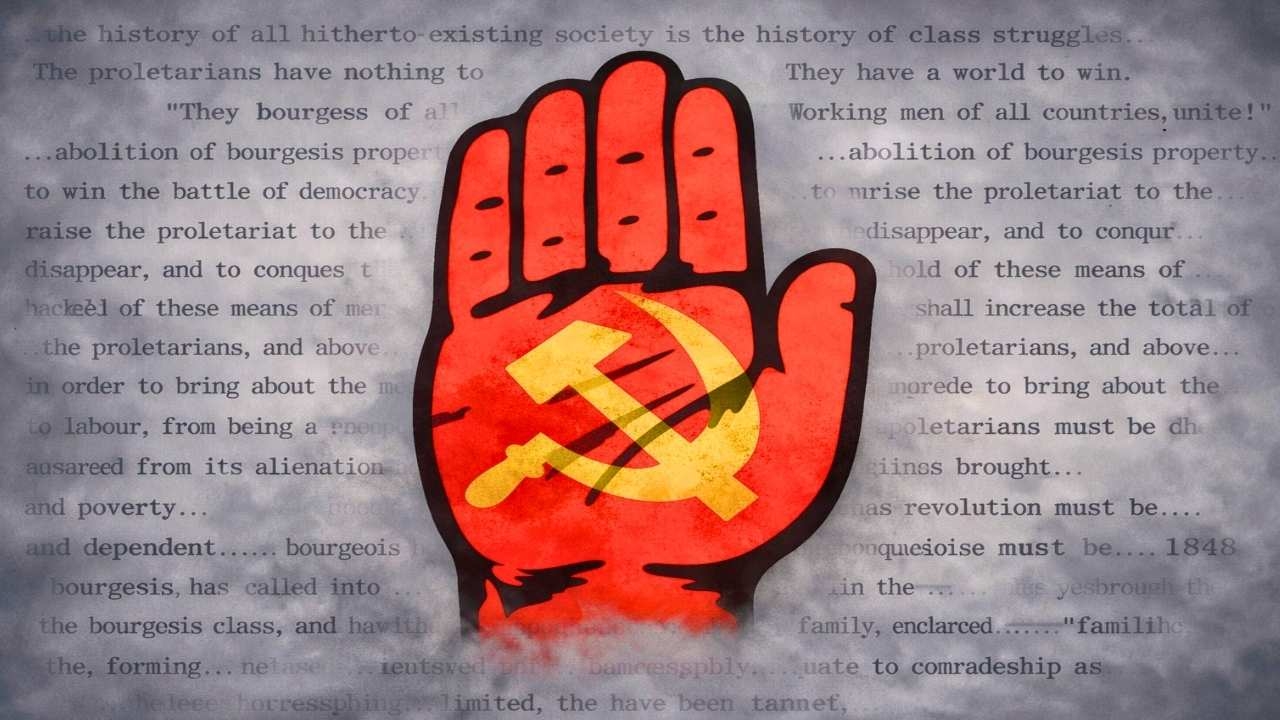
Prime Minister Modi has rebranded the INC as the "MMC – Maoist Muslim Congress", while Home Minister Amit Shah claims "proof" of Congress-Naxal collusion in Chhattisgarh. These are not mere slurs. A forensic comparison of Rahul Gandhi’s agitation with the banned CPI (Maoist)’s 2021 Political Program reveals a chilling structural alignment. From wealth redistribution to caste struggle, read how the Opposition Leader is mirroring the tactical playbook of a Leninist agitator.
THE CHARGE is no longer vague; it is specific, coordinated, and damning. In January, Prime Minister Narendra Modi did not mince words when he rebranded the Grand Old Party not as the INC, but as the "Maoist-Muslim-Congress", signalling a conviction that the party has fundamentally altered its DNA. Then, this past Sunday, February 8, in Raipur, Union Home Minister Amit Shah went a step further. Standing in the heart of the Red Corridor, he declared with "full responsibility" that he possesses proof that the Congress-led government under Bhupesh Baghel (2018 to 2023) had actively sheltered Naxalites, turning the state apparatus into a crutch for insurgents.
For the casual observer, these might sound like the standard hyperboles of an aggressive ruling party. However, if one looks past the political heat, a chilling alignment begins to emerge. A forensic comparison of Rahul Gandhi’s recent agitations with the official "Political Program" adopted by the Communist Party of India (Maoist) in January 2021 reveals that Modi and Shah’s accusations may not be mere rhetoric. When the Leader of the Opposition’s playbook is overlaid with the tactical directives of the banned Maoist outfit, the similarities cease to look like coincidences and begin to look like a shared roadmap for state capture.
The Economics of Seizure: The Congress (Communist?) Manifesto of 2024
The first tremor of this ideological convergence was felt with the Congress party’s aggressive push for a "Caste Census" coupled with a "Financial and Institutional Survey". Rahul Gandhi’s clarion call, “Jitni Abadi, Utna Haq”, was not merely a demand for data. It was a prelude to what he termed "wealth redistribution". This was further compounded when Sam Pitroda floated the concept of an "inheritance tax", a statement the BJP latched onto as proof of Congress’s intent to raid the middle-class nest egg.
While the Congress manifesto was carefully worded, the intent mirrors the explicit directives found in the CPI (Maoist) 2021 Political Program. The Maoist document explicitly calls for the seizure of "surplus lands of the old and the new landlords... big businesspersons... and other such persons" without "any kind of compensation". Rahul Gandhi’s promise to survey and redistribute wealth is a parliamentary sanitisation of the Maoist demand to "seize the investments, banks and properties of all the foreign companies/institutions." Both narratives share a core Marxist axiom: that existing property relations are illegitimate and must be forcibly reset by the state in the name of the "oppressed".
The Corporate Bogeyman: "Adani-Ambani" as State Policy
For years, Rahul Gandhi has centred his political agitation on a singular binary: the people versus "Adani-Ambani". He frames every government policy, from farm laws to port development, as a favour to these specific industrial houses. This specific targeting is not random. It is doctrinal.
The CPI (Maoist) document adopted in 2021 specifically names "Reliance Retail... Tata Croma, Adani Enterprises" as the enemies of the small trader and the working class. It categorises them as "comprador bureaucratic capitalists" who serve "foreign finance capital". The document urges cadres to "fight against all kinds of exploitation by domestic and foreign corporate companies."
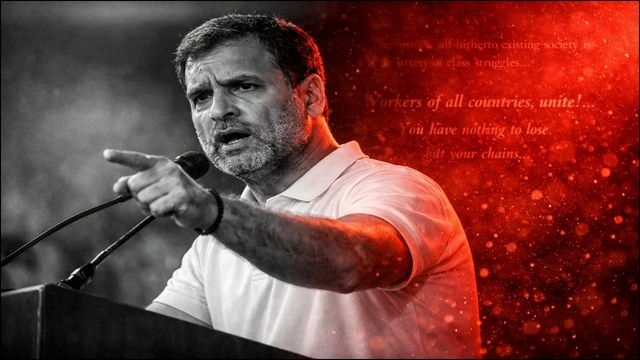
When Rahul Gandhi drove a tractor to Parliament to protest the Farm Laws, framing them as a conspiracy to hand over agriculture to "two or three industrialists," he was engaging in what the Maoists describe as the fight against "contract/corporate/group agriculture." His rhetoric strips away the complexities of market economics and replaces them with a conspiratorial narrative identical to the Maoist claim that the state is merely a manager for "imperialist multinational and comprador companies".
Fracturing the Nation: Caste and Kashmir
Perhaps the most striking parallel lies in the approach to social fault lines. The Maoist programme is built on the strategy of mobilising "oppressed castes" against what they term "Brahmanic Hindutwa fascism". The document explicitly directs its cadres to "resist attacks of the oppressor castes on the Dalit people" and to fight against "Brahmanic Hindutwa communalists".
Rahul Gandhi’s recent pivot to an aggressive anti-Hindutva stance, framing the election as a battle to "save the Constitution" from the RSS/BJP, mirrors the Maoist directive to build a "broad mass-based tactical united front against Brahmanic Hindutva communalism." His categorisation of the nation into a 90% (Dalits, OBCs, Tribals, Minorities) versus 10% (Upper Caste/Elite) binary is a direct application of the Maoist strategy to mobilise the "four revolutionary classes" against the "feudal forces".
On Jammu and Kashmir, the alignment is even more precise. Rahul Gandhi has campaigned vehemently on the narrative that "democratic rights have been taken away." The CPI (Maoist) document lists the "annulment of Articles 370 and 35A" as one of the "anti-people decisions" that must be fought against. It goes further, explicitly calling for the support of "just struggles of the oppressed nationalities in Kashmir... for the right to self-determination." While Gandhi stops short of "self-determination", his framing of the abrogation aligns perfectly with the Maoist agitational goal.
Rahul Gandhi: The Leninist Agitator
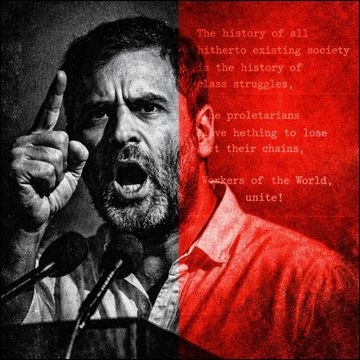
The question then arises: Is Rahul Gandhi simply a politician pivoting to the left, or is he something more specific? To answer this, we must look to Vladimir Lenin.
In his seminal work 'What Is To Be Done?', Lenin distinguishes between the 'propagandist' and the 'agitator'. The propagandist deals in complex ideas presented to a few. The agitator, however, operates differently. Lenin writes:
“The agitator... will take as an illustration the death of an unemployed worker's family from starvation... and utilizing this fact, known to all, will direct his efforts to presenting a single idea to the 'masses'... he will strive to rouse discontent and indignation among the masses against this crying injustice... Agitation must be conducted with regard to every example of this oppression.”
Rahul Gandhi has shed the skin of a parliamentarian and donned the mantle of the Leninist agitator. He does not engage in debates on the technicalities of the Waqf Bill or the fiscal deficit. Instead, he seizes upon "living examples" such as the women wrestlers on the street, the victims of violence in Manipur, or the unemployed youth to "rouse discontent and indignation".
When he speaks in the US, claiming "The fear of Modi is gone," he is using the tactic of 'exposure', aimed at breaking the psychological hold of the state. When he frames the Waqf Bill not as legislation but as a "weapon aimed at marginalising Muslims", he is following the Maoist dictum that "a blunt knife draws no blood". His rhetoric is sharpened to draw political blood, to create a binary of "Justice vs. Injustice", forcing the masses to choose a side.
The Radical Convergence
The similarities between Rahul Gandhi’s agitation and the CPI (Maoist) programme are not merely cosmetic; they are structural. Both seek to delegitimise the current Indian state by framing it as a "fascist" entity run by "Brahmanic" forces and corporate oligarchs. Both prioritise the mobilisation of caste identity as a revolutionary vehicle.
In the Maoist worldview, the "parliamentary parties" are usually dismissed as "traitors". However, the 2021 document also hints at a tactical flexibility, advising cadres to "work together with the revisionist parties... tactically only on the basis of issues." One must ask: has the Congress party, in its desperation to dislodge the BJP, allowed itself to become the parliamentary face of this radical tactical front?
As India moves deeper into 2026, the people must recognise that the rhetoric emanating from the Opposition leader is no longer just political discourse. It is a faithful echo of the hills of Dandakaranya, a strategy of agitation designed not just to win an election but to dismantle the existing social and economic order. The "Hand" may still be the symbol, but the shadow cast upon it is unmistakably red.