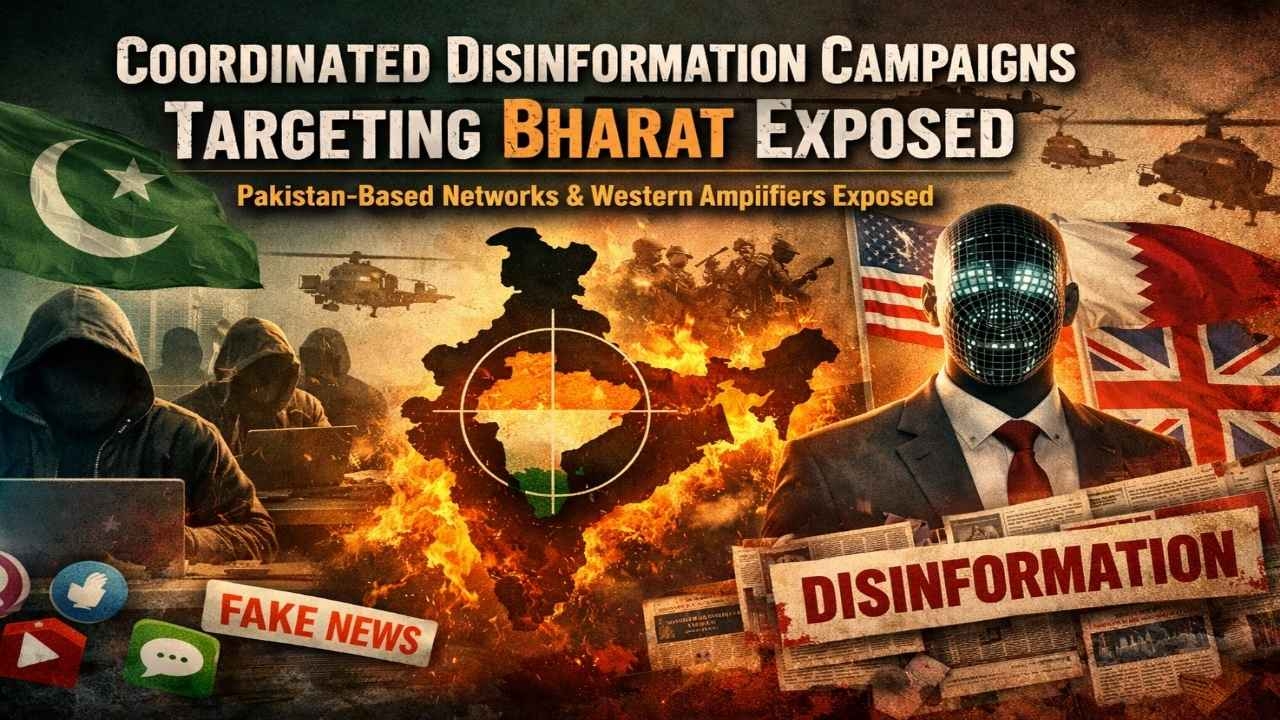
Coordinated Disinformation Campaigns Targeting Bharat Exposed
Evidence shows Pakistan-based networks generated most false narratives, later amplified by coordinated accounts in Western and Gulf countries to give global reach and legitimacy.
Total Views |


The International Fact-Check Report released in January 2026 exposes a coordinated and sustained disinformation campaign targeting Bharat. The report documents 52 distinct cases of verified misinformation identified and debunked during the month. These cases appeared across social media platforms, digital news portals, and video-sharing websites. The scale, consistency, and thematic focus of the content indicate that the campaign was deliberate and organised, rather than accidental or sporadic. The findings point towards a structured information warfare strategy aimed at undermining national institutions and public confidence.
Pakistan Identified as the Primary Source of False Narratives
The report identifies Pakistan as the principal source of the misinformation. Around 81 per cent of the total cases, amounting to 42 out of 52 incidents, originated from Pakistan-based social media handles, digital portals, and coordinated influencer networks.
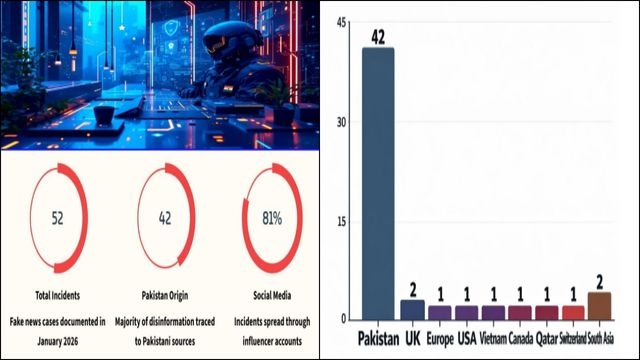
The remaining content did not emerge independently but gained momentum through amplification by accounts operating from the United Kingdom, the United States, Canada, Malaysia, and Qatar. This pattern suggests the use of proxy amplification to provide international reach and credibility to fabricated narratives that originated elsewhere.
Defence and Internal Security as the Main Targets
Defence and internal security emerged as the most targeted sectors in the disinformation campaign. Nearly 38 per cent of the total cases, approximately 20 incidents, focused on Bharat’s armed forces and security operations. These false narratives included claims of imaginary military losses, fabricated encounters, and deepfake videos falsely attributed to senior officers of the Indian Armed Forces.
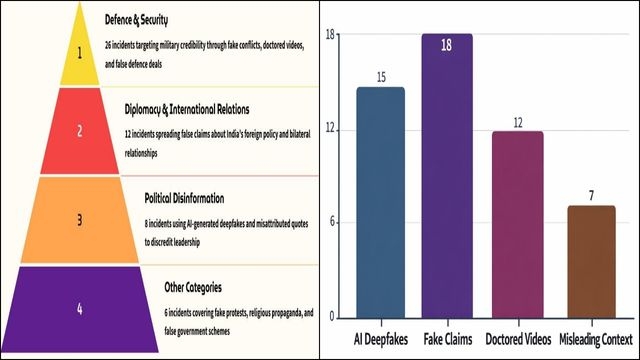
In several cases, old or unrelated visuals were deliberately recycled and presented as recent evidence of casualties or operational failures. The intent behind these narratives appeared to be the erosion of public trust in Bharat’s security institutions.
Diplomatic Misinformation Aimed at Projecting Isolation
Foreign policy and international relations accounted for around 21 per cent of the misinformation cases, covering 11 incidents. These narratives falsely claimed that Bharat was losing support from key global partners or withdrawing from major international initiatives. Fabricated stories involving countries such as Iran, Saudi Arabia, Poland, and the United States circulated widely to suggest diplomatic isolation. The report notes that these claims directly contradicted verifiable facts and ongoing diplomatic engagements, indicating a calculated attempt to distort Bharat’s global standing.
Rise in Political and Social Disinformation
The report also highlights a significant increase in politically and socially motivated misinformation. About 27 per cent of the total cases, representing 14 incidents, fell into this category. These included deepfake statements falsely attributed to national leaders, manipulated visuals of protests, and misleading claims designed to exaggerate internal unrest.
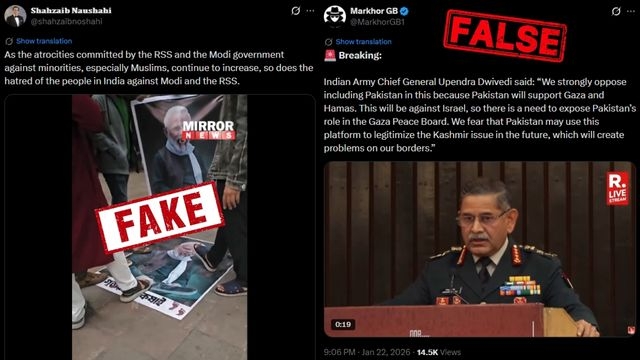
Such content sought to inflame social divisions, provoke distrust, and create a perception of widespread instability within the country.
Deepfakes and Digital Manipulation as Key Tactics
One of the most concerning trends identified in the report is the growing reliance on advanced digital manipulation. More than 55 per cent of the misinformation cases involved edited images, manipulated videos, or AI-generated deepfakes.
This shift marks a clear move away from text-based falsehoods towards visually persuasive propaganda. The use of high-impact visual content increases the difficulty of detection and enhances the credibility of deceptive narratives among unsuspecting audiences.
Fact-Checking and Institutional Response
Despite the scale and sophistication of the campaign, timely interventions played a critical role in limiting its impact. Government bodies such as the Press Information Bureau Fact Check and the Ministry of External Affairs Fact Check, along with independent verification platforms, successfully debunked all 52 cases. In several instances, rapid fact-checking prevented misinformation from gaining wider traction. The report underscores the importance of swift institutional responses and coordinated verification efforts in safeguarding the digital information ecosystem.
Overall, the January 2026 International Fact-Check Report presents clear evidence of a structured and technologically driven disinformation campaign against Bharat. It also highlights the growing importance of vigilance, institutional readiness, and public awareness in countering organised information warfare.
Written by

Kewali Kabir Jain
Journalism Student, Makhanlal Chaturvedi National University of Journalism and Communication