How Bharat Took the Fight to Terror and Naxal Networks
Surgical strikes, stronger intelligence networks and anti-Naxal operations marked a major shift in Bharat’s approach to national and internal security.
Total Views |


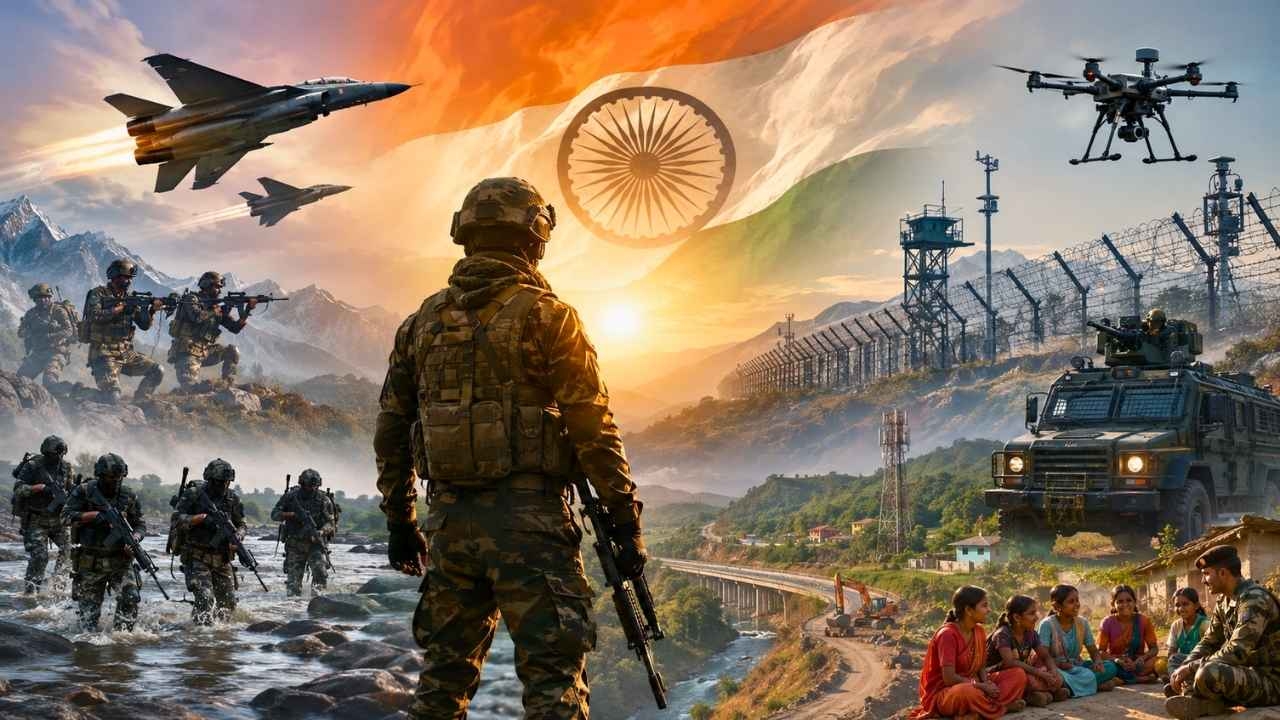
Bharat's national security architecture has undergone a monumental paradigm shift over the past decade under Prime Minister Narendra Modi's leadership. Shedding the historical posture of "strategic restraint", the nation has pivoted towards a proactive, multi-dimensional defence strategy. This transformation is anchored in an uncompromising zero-tolerance policy towards terrorism, the application of active deterrence through surgical strikes, and the systematic, near-total eradication of Left-Wing Extremism (Naxalism).
By synergising kinetic military operations, robust legislative frameworks, diplomatic isolation of adversaries, and grassroots socio-economic development, Bharat is decisively dismantling the forces threatening its internal sovereignty.
Part I: The Zero-Tolerance Policy and the Dismantling of Terrorism
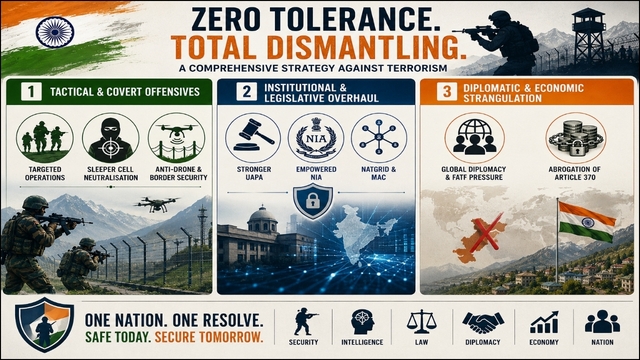
The Indian state has categorically established that terrorism, in any manifestation, will be met with overwhelming state action. The strategy goes beyond merely neutralising terrorists; it focuses on destroying the entire ecosystem that sustains them, including financiers, overground workers (OGWs), radicalisers, and cross-border handlers.
1. Tactical and Covert Offensives
Operation All Out: Launched in Jammu and Kashmir (J&K), this joint offensive by the Indian Army, CRPF, and J&K Police systematically targeted and eliminated top-tier terror commanders, severely crippling outfits such as Lashkar-e-Taiba (LeT) and Hizbul Mujahideen.
Operation Sindoor: A highly specialised and targeted operational framework designed to identify, isolate, and neutralise deeply embedded sleeper cells and terror syndicates. Such covert, intelligence-led sweeps have been instrumental in preventing urban terror attacks and breaking the logistical backbone of extremist networks before they can execute their plans.
Border Fortification and Anti-Drone Technology: To counter the modern threat of cross-border smuggling of weapons and narcotics via drones, Bharat has deployed advanced anti-drone systems, thermal imaging equipment, and smart fencing along the volatile western frontier.
2. Institutional and Legislative Overhaul
Strengthening the UAPA: The Unlawful Activities (Prevention) Act was amended to allow the government to designate individuals as terrorists, preventing them from simply dissolving one banned outfit and creating another.
Empowering the NIA: The National Investigation Agency (NIA) has been granted expanded territorial jurisdiction, enabling it to investigate cyber terrorism and human trafficking linked to terror networks. The agency currently maintains a conviction rate of over 95 per cent.
NATGRID and MAC: The revitalisation of the National Intelligence Grid (NATGRID) and the Multi-Agency Centre (MAC) has ensured seamless, real-time intelligence sharing across state and central security agencies.
3. Diplomatic and Economic Strangulation
Global FATF Diplomacy: Bharat led a relentless diplomatic campaign to expose state-sponsored terrorism at international forums. This sustained pressure proved pivotal in keeping Pakistan on the Financial Action Task Force (FATF) Grey List for years, severely restricting its access to global financial markets and choking funding channels to proxy terror outfits.
The Abrogation of Article 370: The political integration of J&K in 2019 dealt a significant blow to the separatist ecosystem. By bringing the region under direct central governance, the state dismantled the intricate networks of terror financing and hawala operations that had thrived there for decades.
Part II: Surgical Strikes and the Doctrine of Active Deterrence
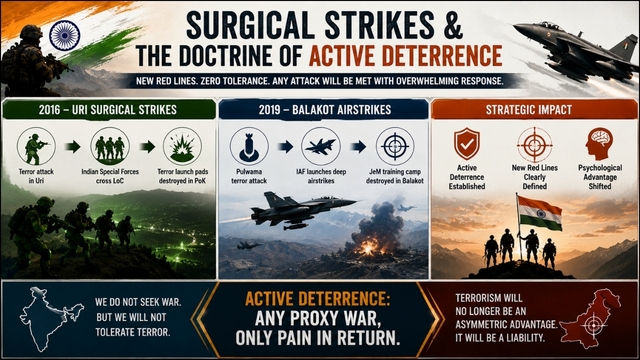
For decades, non-state actors and hostile neighbours exploited Bharat's hesitation to cross borders, using terrorism as an asymmetric instrument of state policy. This defensive posture was permanently abandoned in the late 2010s.
The 2016 Uri Surgical Strikes: Following a devastating attack on an Army base in Uri, Indian Special Forces executed precise cross-Line of Control (LoC) raids into Pakistan-occupied Kashmir (PoK), destroying multiple terror launch pads.
The 2019 Balakot Airstrikes: In response to the Pulwama suicide bombing, the Indian Air Force launched pre-emptive, deep-penetration airstrikes against a major Jaish-e-Mohammed (JeM) training facility in Balakot, Pakistan.
The Strategic Impact: These actions gave rise to the doctrine of Active Deterrence. By establishing new red lines, Bharat demonstrated the political will and military capability to impose severe kinetic costs on its adversaries. The psychological advantage has shifted decisively, proving that the use of proxy terrorism will no longer go unanswered.
Part III: The Near-Eradication of Left-Wing Extremism (Naxalism)
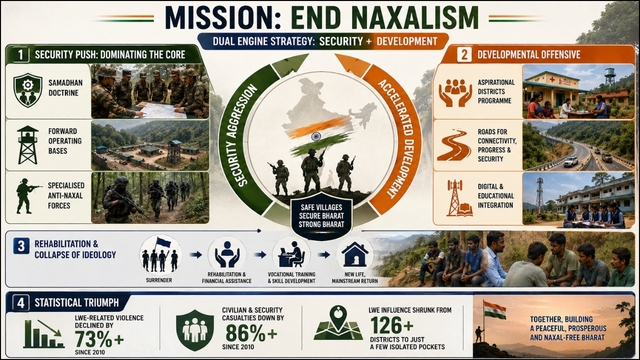
Once regarded as Bharat's gravest internal security threat, Left-Wing Extremism (LWE), commonly known as Naxalism, is now experiencing rapid territorial and organisational collapse. The Red Corridor, which once spanned heavily forested regions across central and eastern Bharat, has shrunk dramatically. The government's masterstroke has been a dual-engine approach combining Security Aggression with Accelerated Development.
1. The Security Push: Dominating the Core
The SAMADHAN Doctrine: Introduced by the Ministry of Home Affairs, this comprehensive strategy encompasses Smart Leadership, Aggressive Strategy, Motivation and Training, Actionable Intelligence, Dashboard-Based Key Performance Indicators, Harnessing Technology, Action Plans for Each Theatre, and No Access to Financing.
Forward Operating Bases (FOBs): Security forces have penetrated the deepest Maoist strongholds, including the Abujhmad forests of Chhattisgarh, by establishing fortified FOBs. These camps have disrupted Maoist supply lines and enabled the reclamation of territory.
Specialised Anti-Naxal Forces: The deployment of highly trained units such as the Greyhounds of Andhra Pradesh and Telangana and the CoBRA (Commando Battalion for Resolute Action) has transformed anti-Naxal operations. Additionally, the CRPF raised the Bastariya Battalion, recruiting local tribal youth to leverage their knowledge of the terrain and language.
2. The Developmental Offensive
Aspirational Districts Programme: The government focused on rapidly improving socio-economic indicators in the most LWE-affected districts, bringing healthcare, electricity, banking, and other essential services to highly marginalised tribal populations.
RCPLWEA (Road Connectivity Project for Left-Wing Extremism Affected Areas): Thousands of kilometres of all-weather roads have been constructed across LWE-affected regions. These roads not only facilitate the swift movement of security forces but also integrate remote villages with local markets and economic opportunities.
Digital and Educational Integration: More than 2,300 mobile telecom towers have been installed to bridge the communication gap. Furthermore, Ekalavya Model Residential Schools have been established to provide quality education to tribal children, shielding them from Maoist indoctrination.
3. Rehabilitation and the Collapse of Ideology
Lucrative Surrender Policies: State governments, backed by the Centre, have introduced robust surrender and rehabilitation packages. These include financial assistance, vocational training, and housing support, leading to the surrender of thousands of disillusioned cadres.
4. Statistical Triumph
The results are undeniable. Since 2010, LWE-related violence has declined by more than 73 per cent. Civilian and security personnel casualties have fallen by 86 per cent. The geographic spread of Naxal influence has contracted from more than 126 districts to only a few deeply isolated pockets today.
Conclusion
Bharat's contemporary security narrative is one of unyielding resolve. By operationalising active deterrence through surgical strikes, suffocating the terror ecosystem through sweeping tactical and legislative reforms, and neutralising the Maoist insurgency through a firm yet development-oriented approach, Bharat has secured its internal frontiers like never before.
Written by

Kewali Kabir Jain
Journalism Student, Makhanlal Chaturvedi National University of Journalism and Communication