Bharat's Higher Judiciary: Collegium System Breeds Arrogance
Has the collegium system created a judiciary that operates without accountability, transparency, or constitutional restraint while remaining insulated from public scrutiny?
Total Views |


I am a 79-year-old war veteran. I keep wondering why our judges behave the way they do. Have they unilaterally appropriated powers to become the supreme authority in the country, even above the Constitution?
Why do judges think they have a right to scold, threaten, or use offensive language against the citizens of this country? Under what law can a judge threaten to rip a citizen apart? In another case, instead of appreciating the threat faced by a lady, she was publicly castigated: "She faces threats or she has become a security threat?" and "It is shameful. She should apologise to the whole country!"
It is only in Bharat that the highest court grants unsolicited bail to an accused in a financial misdemeanour case to carry out election campaigning. A woman activist was granted bail late in the evening by constituting two benches. Consider also the wilful humiliation of a world-renowned exponent of Yoga and Ayurveda, ostensibly at the bidding of the anti-Ayurveda lobby.
The most striking aspect of the judges' conduct is that they never practise what they preach. They repeatedly stress the need for transparency in every sphere, yet collegium proceedings and declarations of judges' personal assets remain shrouded in secrecy. Apparently, transparency is for others and not for judges who consider themselves beyond reproach.
A word about their haughty demeanour is warranted here. The infamous collegium system is to blame for this malaise afflicting our higher judiciary. Bharat is the only country where judges select themselves in a secret conclave.
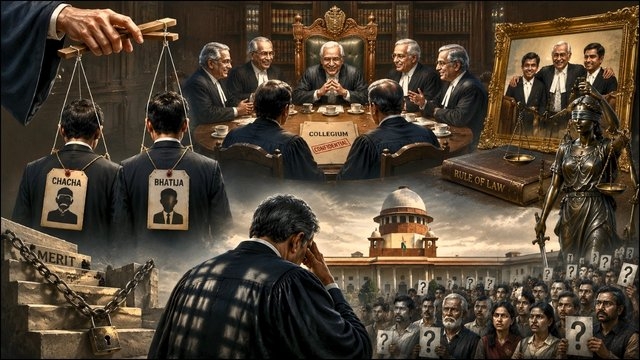
The judges know that they owe their selection to parochial 'Chacha-Bhatija' nepotism rather than to any merit-based process. Worse, they know that the countrymen know it as well. Although judges may not appear apologetic in public, subconsciously they feel embarrassed about their mode of selection, making them suffer from an inferiority complex.
An inferiority complex is characterised by constant feelings of inadequacy. When an individual finds himself ill-equipped to occupy a position, an acute sense of inferiority can affect his psychology. The malady becomes pathological when this feeling of inadequacy overwhelms the personality and causes unbecoming behaviour.
It is universally accepted that an outward display of superiority or arrogance is often a psychological defence mechanism used to conceal feelings of inferiority. The resulting urge to masquerade as a superior and confident being causes many individuals to develop a hubristic demeanour. This explains the behaviour of our judges.
Urgent Need for Corrective Steps
Bharat can never thrive as a vibrant democracy if the higher judiciary is perceived to be failing the country. Therefore, the time has come to take some radical corrective steps.
First of all, the nomenclature "Supreme Court of India" is incongruous. In fact, it is illogical and misleading. The term "Supreme" conveys unbridled power and ultimate authority. It gives judges a false sense of supremacy, leading them to believe that they are truly supreme and that no one is above them.

In a democracy, only the people are supreme. "We, the People of India" have given ourselves a Constitution, and the judiciary is a creation of that Constitution. How can the Supreme Court of Bharat be supreme when it owes its creation and very existence to the will of the people? Moreover, public tax revenue finances judges' salaries, perks, and pensions. They are employees of the country, not its masters. The people have a right to question their performance. Instead of invoking "contempt of court", the judiciary should be held accountable for "contempt of the people" whenever it resorts to inappropriate conduct.
Therefore, it is strongly suggested that the Supreme Court be stripped of the word "Supreme". Only the people of the country are supreme, and the judiciary is answerable to them. It would be more appropriate to call it the Apex Court of Bharat.
Second, the collegium system must be abolished. It is an anathema to democracy and symptomatic of acute judicial superciliousness. When the Supreme Court annulled the National Judicial Appointments Commission (NJAC) Act and the 99th Constitutional Amendment in October 2015, it dealt a severe blow to constitutional and judicial propriety by adjudicating a matter in which it had a direct institutional interest. This was despite the well-established principle of natural justice, Nemo iudex in causa sua, meaning that no person shall be a judge in his own cause.
Third, the power to legislate laws rests with the legislature. The judiciary should not have the power to overrule a law passed by Parliament except in exceptional constitutional circumstances. It cannot usurp the authority of the people's elected representatives. Take the case of Electoral Bonds. How can five self-opinionated judges conclude that they possess greater wisdom than all the duly elected representatives of the people? The apex court should intervene only when the fundamental structure or essence of the Constitution is affected.
Fourth, far too much time is wasted entertaining infructuous Public Interest Litigations (PILs). Filing PILs has become an industry, and a remunerative one at that. A vast ecosystem thrives on it. There exists a coterie of senior, well-connected advocates who benefit from such litigation. Courts know that many PILs have become tools for settling political scores, yet such petitions continue to be admitted, consuming valuable judicial time.
Fifth, judges should confine themselves to legal matters. By failing to distinguish between social evils and matters of faith, they unnecessarily generated animosity among various sections of society in the Sabarimala case. Their intervention in the Shaheen Bagh blockade and the farmers' agitation created immense difficulties for the government and restricted its ability to find speedy solutions. Some of their verbal observations on unrelated matters continue to surprise observers.
Sixth, there should be an annual performance audit of the judiciary conducted by an independent statutory body. The people of this country have a right to know why there is such a massive backlog of court cases. Lakhs of litigants continue to suffer delays. Can the judiciary explain such an abysmal state of affairs? What steps are being taken to expedite pending cases?
Finally, there is a need to change with the times. Bharat's higher judiciary continues to follow a dress code prescribed by the British. Dress exerts a profound psychological and behavioural influence on the wearer. Black coats may encourage judges to view themselves as demi-gods, elevating themselves above others and fostering a sense of invincible superiority and the arrogance associated with it. Why cannot judges wear a less intimidating form of attire?
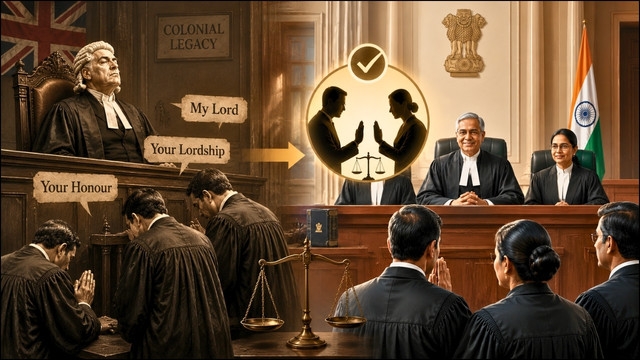
Similarly, why continue with salutations such as "My Lord", "Your Lordship", or "Your Honour"? Such terms are relics of the colonial era and symbols of subservience. The only requirement is that judges be addressed respectfully and with dignity.
Finally
In broad terms, a coup is defined as an illegal seizure of power. While coups are generally associated with the overthrow of constitutionally established governments by the military, there are many other forms of unilateral power grabs. According to Wikipedia, such transgressions are often described as coups with qualifying adjectives. A judicial coup falls within this category. It implies an unconstitutional usurpation of power by the judiciary. The collegium system is nothing but a de facto judicial coup with serious constitutional implications. The judiciary has hijacked the system and become the uncrowned ruler of the country. The then Finance Minister, Arun Jaitley, aptly described it as the "tyranny of the unelected".
Finally, the judiciary must appreciate that respect and trust cannot be extracted through coercion or the threat of contempt proceedings. They must be earned through transparent and above-board conduct. Equally important, the judiciary must understand that it is not empowered to administer the state. Only the people's elected representatives receive a mandate to govern the country, and that is the essence of democracy.
Written by

Major General Mrinal Suman (Retd)
AVSM, VSM, PhD, commanded an Engineer Regiment in the Siachen-Kargil sector. He was also the Task Force Commander at Pokhran and was responsible for designing and sinking shafts for the nuclear tests of May 1998. He is a highly qualified officer – B Tech, MA (Pub Adm), MSc (Def Studies) and Doctorate in Public Administration. He is a prolific writer having published nine books and over 550 articles.