Decolonising the Indian Mind: Reclaiming Bharat’s Civilisational Narrative from Colonial and Marxist Distortions
Colonial education and post-Independence ideological historiography reshaped how Indians understood their own past. Today, Bharat’s civilisational narrative is being reclaimed from those inherited frameworks.
Total Views |


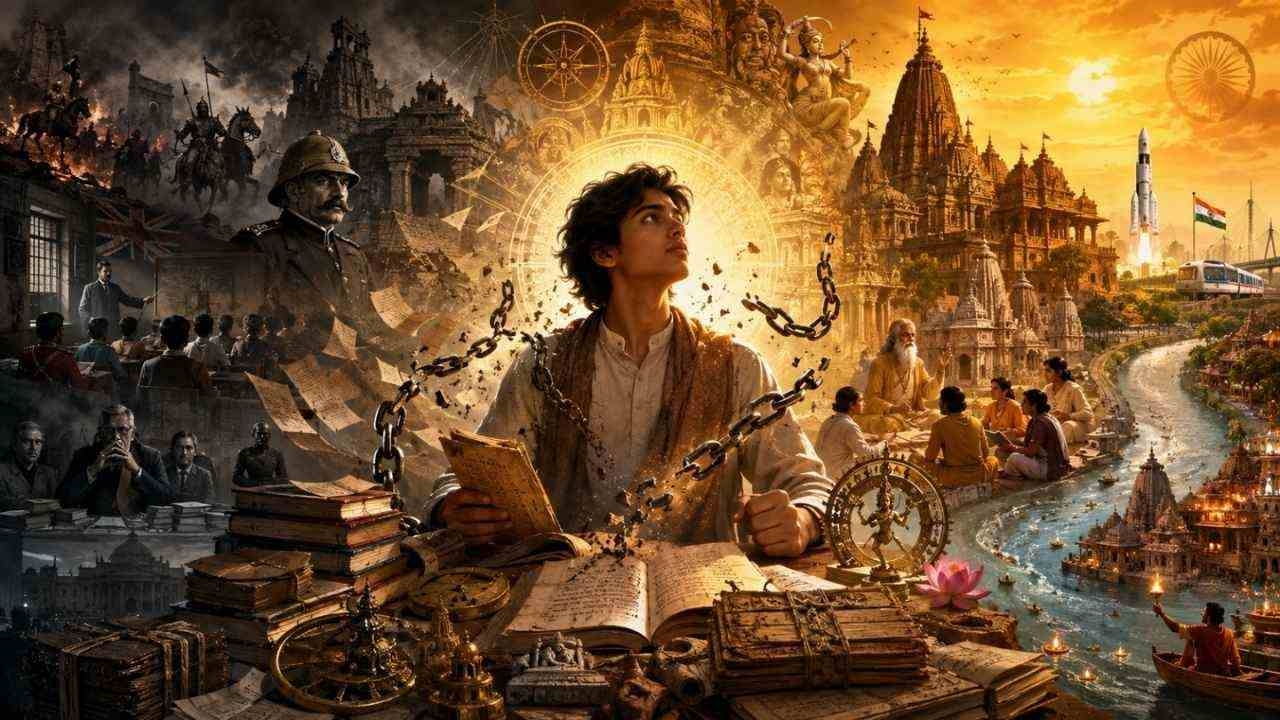
For nearly two centuries, the Indian psyche has been shaped by successive layers of imposed narratives, first Islamic conquests that disrupted indigenous polities and temple-centred societies, then British colonial rule that systematically denigrated native knowledge systems, and finally a post-1947 academic establishment dominated by Marxist historians who institutionalised a selective, ideologically driven historiography.
The result led to generations of Indians taught to view Bharat’s civilisational achievements with embarrassment, to romanticise invaders, and to internalise a sense of perpetual subjugation. Since 2014, under the Prime Minister Narendra Modi’s leadership, a deliberate project of cognitive decolonisation has accelerated, embodied in the Panch Pran (five pledges) articulated in the 2022 Independence Day address: building a Viksit Bharat, shedding the colonial mindset, taking pride in heritage, fostering unity, and prioritising duties.
Roots of Cognitive Colonisation: Macaulay to Nehru
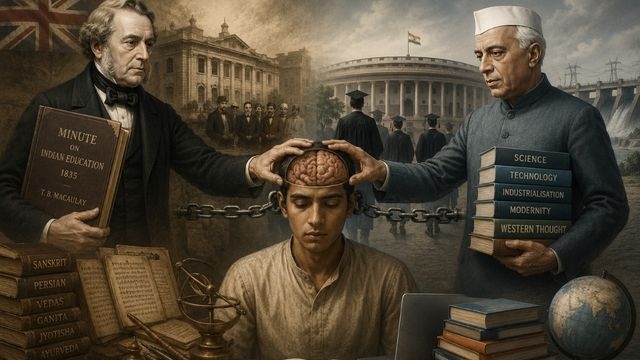
Thomas Babington Macaulay’s 1835 Minute on education remains the foundational document of mental colonisation. His explicit aim was to create “a class of persons, Indian in blood and colour, but English in taste, in opinions, in morals, and in intellect.” Indigenous systems of learning Sanskrit, Persian, vernacular traditions, and knowledge of mathematics, astronomy, metallurgy, and philosophy were dismissed as inferior. English was imposed as the language of power, administration, and elite aspiration. Post-Independence, this framework persisted under Nehruvian modernity.
The Marxist Capture of Historiography
After Independence, control of key institutions the Indian Council of Historical Research (ICHR), National Council of Educational Research and Training (NCERT), and university history departments passed largely to a network of left-leaning, often explicitly Marxist scholars.
Figures such as Romila Thapar, Irfan Habib, R.S. Sharma, Bipan Chandra, Satish Chandra, and D.N. Jha shaped school textbooks and academic discourse for decades.
Arun Shourie seminal 1998 book Eminent Historians: Their Technology, Their Line, Their Fraud documented how this group acquired institutional power, suppressed alternative scholarship, and produced narratives that inverted historical realities.
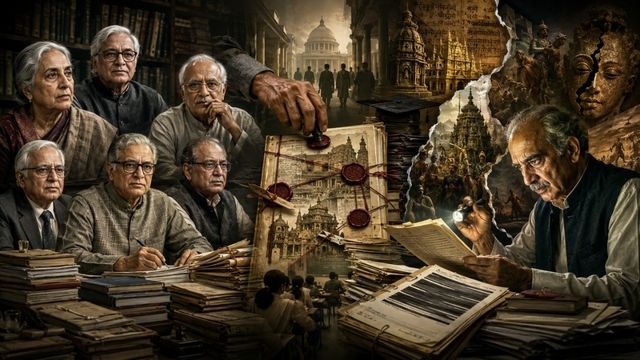
Key patterns of distortion, as critiqued by Shourie, Sita Ram Goel, K.S. Lal, and others, include:
Whitewashing of Islamic invasions and temple destruction. Primary Persian sources like contemporary chronicles have repeatedly celebrated the destruction of temples, iconoclasm, massacres, and forced conversions as religiously meritorious acts. Mahmud of Ghazni’s raids on Somnath, Bakhtiyar Khilji’s destruction of Nalanda and other centres of learning, and Aurangzeb’s documented temple demolitions and reimposition of “Jizya” were systematically minimised or explained away as political rather than religious.
West Bengal’s Left Front government in 1989 issued circulars instructing that “Muslim rule should never attract any criticism” and that “destruction of temples by Muslim rulers and invaders should not be mentioned.” Similar directives shaped NCERT content. In contrast, the same historians amplified rare instances of Hindu kings desecrating temples of rivals (a political practice of asserting sovereignty common across medieval polities) to claim moral equivalence.
Marginalisation of Indigenous Resistance and Hindu Achievements :
Figures such as Maharana Pratap, Chhatrapati Shivaji Maharaj, the Vijayanagara Empire, Ahom warriors, Lachit Borphukan, and countless regional resistance figures were reduced to footnotes or “regional leaders.”
Ancient India’s scientific, philosophical, and economic accomplishments were underplayed in favour of economic-determinist frameworks that emphasised class conflict and portrayed the caste system as the defining feature of “Hindu” society.
Aryan Invasion Theory and Civilisational Discontinuity:
The Aryan invasion/migration theory (now largely abandoned or heavily qualified even by many of its earlier proponents) was used to portray Vedic culture as foreign, severing continuity between the Indus-Saraswati civilisation and later Indian traditions. The Saraswati river was dismissed as mythical by some Marxist historians despite hydrological and archaeological evidence.
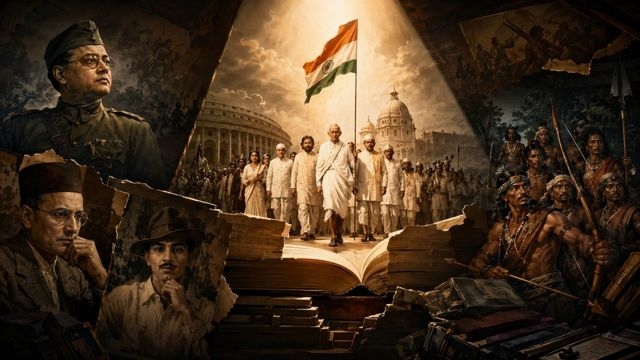
Freedom struggle narrative: Revolutionary nationalists and figures outside the Congress mainstream (Subhas Chandra Bose, Veer Savarkar, Bhagat Singh in certain contexts, Vanvasi leaders) were often sidelined or pathologised, while a narrow Congress-centric story was privileged.
Shourie and others noted the irony that Soviet histories of India were often more candid about Islamic conquests and less ideologically contorted than Indian Marxist textbooks. The monopoly was maintained through control of appointments, funding, and the pejorative labelling of dissenting scholars as “communal” or “non-historians.”
Concrete Decolonisation Measures Since 2014
The Modi government has pursued both symbolic and structural changes.
Renaming and reclaiming spaces has been one of the most visible expressions of this shift. The grand ceremonial avenue once known as Rajpath, a clear reminder of imperial power, was renamed Kartavya Path to place duty at the centre of public life.
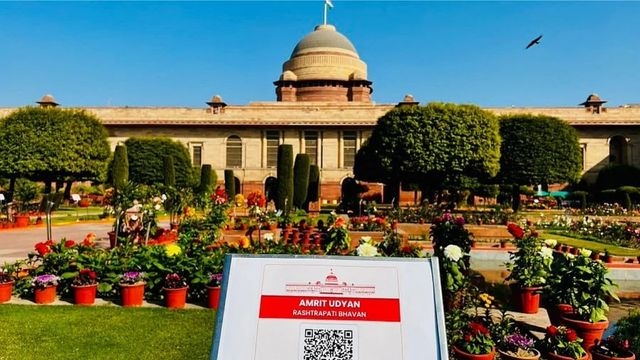
The Mughal Gardens at Rashtrapati Bhavan became Amrit Udyan, Race Course Road was changed to Lok Kalyan Marg, and Aurangzeb Road was renamed after Dr. A.P.J. Abdul Kalam.
In the Andaman and Nicobar Islands, colonial names were systematically replaced: Ross Island became Netaji Subhash Chandra Bose Dweep, Neil Island turned into Shaheed Dweep, Havelock Island was rechristened Swaraj Dweep, and in 2024 Port Blair itself was renamed Sri Vijaya Puram, while twenty-one islands were given the names of Param Vir Chakra awardees.
The Indian Navy discarded the colonial St. George’s Cross from its ensign and adopted a design that draws on Chhatrapati Shivaji Maharaj’s maritime legacy. Even the Beating the Retreat ceremony began featuring Indian instruments sitar, santoor and tabla instead of remaining locked in older colonial forms.
On the legal and institutional front, long-standing colonial practices were quietly set aside. The separate Railway Budget and British-era tradition, was merged with the Union Budget in 2017.
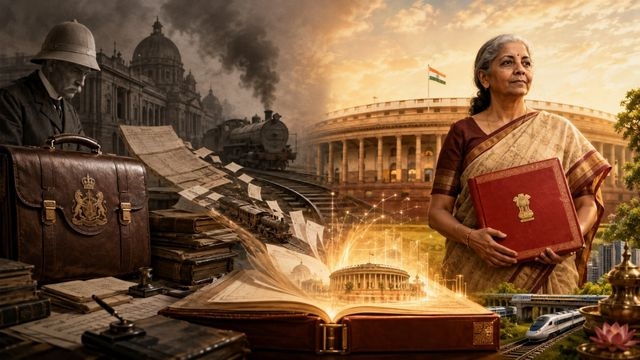
The Finance Minister began presenting the Budget with a traditional bahi-khata rather than the colonial briefcase.
The Indian Penal Code of 1860, the Code of Criminal Procedure and the Indian Evidence Act were replaced by the Bharatiya Nyaya Sanhita, Bharatiya Nagarik Suraksha Sanhita and Bharatiya Sakshya Adhiniyam, framed as laws that prioritise justice rooted in Indian values. Hundreds of obsolete British-era statutes were simply repealed.
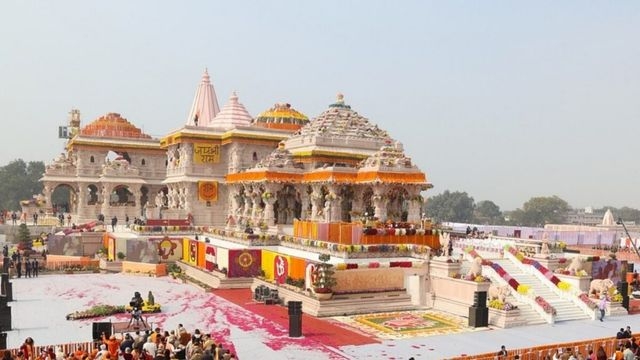
Cultural and heritage revival has been equally purposeful. The consecration of the Shri Ram Temple in Ayodhya in 2024 fulfilled a civilisational aspirations that had endured for five centuries. The Kashi Vishwanath Dham was redeveloped to create an open, unhindered path between the temple and the Ganga. At Pavagadh, the Shikhar Dhwaj was unfurled at the Kalika Mata Temple after five hundred years.
New national monuments including the Statue of Unity honoring Sardar Patel, the National War Memorial, the grand statue of Netaji at India Gate, and the Birsa Munda memorial have brought forgotten or under-celebrated heroes into the public imagination. This renewed recognition is further marked by the declaration of Janjatiya Gaurav Divas and nationwide tributes to iconic figures like Rani Gaidinliu and Lachit Borphukan.
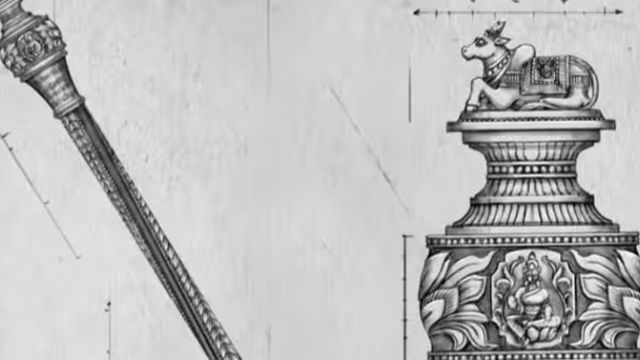
The Sengol was installed in the new Parliament building as a living symbol of the transfer of power drawn from Tamil and broader Indian tradition. More than 640 antiquities were brought back to India.
Yoga, Ayurveda and other traditional knowledge systems received fresh institutional support through International Yoga Day and the Ministry of Ayush.
The National Education Policy of 2020 placed Indian knowledge systems and mother-tongue instruction at the centre of schooling, deliberately reducing the weight of colonial pedagogical frameworks.
Written by
Kewali Kabir Jain
Journalism Student, Makhanlal Chaturvedi National University of Journalism and Communication