From Biases to Propaganda: The Wire Engineering Misleading Narratives Against Bharat
The Wire’s reporting pattern reveals repeated inaccuracies and ideological selectivity that consistently shape public opinion against Bharat while weakening trust in credible institutional findings.
Total Views |


The Wire, founded in 2015 by Siddharth Varadarajan, has emerged as a controversial news outlet accused of consistently peddling anti-Bharat and anti-Hindu narratives. Over the years, the platform has gained notoriety for its role in spreading misinformation, often with an apparent bias against the government and Hindutva ideologies. While masquerading as an independent news source, The Wire has been implicated multiple times in propagating falsehoods and sensational claims, undermining public trust in institutions and fuelling communal tensions.
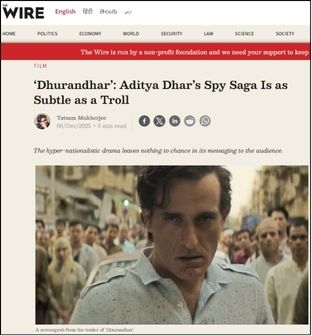
Over the years, a recurring pattern has emerged in the reportage of The Wire, where several stories were published with questionable sourcing, distorted context, or overt ideological framing. The most recent instance surfaced on 06 December 2025, when the portal heavily criticised Dhurandhar Films for using 26/11 transcripts in their storytelling while simultaneously praising the film Pathaan as an artistic representation of “love” despite its glamorisation of a RAW–ISI romance. This discrepancy reflects a broader inconsistency in the portal’s cultural criticism. A day earlier, on 05 December 2025, The Wire published an article alleging that the Indian government proposed mandatory always-on location tracking on mobile phones. In reality, the core proposal originated from telecom operators, as indicated by the original Reuters report; however, the portal reframed the headline to suggest direct governmental overreach. On 26 November 2025, another misleading claim asserted that the newly built Shri Mata Vaishno Devi Institute of Medical Excellence had received ₹121 crore from the J&K government. The actual grant was given to the university (SMVDU), not the hospital, making the attribution fundamentally incorrect.
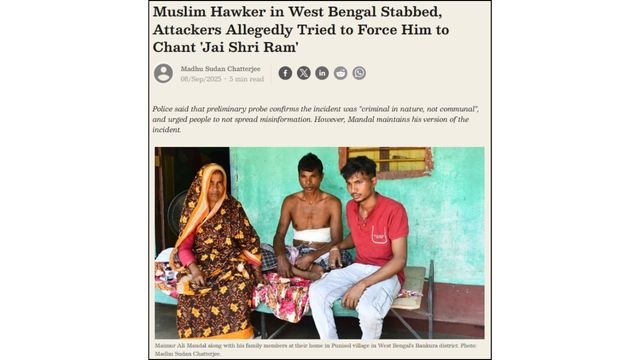
In September 2025, The Wire reported that a Muslim hawker in Bankura was stabbed and forced to chant “Jai Shri Ram”. The Bankura Police investigation found no such communal angle; the attack was criminal, not religious. Later in August, the portal framed Amit Shah’s remarks on the Salwa Judum verdict in a highly politicised manner, implying that constitutional checks had aided Naxals, which was an interpretation rather than a fact. The same month, The Wire published a story claiming severe voter-registration irregularities in Bihar, including tens of thousands of voters linked to a few hundred addresses. In truth, the Election Commission found only a handful of cases under inquiry out of nearly eight crore voters. These numbers exposed the sensationalism embedded in the portal’s reporting. On 22 August 2025, the portal accused the Election Commission of acting as a shield for the ruling party, citing isolated procedural disputes as evidence of systemic bias. However, electoral outcomes and official clarifications did not support this sweeping conclusion.
In June 2025, The Wire published a report claiming an IAF aircraft was lost because of political constraints, quoting a defence attaché misleadingly. The embassy later clarified that the remark was about military doctrine, not political interference. In May 2025, the portal amplified a CNN story saying Pakistan had shot down an Indian Rafale, a claim that was widely debunked. The same pattern appeared in April 2025, when The Wire misquoted an eyewitness in the Pahalgam attack: it claimed the victim was shot “for being Muslim”, although the witness actually said the attackers assumed he was not Muslim. In March 2025, the portal framed India’s stock-market dip as a uniquely domestic failure without acknowledging similar global declines. In November 2024, The Wire pushed the narrative that Maharashtra’s election results reflected “extra votes”, implying manipulation; the Election Commission’s data contradicted this. Similar speculative content reappeared in 2024 when The Wire alleged missing EVMs in Haryana and published flawed voter-turnout comparisons suggesting a massive disappearance of votes.

Perhaps one of the most high-profile episodes occurred in January 2024, when The Wire published the Tek Fog investigation, alleging mass digital manipulation by the ruling party. The story was later proven to be based on fabricated screenshots and unverifiable claims, leading to a formal retraction. Around the same time, the portal falsely claimed that India ranked first in the world in fake news, according to the World Economic Forum’s Global Risk Report. No such ranking existed in the report. In 2023, the portal published a story saying martyr Ranjit Yadav’s family had not received compensation, a claim refuted by official documents confirming payment. In early 2023, a case in Delhi involving a poster warning Hindus not to sell property to Muslims was misattributed to a lawyer who denied any involvement. The Wire did not correct the story promptly.
Throughout 2022, The Wire published several communally charged reports, including claims that Hindutva groups had beaten Muslims attending Garba. Multiple cases later revealed that several incidents involved misbehaviour or identity fraud, not communal targeting. In mid-2022, the portal falsely reported that a three-year-old boy saw police kill his grandfather; it was later established that terrorists had committed the murder. In June 2022, The Wire alleged that Muslims were fleeing Jahangirpuri due to police harassment, although ground-level assessments found shops operating normally and no mass migration. A misleading narrative was crafted in April 2022 around an alleged saffron flag atop a mosque during Karauli violence; the video cited was from an unrelated place. The portal again published a manipulated communal image during COVID-19, suggesting Hindutva propaganda against Muslims, though the image originated abroad.
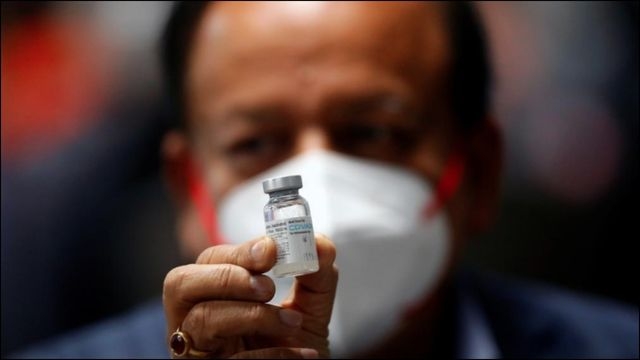
Between 2020 and 2022, The Wire repeatedly targeted Covaxin with articles questioning its approval, safety, and immunogenicity. A court later ordered 14 of these articles taken down, reinforcing criticism that the portal had promoted vaccine hesitancy. Earlier, the portal claimed no scientific data existed for Covaxin, even though the data had been published in peer-reviewed journals. In 2021, The Wire falsely claimed that many special police officers had defected to militancy; security agencies denied this unequivocally. The same year, it shared inaccurate allegations about the deliberate desecration of a mosque in Barabanki; district authorities refuted the claims. Its coverage of a Ghaziabad assault case, where it asserted that a Muslim man was forced to chant religious slogans, led to an FIR against the portal for misinformation.
During the Delhi riots period, The Wire repeatedly amplified one-sided narratives. It falsely reported that a Hindu-run school was labelled as Muslim to justify attacks. In 2020, the portal published and later removed a story claiming recitation of Ramcharitmanas was being promoted as a cure for COVID-19. It also alleged that new IT rules empowered the government to appoint regulatory bodies, a claim fact-checked as false. Its reportage on caste-violence incidents selectively omitted relevant religious identities, shaping the narrative for ideological ends. In several cases across 2019–2020, The Wire published exaggerated or unverified accounts of Muslim displacement during riots, claims of Kashmiri students being targeted post-Pulwama, and depictions of state-controlled media blackouts in Kashmir that were contradicted by documentary evidence of newspapers being printed.
The portal’s distortion of heritage narratives surfaced again in 2019 when it claimed that a major temple in Gorakhpur was built on land donated by a Muslim Nawab, which is historically inaccurate based on archaeological records. In numerous cases involving Kashmiri students in Dehradun, Rajasthan, and Uttarakhand, The Wire positioned disciplinary or administrative action as communal persecution, though police records suggested otherwise. Claims of mobs threatening students or institutions acting out of bigotry were often found unsubstantiated.
Article by
Kewali Kabir Jain
Journalism Student, Makhanlal Chaturvedi National University of Journalism and Communication