What Hagar and Bilhah’s Troubling Stories Expose About Power and Overlooked Consent
A critical analysis of Genesis 16 and Genesis 30 asks whether ancient thoughts about obtaining children through female servants offer a framework for understanding modern assisted reproduction or whether their deeper lesson concerns power, consent and the dignity of women
Total Views |



IVF and surrogacy promise parenthood, but at whose expense? Drawing on Hagar and Bilhah’s biblical stories, this article questions whether commercial interests and unequal power can push women’ consent, health and dignity into the background.
Connections of IVF From Biblical Household Arrangements to Modern Reproductive Systems
In vitro fertilisation (IVF) and surrogacy have transformed the possibilities of parenthood for people experiencing infertility. These technologies can help individuals and couples build families, but they also raise difficult ethical questions about the commercialisation of reproduction, unequal access to medical treatment, the rights of women carrying pregnancies and the role of financial interests in reproductive healthcare.
The biblical thoughts of Sarah and Hagar in Genesis 16:1-4 and Rachel and Bilhah in Genesis 30:1-5 offer an ancient point of comparison. In these accounts, women who have not conceived arrange for their husbands to have children through female servants. The resulting pregnancies occur within household relationships marked by unequal social status.

The connection with modern IVF and surrogacy is not that the Bible describes contemporary medical procedures. It does not. Rather, the comparison raises a broader question: when the desire for a child becomes the organising principle of a reproductive arrangement, whose interests receive priority - the intended parents, the woman providing reproductive labour, or the child?
This question is particularly important when fertility treatment involves commercial agencies, medical institutions, intermediaries and financial contracts. A critical examination should investigate the documented practices of these systems without assuming that every fertility clinic or surrogacy arrangement is exploitative.
It is also necessary to distinguish a biblical narrative from a divine command. Genesis recounts particular family arrangements; it does not prescribe IVF, establish modern surrogacy contracts or command infertile couples to obtain children through other women.
1. The IVF-surrogacy nexus: where medicine, money and parenthood intersect
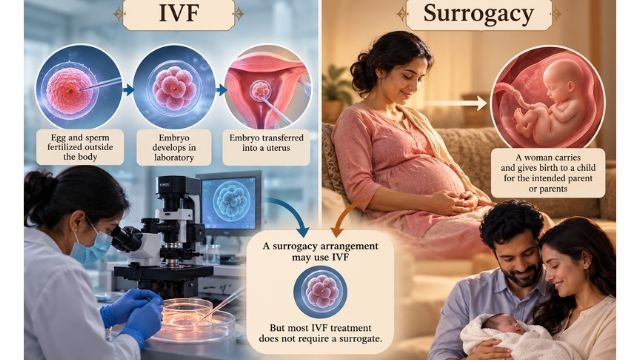
IVF and surrogacy are related but distinct practices. IVF involves fertilizing an egg with sperm outside the body and transferring an embryo into a uterus. Surrogacy involves a woman carrying and giving birth to a child for the intended parent or parents. A surrogacy arrangement may use IVF, but most IVF treatment does not require a surrogate.
The distinction matters because the ethical concerns are not identical. IVF raises questions about treatment costs, embryo creation and storage, the use of donor gametes, treatment success and the handling of genetic information. Surrogacy additionally raises questions about pregnancy, bodily autonomy, the surrogate's medical decisions, legal parenthood and the responsibilities of intended parents.
The potential commercial nexus arises when multiple services operate around a single reproductive goal. Clinics provide medical procedures; laboratories handle gametes and embryos; donor programmes facilitate access to eggs or sperm; agencies may coordinate services; lawyers prepare agreements; and other intermediaries may provide accommodation, insurance or logistical assistance.
These arrangements can offer valuable support. They can also create financial incentives that deserve scrutiny. Where providers receive payment for repeated procedures, for example, patients need transparent information about likely success rates, risks, alternatives and total costs. Where surrogacy is involved, safeguards must ensure that a woman's economic circumstances do not become a means of pressuring her into pregnancy.
The World Health Organization's infertility guidance, published in November 2025, identifies affordability and unequal access as major challenges, noting that fertility treatment can impose severe financial burdens on patients.
The critical question is therefore not whether fertility medicine is inherently exploitative. It is whether medical and commercial systems are structured to protect patients and reproductive workers or whether financial incentives can sometimes take precedence over their welfare.
2. The biblical parallel: Hagar and Bilhah as women within unequal reproductive arrangements

The most relevant biblical passages for this discussion are Genesis 16:1-4 and Genesis 30:1-5.
In Genesis 16, Sarah gives Hagar, her Egyptian servant, to Abraham in the hope of obtaining children through her. In Genesis 30, Rachel gives Bilhah to Jacob for a similar purpose.
These passages reveal a recurring pattern: a woman who desires a child arranges a reproductive relationship involving another woman whose social position is subordinate to hers.
A critical reading must recognise that the circumstances differ from modern IVF and surrogacy. Hagar and Bilhah are servants in ancient households; they are not patients undergoing modern fertility treatment, and the text does not describe medical procedures or contemporary contracts. It would be historically inaccurate to treat these stories as direct descriptions of the modern fertility industry.
Nevertheless, the ethical comparison is meaningful. In both ancient thoughts, the decisions of socially powerful household members determine the reproductive role of women who occupy less powerful positions. The servants' explicit consent is not recorded in the initial arrangements.
This raises a question that remains relevant today: can a reproductive arrangement be considered ethical merely because the intended parents desire a child, or must the freedom and welfare of the woman carrying the pregnancy be treated as equally important?
The biblical accounts do not provide a modern legal answer. They do, however, give readers a reason to examine reproductive arrangements through the lens of power, vulnerability and human dignity.
The distinction between a biblical event and a biblical command

Neither Genesis 16 nor Genesis 30 establishes a universal religious instruction to use another woman's reproductive capacity when infertility occurs.
A practice described in scripture is not automatically a practice commanded for all generations. Any argument that these passages provide blanket religious approval for modern commercial surrogacy would require additional theological reasoning; it cannot be established simply by quoting the verses.
Equally, it would be an overstatement to claim that these passages directly condemn IVF, which did not exist in the biblical world.
The more defensible conclusion is that these thoughts provide material for ethical reflection on reproduction and social power, while modern medical technologies must be assessed in their own clinical, legal and moral contexts.
3. Is there a “deep-state” nexus in IVF and surrogacy?

If “deep state” refers to a secret, coordinated network controlling fertility treatment or surrogacy, that is a serious allegation and should not be presented as fact without verifiable evidence. The existence of clinics, agencies, commercial incentives or regulatory weaknesses does not by itself demonstrate a covert conspiracy.
A more evidence-based critical analysis examines the institutional nexus among healthcare providers, private investment, intermediaries, legal arrangements and government regulation.
Four areas merit particular attention
Commercial incentives: Patients should be able to understand treatment costs, the basis for recommending procedures, realistic success rates and any financial relationships between providers and intermediaries.
Information asymmetry: Fertility specialists possess technical knowledge that patients may not have. This makes independent counselling, clear explanations and informed consent particularly important.
Economic inequality: People with substantial financial resources may be better positioned to access treatment, while economically disadvantaged women may face pressures that make reproductive labour a source of income. Such pressures should be investigated rather than assumed in every case.

Regulatory accountability: Licensing, record-keeping, medical oversight, grievance procedures and enforcement help determine whether reproductive services operate safely and transparently.
These are legitimate subjects for investigative journalism. They can be examined through clinic records, disclosed financial arrangements, court judgments, regulatory findings, interviews with patients and surrogates, and independently verified data.
A critical article should distinguish documented misconduct from structural risks and both from unsubstantiated claims of secret coordination. That distinction strengthens scrutiny rather than weakening it.
4. India: the legal and ethical framework

India provides an important case study because fertility treatment, surrogacy and reproductive health are subject to specific legislation.
The Assisted Reproductive Technology (Regulation) Act, 2021 establishes a framework for regulating assisted reproductive technology clinics and banks, including safeguards intended to promote safe and ethical practices. The Surrogacy (Regulation) Act, 2021 establishes a separate framework for regulating surrogacy. Both Acts came into force on 25 January 2022.
India's Surrogacy (Regulation) Act distinguishes altruistic surrogacy from commercial surrogacy. Its definition of altruistic surrogacy permits prescribed medical expenses and insurance coverage, while excluding remuneration and other monetary incentives of the kind prohibited by the Act. Commercial surrogacy is prohibited under the Indian framework.
This legal distinction is central to any serious examination of the IVF–surrogacy nexus. It means that the existence of a commercial fertility sector does not establish that commercial surrogacy is legally permissible in India. IVF services and surrogacy are governed by different, though related, regulatory requirements.
The key questions for public accountability include whether clinics and banks comply with registration requirements, whether patients receive accurate information, whether surrogate mothers are protected against coercion, and whether authorities investigate suspected violations effectively.
A law's existence is not, by itself, proof of either successful enforcement or widespread non-compliance. Claims about regulatory failures must be supported by documented cases, inspection findings, court decisions or other reliable evidence.
5. The ethical questions that deserve greater public attention

A critical examination of fertility services should address the interests of all parties rather than reducing the debate to a conflict between intended parents and surrogates.
The intended parents: Infertility can cause considerable emotional distress. People seeking treatment deserve compassionate medical care, realistic information and protection from misleading promises.
The woman undergoing treatment or carrying a pregnancy: Her physical health, privacy, informed consent and authority over medical decisions must remain central. Financial hardship or family pressure should not be exploited to obtain her participation.
The child: The child's welfare must not become secondary to contractual or commercial interests. Questions concerning parentage, medical history, genetic origins and long-term responsibilities require careful consideration.
The medical institution: Clinics have a responsibility to explain the benefits, risks, limitations and alternatives of treatment. Professional obligations cannot be replaced by commercial agreements.
The World Medical Association's statement on assisted reproductive technologies emphasises informed consent, patient autonomy and protection against coercion. Its guidance on surrogacy also stresses the importance of protecting the surrogate's rights and interests.
6. A critical biblical conclusion: when the desire for a child meets the power over another woman

The stories of Sarah and Hagar, and Rachel and Bilhah, remain ethically significant because they expose the tension between the desire for parenthood and the position of women whose reproductive capacities are used to fulfil that desire.
They should not be treated as direct biblical endorsements of modern IVF or surrogacy. Neither should they be used to stigmatise people experiencing infertility or to suggest that all assisted reproduction is morally equivalent to exploitation.
Does the pursuit of parenthood respect the dignity of everyone involved? Can consent be considered meaningful where severe economic or social pressure exists? Are the interests of the woman carrying the pregnancy protected independently of the interests of the intended parents? And can religious authority be invoked to settle complex medical and ethical questions without examining their consequences?
These questions connect the ancient thoughts with contemporary concerns about commercial incentives and reproductive inequality without confusing historical scripture with modern medical practice.
Ultimately, the ethical challenge is not simply whether technology can make parenthood possible. It is whether the institutions surrounding that technology protect the people whose bodies, health, resources and futures are involved.
The central argument is that neither scientific progress nor religious tradition should exempt reproductive practices from ethical scrutiny. IVF and surrogacy must be evaluated on their actual medical, legal and social merits, while the biblical thoughts of Hagar and Bilhah remind readers to pay particular attention to the dignity and agency of women who may otherwise be overlooked.
Rupkunvar Ghelot