41 Cases, One Pattern: The Rising Web of Radicalisation, Espionage, and Technological Subversion
How are false identities, decentralised cells, and foreign handlers enabling deeper infiltration into Bharat"s civilian and strategic infrastructure?
Total Views |



A recent crackdown by the Delhi Police Crime Branch at IGI Airport on 2 April 2026 has once again brought into sharp focus the evolving nature of espionage and terror-linked networks operating within Bharat. The arrest of two accused, Imran and Mohammad Kamran, linked to an alleged ISI-backed international arms smuggling module, underscores the persistence and sophistication of such threats.
Why This Matters Now
The Delhi case exposed a sophisticated transnational supply chain routing advanced weaponry from Pakistan through Thailand and Nepal into Bharat. The accused reportedly used concealed vehicle compartments to transport arms, indicating logistical precision and careful operational planning. Investigators have linked them to a larger network allegedly coordinated by Shahbaz Ansari.
This development coincides with a broader compilation of 41 major espionage and terror-linked cases between 2019 and 2026, which reveals recurring patterns in recruitment, methods, and intent.
The reported 41 espionage and terror-linked incidents between 2019 and 2026 reveal a clear evolution in operational tactics, particularly through the adoption of hybrid warfare strategies and advanced technological tools. Investigations, especially in cases such as the March 2026 Ghaziabad module and the April 2026 Delhi crackdown, demonstrate how operatives increasingly relied on solar-powered CCTV cameras, GPS-enabled tracking systems, and encrypted communication platforms such as Telegram and WhatsApp. These tools enabled real-time transmission of sensitive data, including live feeds of railway stations and strategic installations, directly to handlers across borders. For instance, in the Ghaziabad case, authorities uncovered plans to install up to 50 such surveillance devices near critical infrastructure, highlighting a systematic attempt to digitise espionage operations.
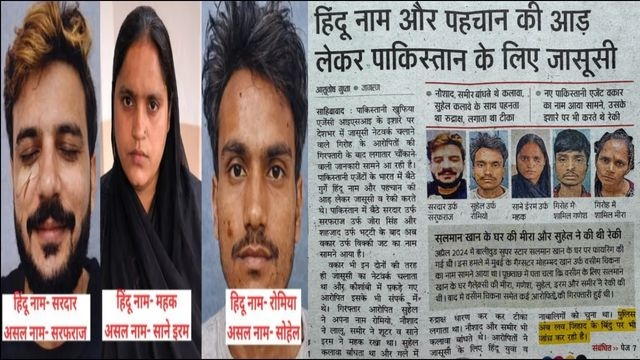
Another prominent trend is the use of false identities and social camouflage to evade detection. Several accused individuals adopted aliases aligned with local cultural identities to integrate seamlessly into communities. In the March 2026 Ghaziabad espionage network, operatives reportedly used names such as "Vicky Jatt" and "Jora Singh", masking their real identities while conducting reconnaissance and coordinating activities. This deliberate identity manipulation not only complicated intelligence tracking but also enabled deeper infiltration into civilian and sensitive zones without raising suspicion.
Equally concerning is the growing role of digital platforms in radicalisation and recruitment. A pattern observed across multiple cases indicates that social media has become a primary tool for ideological indoctrination and operational coordination. These platforms have been used to inject extremist narratives and propaganda among youth, often linked to global jihadist ideologies. In the April 2026 Lucknow case, suspects were found to be in contact with foreign handlers via platforms such as Instagram and Telegram, receiving instructions and financial incentives through QR code-based transactions. This convergence of ideology and monetary inducement underscores a hybrid recruitment model that is both scalable and difficult to trace.

The decentralised nature of these networks further complicates countermeasures. The cases point to the existence of loosely connected but ideologically aligned cells operating across multiple states, including Uttar Pradesh, Maharashtra, Kerala, Assam, and Rajasthan. While these modules often function independently, investigations have consistently traced their links to handlers based in Pakistan, Afghanistan, and Bangladesh. The April 2026 Amravati case, which exposed links to ISIS and AQIS, exemplifies how local modules can be embedded within broader transnational terror ecosystems while maintaining operational autonomy.
Additionally, the diversity in the recruitment base challenges traditional assumptions about the profiles of individuals involved in espionage. The accused across these cases include students, lawyers, YouTubers, security guards, and small traders, indicating that recruitment strategies are opportunistic and target individuals across socio-economic strata. This wide-ranging outreach increases both the resilience and unpredictability of such networks.
Geographically, the spread of these 41 incidents from North Bharat, including Uttar Pradesh, Delhi, and Haryana, to the Northeast, including Assam and Arunachal Pradesh, and further into southern states such as Kerala and Tamil Nadu, demonstrates that espionage activities are no longer confined to border regions. These activities have penetrated deep into the hinterland, thereby amplifying the scale of the security challenge.
Collectively, these findings highlight critical security implications. The reliance on local recruits reduces the need for physical cross-border infiltration, while the weaponisation of widely accessible technology enhances operational efficiency. Moreover, the systematic collection of sensitive infrastructural and military data points towards an emerging dimension of information warfare, posing long-term strategic risks to national security.
Written by

Kewali Kabir Jain
Journalism Student, Makhanlal Chaturvedi National University of Journalism and Communication