The Dilemma of Sovereignty and Subversion
A closer look at how modern states balance sovereignty, foreign influence, strategic dependence and covert subversion in an increasingly contested global order.
Total Views |


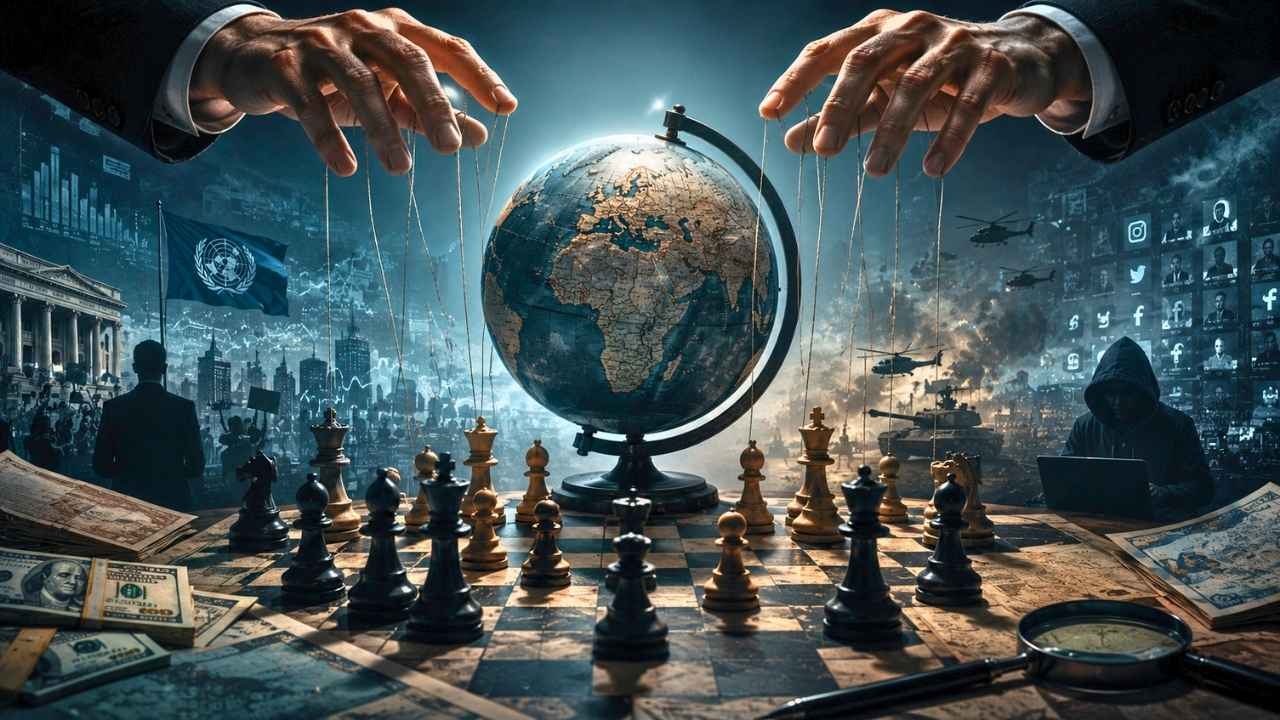
The concept of de jure nation-states and sovereignty, as understood today, is an ancient concept tied to the recognition of states but is formally traced to the Treaty of Westphalia of 1648. This treaty brought an end to the Thirty Years' War in the Holy Roman Empire and the Eighty Years' War between Spain and the Dutch Republic. The compromise resulted in peace, where states agreed to uphold each other's legitimacy. Based on the Declaratory Theory of Recognition of States, more than 200 states exist today—to which the followers of the Constitutive Theory will have a different answer.
UN member states are supposed to be sovereign states, as the UN Charter outlines in Article 2(1). It proclaims the concept of sovereign equality among its members, which is to say that all its members shall be equally sovereign regardless of their practical stature, be it Somalia or China. A sovereign is supposed to operate without external influence while being the sole power to decide its internal matters, to legislate and adjudicate law in its territory, and to decide for itself. Alas! These wings of sovereignty have been so chipped today by globalisation and stark contrasts in the capacities and capabilities of nations that, for realpolitik, most states are under the 'persuasion' of one state or another.
It is totally acceptable that it may be in the national interest of geographically less gifted and lacking states to join the camps of political powers and abide by their dictates out of a sheer need for security across any of the sixteen elements of national security, be it the traditional military aspect or the microbiomic aspect, whose importance was demonstrated by the COVID-19 pandemic. Sometimes, a state may be forced to accept the umbrella of a larger power because of the rising reach of a rival group on its periphery. Thus, there can be different subservient states in the world, which can be categorised as clients, vassals, bandwagons, and partners, depending on the extent of their independent decision-making:
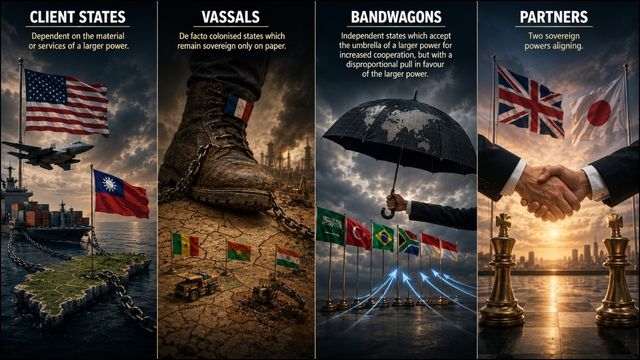
Client states: Dependent on the material or services of a larger power (e.g., Taiwan and the USA).
Vassals: De facto colonised states which remain sovereign only on paper (e.g., Sahel states and France before recent coups).
Bandwagons: Independent states which accept the umbrella of a larger power for increased cooperation, but with a disproportional pull in favour of the larger power.
Partners: Two sovereign powers aligning.
While all these situations often begin with the wilful consent and choice of a sovereign state to leverage its interests, the loss of sovereignty can also happen by subversion. Here, the decision to accept an overlord or to decide matters in a certain way is limited by invisible hands, where the body of a government is haunted by a foreign spirit. Natural bandwagoning can also, in time, unwittingly turn into de facto colonisation through subversion.
It must be the combination of natural alignments, influences, and subversion that recently led the deputy head of the Presidential Administration for Russia, Maxim Oreshkin, at the 'Open Dialogue' Forum at the Russia National Centre, to state, "In essence, four poles of sovereignty are now being formed—economic, public and state sovereignty—these are the USA, China, Russia, and India."
This assessment by Mr Oreshkin appears to be correct. The USA and Russia form the political bipolarities of the current world order and are thus sovereign. China, meanwhile, has gained its ground through its large size, achieved by its relentless growth under its earlier non-threatening pretence. India has retained its sovereignty through hedging opportunities gifted by its geography and its unique position as a power balancer in Asia—a stance formerly officially called "non-alignment" and currently referred to as a multi-alignment policy, through which India attempts to rise to be the Vishwaguru.
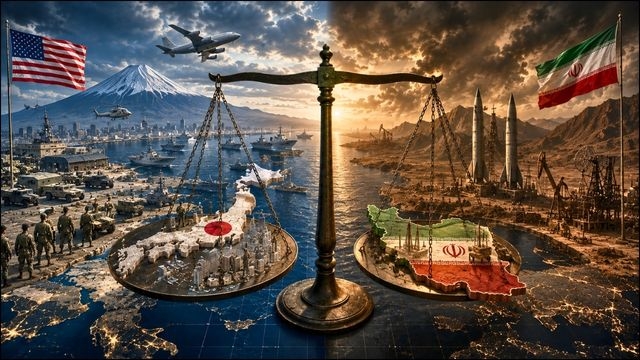
If one were to think about other states like Japan and Iran at the two ends of the spectrum, one could judge them by their requirements from their larger partners for their existential security needs. In the case of Japan, as per Dr David Vine, over 120 US military facilities operate in Japan as of this date. Furthermore, Japan, with its unstable political system, has been unable to amend its post-war constitution drafted under the supervision of the USA even a single time since its conception. This doesn't mean that Japan is a masked USA. In fact, the convergence of America with its 'allies' can only be imagined to an extent that is doable for the junior partner. In cases of being scapegoated, it is still expected that there can be divergence under the US umbrella. Such divergence could emerge in the near future if a future Taiwan war is won by the PRC. The question is finding that threshold. Subversion, however, can widen the threshold and can force continuity even if it is not natural or logical.
Among the four sovereigns and the subservient states, various powers attempt to influence institutions, leadership, and elements of national security so as to try and get hold of a state. The release of the Epstein Files demonstrates that even two states under a single umbrella (Israel and the US, in this case) can try to gain control over each other.
Such influence can be differentiated and categorised as subversion and others based on the Threat Matrix Cube (suggested by Dr Prabhakaran Paleri in his book Revisiting National Security), which is a combination of three dimensions:
1. External and Internal
2. Covert and Overt
3. Direct and Indirect
The three dimensions produce six existent opposites within the eight cubical dimensions of threat perception. Direct, military-based arm-twisting can be categorised in the External-Overt-Direct cube, while in the case of Epstein, the cube would be External-Covert-Indirect. There can be various combinations based on the type of influence. The objective of the influence ideally should be to target the centre of gravity of the subject, which means the core of its existence. That can be done by directly approaching the centre or by affecting its periphery to then influence it.
In this process, the influencing states can opt for various means, even those which may go against their own ideological setup. While the political West is predominantly Christian, and Islamic migrants are a political issue within individual states, one can see the Western hand in the initial collaboration with the Taliban to overthrow Soviet influence over Afghanistan. American hands in Pakistan and with so-called non-state actors can also be cited. It should thus be clear that states can operate various religious, ideological, and ethnic organisations with loyalties tied to their own national interests. It was therefore no wonder to see the former American Ambassador Eric Garcetti sitting with individuals and organisations considered to be Marxists and neo-Marxists. In realpolitik, results are placed above any ideals.
Such influences (threats) can show different faces of the Threat Matrix Cube. While states that are 'friends' and others attempt to influence across the sixteen elements of national security, it is handy to discuss indirect and covert means. Friends will try to influence a state to cast their bonds in stone, while non-friends will do so to damage the adversary. Isn't it important for the US and Russia to have some admirers in a state that may not currently need any great assistance? And what guarantees that a friend cannot join the enemy camp next? Thus, states attempt to buy admiration and loyalty with money, compromises, organisations, social movements, and so on; rival states can operate via similar means within a single target state. A young political leader on his way to the US, Russia, or any sizeable state for a foreign event can easily slip down the slippery slope of desires, only to be reminded about it decades later. Likewise, a struggling group can be granted PR and funds to "continue working for humanity". It is a beautiful facade in itself, and all across the spectrum, different environmental groups emerge purely to "save Mother Earth".
Maybe it is this tussle of foreign powers within India that had, in the past, allowed it not to fall into anyone's camp, owing to the neutralising effect of the tussle. Today, however, India must remain India, and for India, it must subdue the influences of foreign powers. While it is not easy to locate external-covert-indirect means, the internet has enabled us to look at direct/indirect-overt influences with little effort today. One can connect the dots using financial trails and the workings of organisations to judge loyalties and uncover foreign hands. As a society, we must attempt to expose such influences so that the subversion of India can be minimised, ensuring that India continues to be a sovereign state.
(This article serves as an introduction to a forthcoming series on direct/indirect overt influences centred around India.)
Written by

Adv. Shreeacharya Mishra
(The author is a student at Rashtriya Raksha University, a premier national security institution under the Ministry of Home Affairs.)