1956: Report of the Christian Missionary Activities Enquiry Committee (Part 4)
Through historical examples from Christian and Islamic rule, the report assessed the impact of conversion, religious control, and intolerance on society.
The Narrative World 10-Jun-2026
Total Views |


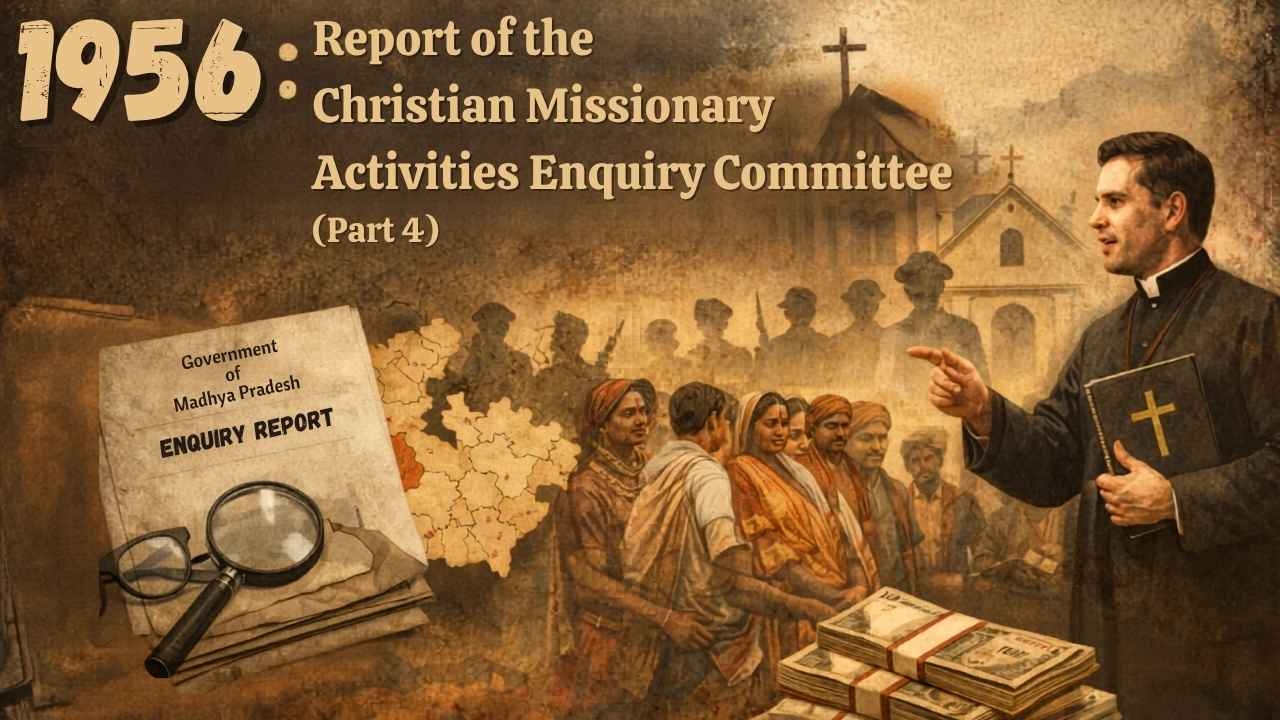
The report covered many aspects of missionary activities and also presented the historical background in considerable detail. It referred to several related concepts and theories as well. The third part of the report discussed the concept of religious liberty in different countries.
Religious liberty implies the freedom of an individual to change his religion and also includes the freedom to preach, educate, publish, and carry on missionary activities.
On the other hand, for Hindus, religious liberty implies a receptive attitude towards other faiths. It is a concept of coexistence without attempting to oust others. The Jain and Buddhist schools of thought had sufficient space to flourish, and there was no conflict of group wills against other groups. Bharatiya society maintained the spirit of religious tolerance.
With Christianity, however, the elements of intolerance became more noticeable, along with religious exclusivism. The idea of one God and one religion prevailed. A historical account of Christianity is explained in the report, and in a way, it shows that Christianity sought to establish an absolute and dominant position in the world.
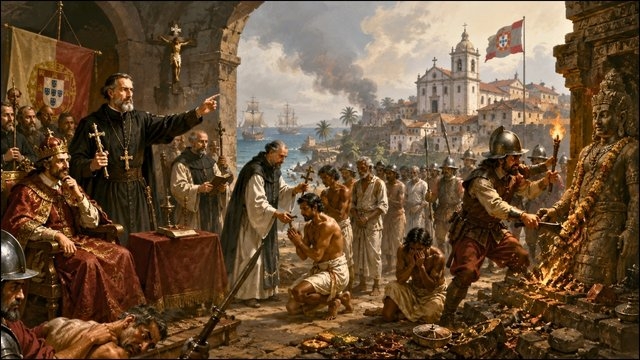
For the Portuguese State, religious conversion was an officially accepted policy. In a way, conversion was used as a tool to win the favour or goodwill of the King of Portugal. The Holy Inquisition, which was absolutely unholy and wicked, lasted for about 250 years. It was exercised by the Portuguese in Goa as well. They were ruthless and wanted a strong foothold in our country.
Hindu temples and images were destroyed, and even Hindu festivals were prohibited. Churches were built after demolishing temples, and many still stand at the same locations. Hindus were not allowed to perform religious ceremonies. The use of the mother tongue was strictly prohibited, and everyone was compelled to learn Portuguese. The only options available were either to embrace Christianity or leave the State. At the same time, mutual intolerance among different denominations of the Church also existed.
The British adopted a slightly different policy. Initially, they did not want to interfere with religious habits, social practices, or beliefs. After the East India Company assumed power in the country in 1757, it generally did not encourage missionary activities. However, by the end of the eighteenth century, Evangelism, which aimed at persuading people to convert, had entered Bharat. In 1813, when restrictions associated with the East India Company were removed, missionaries could visit Bharat freely.
The Portuguese were confined to a much smaller area compared to the territories under British rule. From 1793 onwards, Protestant missionaries dominated missionary work. After the War of Independence in 1857, the British Crown assumed direct control over governance. Missionaries won patronage and support from the government.
Legislation against social evils such as infanticide and sati provided opportunities to promote Christianity. Several laws were passed that, according to the report, struck at the roots of social life and facilitated the Christianisation of the country. For example, the right to inheritance was granted to converts, and their rights or shares in joint Hindu families were protected by legislation. Even a male convert could allegedly use his position to pressure his wife to convert. Missionaries were encouraged to work among backward tribes.
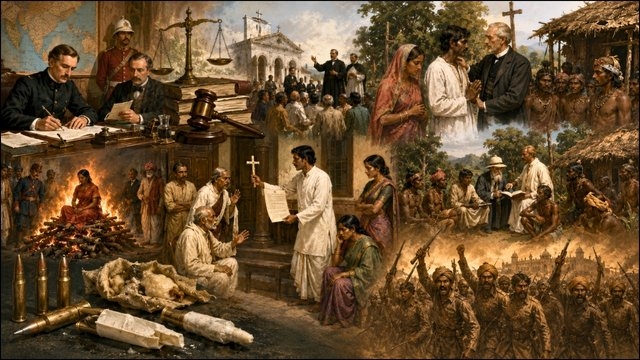
Such policies had already created discontent within society, and the issue of greased cartridges using cow and pig fat merely acted as a trigger for the uprising.
The promise of liberty and neutrality remained largely on paper until 1947. Equal and impartial treatment under the law and non-interference with religious beliefs were, according to the report, hollow promises. The reality on the ground was quite different. Considerable encouragement and facilities were extended to Christian missionaries, and Christians enjoyed a privileged position.
Muslims invaded India in 711 AD, and progressive conquest continued until around 1000 AD. By the sixteenth century, they had established political and military dominance over Hindus. In 1633, Shah Jahan ordered the destruction of Hindu temples, and intermarriages between Hindus and Muslims were prohibited. In 1669, Aurangzeb ordered the demolition of Hindu schools and temples to stop the religious practices of infidels, referring to Hindus.
Cows were slaughtered, and idols were trampled upon in full public view. Religious fairs were forbidden. Grants, government jobs, and even liberation from prison were offered to those who embraced Islam. According to the report, these developments dealt a severe blow to Buddhism and Jainism. However, Sikhs were comparatively less affected because of their strong organisation and military power, making them difficult to overwhelm.
In 1924, the Unity Conference was organised, with Mahatma Gandhi Ji being one of its prominent figures. The conference passed resolutions seeking complete freedom of conscience and religion, full tolerance of all faiths and practices, and condemned the destruction of religious places belonging to any faith.
Everyone was to enjoy full liberty to express their beliefs and follow religious practices of their choice. Insulting any holy person or the tenets of any faith was expected to be avoided. The liberty to follow any faith or change it was recognised. No punishment was expected for adopting or reverting to any faith. At the same time, the conference condemned conversion through compulsion, force, fraud, or other unfair means at the expense of the rights of others.
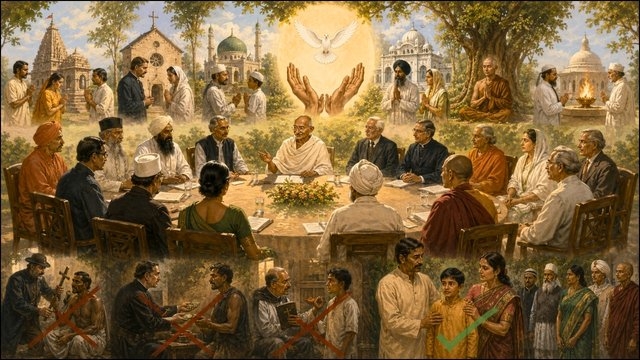
The conversion of anyone below the age of sixteen without the permission of parents or guardians was considered undesirable. In this way, the principle of liberty to accept any faith without interference was emphasised.
The report also described the situation in other European countries regarding this issue. For example, in Spain, a Catholic country, religious liberty scarcely existed. The Spanish Revolution is described as a bloody chapter marked by persecution, looting, killings, and executions. Believers of other faiths, particularly churches other than the Catholic Church, enjoyed neither rights nor status. There was hardly any space for Protestant churches.
Smaller communities were often denied employment, opportunities for trade, and even access to government relief.
Portugal, too, exercised complete authority in religious matters. Portugal ruled Goa for approximately 450 years and, according to the report, surpassed all limits of cruelty in its efforts to convert people.
Education was expected to be guided by Church doctrines. Religious textbooks had to be approved by the Catholic Church, which enjoyed a monopoly over spiritual training. Non-Catholic missions were subjected to restrictions and discrimination.
As Goa was not considered satisfactory in terms of conversion efforts, St Xavier and his fellow Jesuits were sent there, giving them an opportunity to work towards rapid conversions. According to the report, all means, fair or foul, were freely employed.
The report also provides an overview of the attitudes adopted by other European countries towards religious liberty and conversion.
The overview of British rule will be discussed in the next part, as British governance had a far-reaching impact owing to the vast territory under its control.

प्रो. विद्या देशपांडे
Professor Vidya Deshpande has over four decades of experience in education. Her main expertise is philosophy; she taught philosophy and logic at Nowrosjee Wadia College for 36 years. She has been associated with the Janakalyan Blood Bank for the last 38 years and served as a management committee member of Karve Stree Shikshan Sanstha for 10 years. Her special fields of interest include the philosophy of social sciences, school education, development of self-reliance skills, and top-up skills to make students profession-ready.