The Eternal Prince and the Shadow of 56 Years He Casts
Why have Rahul Gandhi"s statements on religion, the Army, China and Indian democracy continued to trigger intense political and public scrutiny?
Total Views |


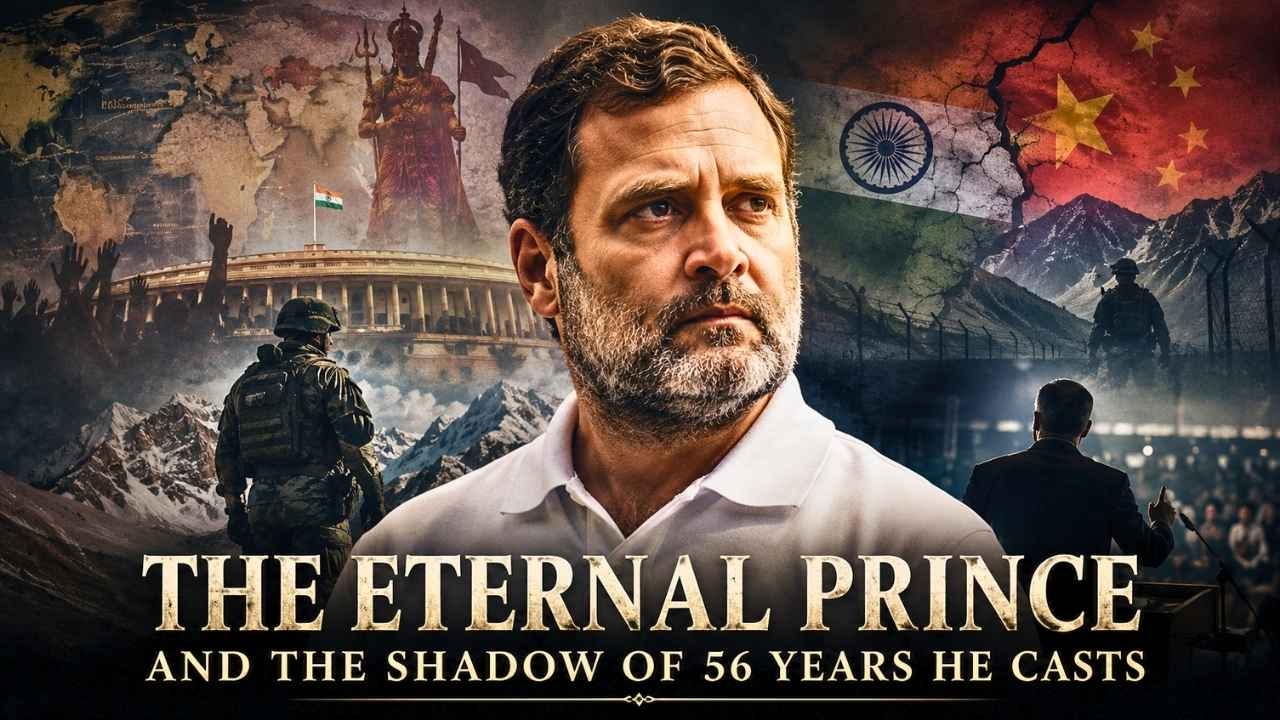
Rahul Gandhi, the scion of Bharat's most enduring political dynasty, remains one of the most debated figures in contemporary Indian politics. For decades, he has occupied a prominent space in the national discourse, attracting both admiration from supporters and criticism from opponents. Despite his long political career, a series of controversial statements and positions have continued to generate debate about his vision for Bharat and his approach to national issues.
One of the earliest controversies emerged from a 2009 diplomatic cable released through WikiLeaks. According to the cable, Rahul Gandhi reportedly stated during a conversation with the US Ambassador that the growth of radicalised Hindu groups could pose a greater long-term challenge than Islamist terror networks operating worldwide. These remarks came in the aftermath of the 26/11 Mumbai terror attacks, and critics argued that such a formulation appeared to diminish the gravity of Pakistan-backed terrorism, which had already claimed hundreds of Indian lives.
Hinduism, Hindutva and the Political Firestorm
The debate intensified in July 2024 during Rahul Gandhi's speech in the Lok Sabha. Declaring that those who spread violence and hatred while calling themselves Hindus were "not Hindus at all", he sparked a major political controversy.
The BJP and several Hindu organisations responded sharply. Many argued that the statement unfairly generalised millions of Hindus and reflected a broader tendency within sections of the opposition to associate Hindu political assertion with intolerance. A very few, however, maintained that his remarks were directed at more than just individuals who misuse religion to justify violence.
Bringing the Army into the Caste Debate
Another major controversy emerged when Rahul Gandhi linked representation in national institutions, including the armed forces, to caste demographics. Speaking in the context of the caste census debate, he argued that a small section of society exercises disproportionate influence over key institutions.
At a rally in Bihar in November 2025, Rahul Gandhi stated that a mere "10%" of the population, namely the upper castes, controls the Army and other key institutions, while the remaining 90% remain sidelined.
The remarks drew criticism from veterans, defence commentators and political opponents, who maintained that the Indian Army's credibility rests upon professionalism, merit and national service rather than caste identity. The majority contended that introducing caste considerations into discussions about the armed forces risked undermining the institution's apolitical character.
China, Border Security and Questions of National Messaging
Rahul Gandhi's repeated comments on the Bharat-China border dispute have also generated intense political confrontation. Over several years, he accused the government of concealing the extent of Chinese incursions and failing to respond adequately to Beijing's actions.
Such statements provided strategic ammunition to adversarial powers and risked undermining public confidence in the armed forces during a sensitive geopolitical confrontation. Public commentary on national security issues should be exercised with greater caution, particularly during periods of heightened tension along the border.
Criticism on Foreign Soil
Perhaps no issue has generated more political debate than Rahul Gandhi's speeches abroad. During visits to the United States, the United Kingdom and other countries, he criticised aspects of Indian democracy, institutions, electoral processes and governance. His comments frequently became the subject of political controversy back home, with many accusing him of presenting a negative image of Bharat before foreign audiences.
Rahul Gandhi continues to remain at the centre of numerous political controversies that have accompanied his journey in public life. These episodes have shaped public perceptions of his political discourse and leadership. Taken individually, each statement has generated debate and attracted explanations, clarifications and counterarguments from his supporters. Taken collectively, however, they have ensured that Rahul Gandhi remains one of the most scrutinised and polarising figures in Indian politics.
Written by
Kewali Kabir Jain
Journalism Student, Makhanlal Chaturvedi National University of Journalism and Communication