Narayanpur and Beyond: How 2010 Became the CRPF's Deadliest Year
The Narayanpur ambush followed the Tadmetla massacre, as repeated Maoist attacks in Bastar made 2010 the deadliest year ever faced by the CRPF.
Total Views |



The Narayanpur ambush was a carefully planned Maoist ambush on a Central Reserve Police Force (CRPF) team returning from a road-opening operation. Exploiting the dense forests and hilly terrain, Maoists launched a surprise attack that claimed the lives of 27 CRPF personnel. This grave incident formed part of a series of deadly attacks carried out by Maoists across the Bastar region in 2010, a year marked by unprecedented violence against Bharat's security forces.
On 29 June 2010, Maoists ambushed a CRPF team while it was returning from a road-opening patrol in Narayanpur district. Using the surrounding mountains and dense forests to their advantage, the Maoists launched a sudden and coordinated assault. According to various reports, 26 CRPF personnel were martyred. However, official records released later by the Ministry of Home Affairs (MHA) placed the death toll at 27 personnel, with five others sustaining serious injuries.
The attack took place in Narayanpur district, located in the Bastar division of Chhattisgarh, which serves as the gateway to Abujhmarh, a vast and densely forested area where Maoist influence had historically remained strong. The Ministry of Home Affairs informed Parliament that the incident occurred in a heavily Maoist-affected area with extremely challenging terrain, where the security personnel were caught off guard by the Maoists.
Reports indicate that the Maoists had positioned themselves deep inside the forest and opened fire as soon as the CRPF column passed below them. The ambush dealt a severe blow to the CRPF's anti-Maoist operations in Bastar and once again demonstrated the brutal nature of Maoist violence.
One of the most dangerous aspects of the attack was its timing. The CRPF team had already completed its road-opening duty and was on its return journey. By that stage, the personnel were physically exhausted, movement through the difficult terrain had become slower, and the dense jungle provided the Maoists with ideal cover to launch a devastating surprise attack.
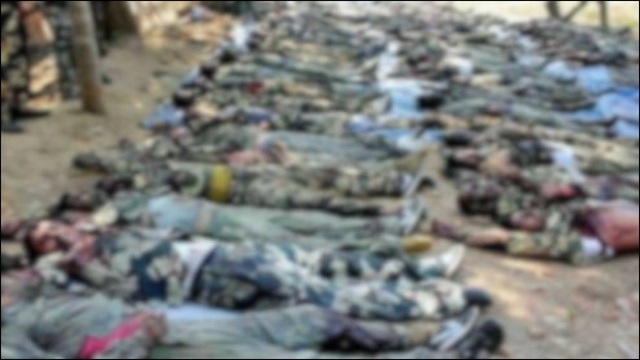
This ambush ranks amongst the most serious Maoist attacks of 2010. Just three months earlier, on 6 April 2010, Maoists had carried out another devastating ambush in which 75 CRPF personnel and one state police officer lost their lives. These repeated large-scale attacks made 2010 one of the bloodiest years ever witnessed by Bharat's security forces in the fight against Left-Wing Extremism.
The incident demonstrated that the Maoists possessed the capability to meticulously plan and execute large-scale ambushes, exploit the dense jungle terrain of Bastar, and deliberately target security patrols operating in remote areas. Their tactics relied heavily on surprise attacks, local geographical knowledge and the use of difficult terrain to inflict maximum casualties on security personnel.
During this period, the principal centres of Maoist violence stretched across the forested regions of Chhattisgarh, Jharkhand, Odisha, Andhra Pradesh and Maharashtra. In the Bastar region, Maoists strongly opposed road construction, the establishment of police camps, the expansion of government administration and various development projects, as they recognised that such infrastructure would weaken their grip over the remote forest areas and reduce their operational freedom.

The Narayanpur-Abujhmarh belt remained strategically vital for Maoist operations. The dense forests and rugged terrain of Abujhmarh enabled the Maoists to evade security forces, organise coordinated ambushes and maintain their presence for extended periods, effectively turning the region into one of their strongest operational bases.
As a result, whenever security forces conducted road-opening exercises or area domination operations, Maoists frequently attempted to challenge them through carefully planned ambushes and violent attacks aimed at disrupting security operations and maintaining their influence over the region.
In a Nutshell
The Narayanpur ambush is a woeful reminder of the killing spree of the Maoists in central Bharat in 2010. It underscored the tremendous tactical difficulty encountered by security forces working in the thick forest and emphasized the need for improving intelligence efforts, operational planning, and preparedness to effectively counter LWE. The attack also revealed a heavy human price tag for Maoist terrorism, which constantly and repeatedly attacked the security forces of Bharat and tried to hinder the peace, governance, and development of affected areas.
Written by

Mokshi Jain
Sub-editor, The Narrative