Keralam emerges as the political epicentre of opposition
Why has Keralam become the strongest political base opposing the proposed FCRA Amendment Bill through legislative action and coordinated civil society mobilisation?
The Narrative World 04-Jul-2026
Total Views |


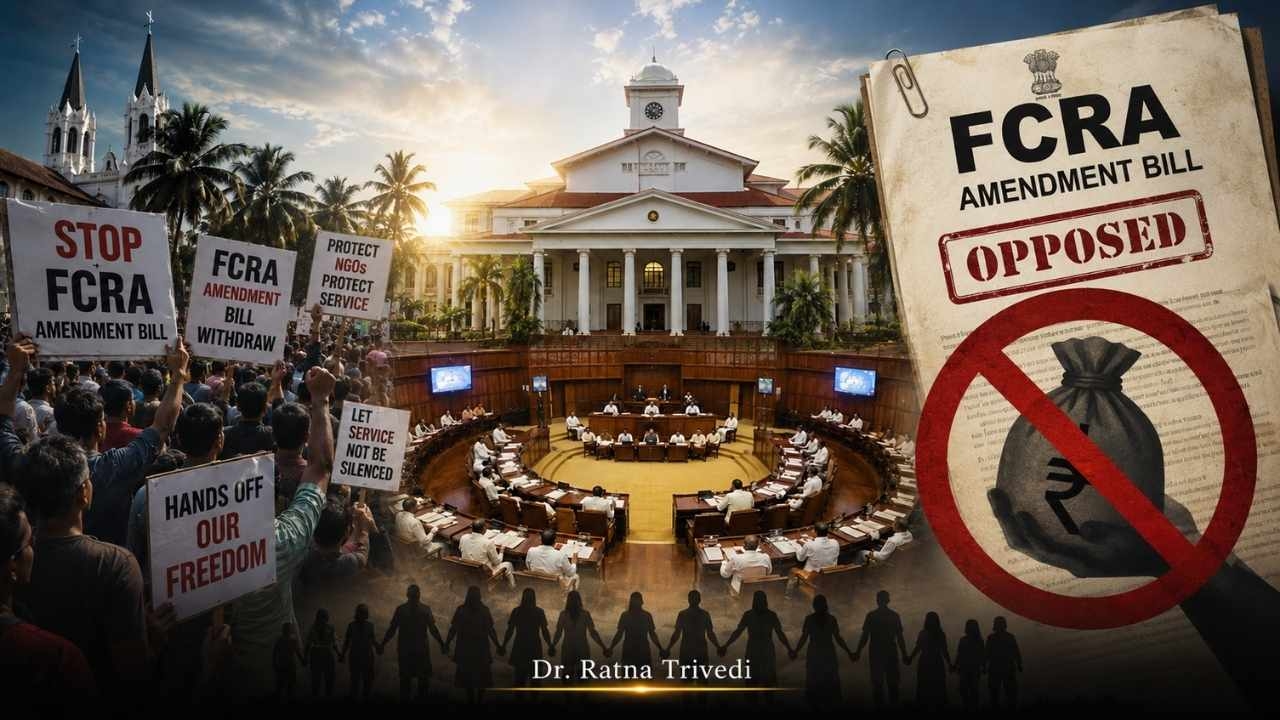
Among all the states opposing the proposed FCRA Amendment Bill, Keralam has emerged as the most politically organised centre of resistance. The opposition has extended beyond civil society organisations and church institutions into the state's political establishment.
A significant development came on 1 July 2026, when the Keralam Legislative Assembly passed a resolution urging the Union Government to withdraw the proposed FCRA Amendment Bill. The resolution expressed concern that the proposed amendments could adversely affect the functioning of voluntary organisations, charitable institutions, educational bodies, healthcare organisations and faith-based social service institutions that depend on foreign contributions for legitimate developmental activities. It also argued that the proposed changes may centralise administrative powers and create additional compliance burdens for non-governmental organisations.
The resolution reflected a rare convergence between the state government and several civil society organisations that had already begun campaigning against the Bill. Political leaders in Keralam argued that while financial transparency is essential, the proposed amendments should not undermine the autonomy of voluntary organisations engaged in education, healthcare, tribal welfare, disaster relief and community development.
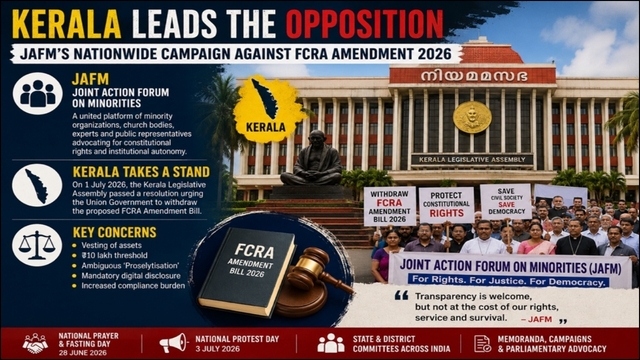
Keralam has also become the organisational hub of the campaign because many prominent Christian institutions, charitable trusts, educational societies and social service organisations operate from the state. These organisations have actively participated in consultations organised by the Joint Action Forum on Minorities (JAFM) and supported nationwide awareness programmes, including the National Day of Prayer and Fasting held on 28 June 2026.
For JAFM, Keralam represents more than a state-level protest. It demonstrates how opposition to the proposed amendments has moved beyond individual organisations to include legislative action, coordinated political advocacy and public mobilisation. The Keralam Assembly's resolution has become one of the most significant institutional responses to the proposed FCRA Amendment Bill and has added political momentum to JAFM's nationwide campaign.
Article by
Dr. Ratna Trivedi
Management Institute of Tribal and Rural Advancements, Gujarat

नैरेटिव डेस्क
नैरेटिव डेस्क