Rasuwa Before BRICS: China’s Himalayan Ambitions Come Under the Lens
The Rasuwa flood has revived allegations over Chinese construction near Gyirong and Xiaokang settlements, raising fresh concerns over Himalayan instability and downstream risks for India ahead of BRICS.
Total Views |


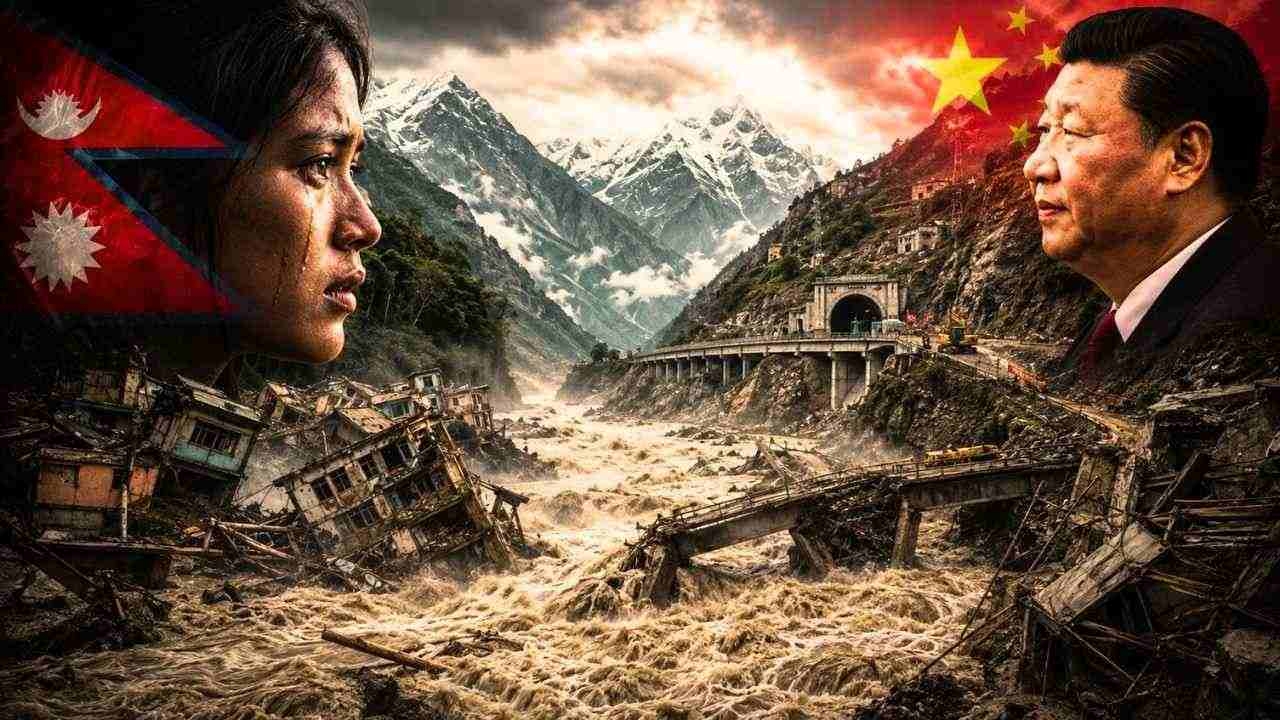
A catastrophic flash flood struck Nepal’s Rasuwa district on 26 August 2026, killing hundreds, destroying critical infrastructure and raising questions over upstream Himalayan construction and downstream risks for India.
The disaster began when a massive surge of water, mud, rock and debris tore through the Rasuwa region and swept into the Trishuli river system, obliterating villages, bridges, roads and hydropower infrastructure along its path.
Moreover, hydropower projects were smashed, and the vital Rasuwagadhi Gyirong border crossing which is also China’s key gateway into Nepal, all was reduced to sludge.
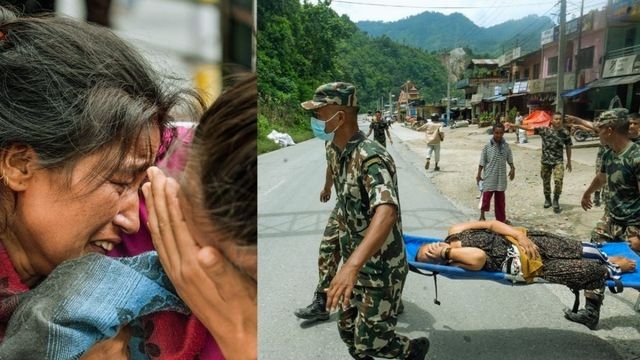
Official tally suggest that more than 600 are confirmed dead in Nepal only, with well over a thousand still missing across both sides of the border, including large numbers of Indian pilgrims, foreign tourists, security personnel, and hydropower workers.
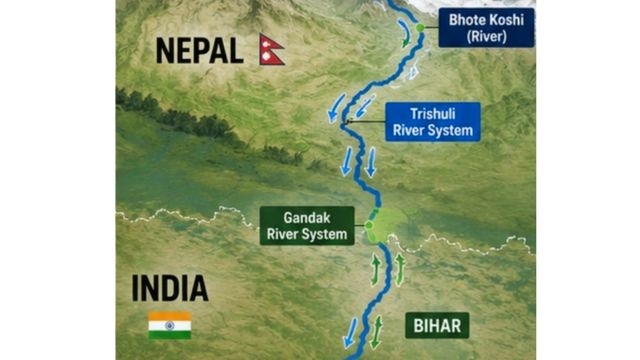
Notably seeing the conditions India has already had to prepare evacuations in Bihar and Uttar Pradesh as the surge threatens the Gandak (the Trishuli Indian continuation).
Nepalese authorities and independent analysts, drawing on Planet Labs satellite imagery and seismic data, point to an ice-rock avalanche or glacial collapse high in the Langtang region likely near or across the border that dammed a tributary (Lhende/Lende Khola), formed a temporary barrier lake, and then released a sudden, debris-laden flood.
The U.S. Geological Survey reclassified an initial “earthquake” signal as the landslide itself. No significant rainfall occurred in the catchment that morning. This is the kind of high-altitude Himalayan disaster that communist alarmists love to claim as “global warming,” but in reality , it's the domino effect of rising dragon hunger.
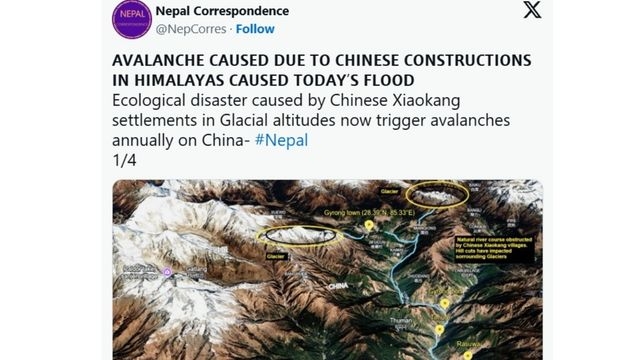
A Nepali journalists collective operating as “Nepal Correspondence” on X (twitter) called the flood a “purposeful ecological disaster.” Their thread alleges that Chinese Xiaokang settlements built at glacial altitudes, the expansion of Gyirong town by cutting into hills and placing construction on the natural course of the Trishuli system, and the deliberate siting of the Gyirong port at a critical river confluence have destabilised the fragile ecosystem. Leading to annual avalanches that now unleash destructive flash floods into Nepal.
Chinese state media has focused on its own casualties at Gyirong Port while playing down any upstream human contribution. Yet the same China that lectures the world on “ecological civilisation” has spent years pushing roads, settlements, and border infrastructure deep into the most sensitive high-altitude zones of occupied Tibet.
Hill-cutting, river-course alteration, and rapid urbanisation in glacial terrain are not subtle. Nepal highway corridors have already flagged how construction increases exposure to glacial lake outburst floods and debris flows.
Chaos Before BRICS:
The strategic timing and geography are hard to ignore. The Trishuli-Narayani-Gandak system is a direct artery into Bihar and eastern Uttar Pradesh. A sudden surge that devastates Nepali infrastructure, kills or strands hundreds of Indians, and forces Indian authorities into emergency mode creates precisely the kind of cross-border chaos that benefits an adversary seeking leverage.
All of this unfolds in the run-up to a BRICS Summit, an occasion Beijing uses to posture as the responsible leader of the Global South while quietly tightening its grip on the Himalayan periphery. Floods that kill Nepalis and Indians, damage trade routes, and generate anti-China resentment in Kathmandu serve a dual purpose: they remind smaller neighbours of Chinese power while testing New Delhi’s capacity to respond under pressure.
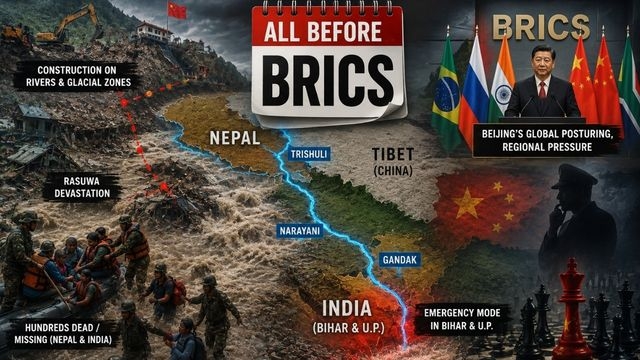
Chinese construction activity across the Tibetan plateau has repeatedly raised ecological and strategic alarms in the Brahmaputra cascade dams and road-building near disputed borders.
The Xiaokang villages programme has also been a tool of demographic and infrastructural consolidation in sensitive frontier zones. When those projects coincide with recurring avalanches and flash floods that devastated downstream Indian-linked river systems, the burden of proof should not rest solely on the victims.
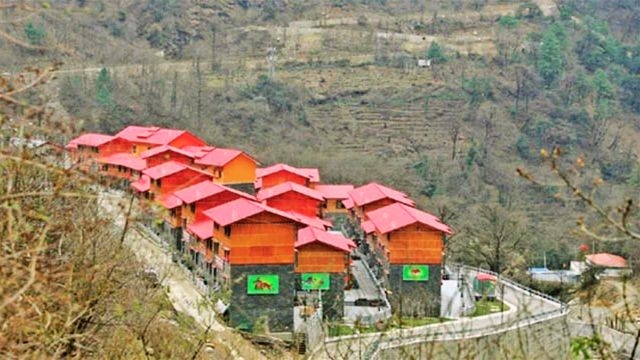
The Himalayas are not a Chinese internal playground. Every cut hillside, every altered river course, every new settlement at glacial altitude carries consequences that flow southward into India. The Rasuwa flood has already claimed hundreds of lives and left thousands missing.
If Chinese engineering and settlement policy contributed to the instability that triggered it as Nepali investigators allege that this is not merely a humanitarian crisis. It is a warning of ecological warfare by other means, timed for maximum geopolitical effect.
India cannot afford to look away.
Written by

Kewali Kabir Jain
Journalism Student, Makhanlal Chaturvedi National University of Journalism and Communication