When Diwali Comes with Warnings and Christmas Comes with Cheer
30 Dec 2025 13:40:17

Incidents across leading media houses, corporate brands, and political leadership reveal a persistent bias in how Hindu festivals, particularly Diwali, are framed. Coverage routinely places Diwali under the prism of guilt, health warnings, pollution, and restriction. In contrast, Christian festivals, most notably Christmas, are projected almost uniformly as occasions of joy, indulgence, culture, and celebration.
Diwali coverage is regularly accompanied by alarmist headlines on air pollution, diabetes, adulterated sweets, animal suffering, noise hazards, and even moral admonitions about excess. At the same time, Christmas reporting remains largely uncritical, celebrating cakes, alcohol-infused desserts, lavish décor, and extended festivities, with negligible attention to health concerns, environmental impact, or consumer excess.
Media Narratives: Caution for One, Celebration for Another
Mainstream outlets such as The Times of India, Mint, The Indian Express, The New Indian Express, Scroll.in, The Wire, The Quint, and The Economic Times illustrate this asymmetry vividly. Diwali sweets are described as unhealthy, adulterated, or dangerous for diabetics. Christmas cakes, often high in sugar, alcohol, and saturated fats, are framed as healthy, traditional, or even immunity boosting.
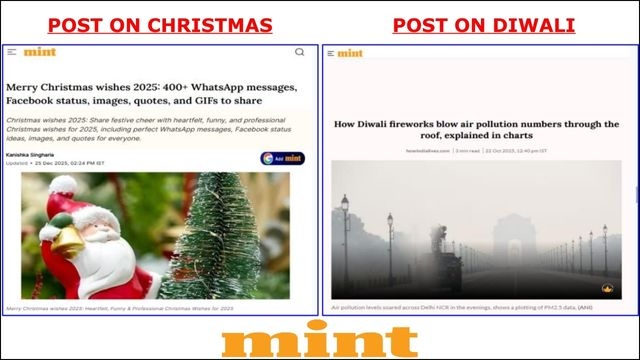
Firecrackers during Diwali are linked almost exclusively to pollution and harm. Christmas celebrations, however, escape comparable scrutiny of their environmental footprint, waste generation, or prolonged commercial lighting.
Lifestyle framing follows the same script. Diwali is associated with guilt, restraint, and corrective behaviour through phrases such as detox, mindful eating, and avoid excess. Christmas, by contrast, is marketed as indulgence without consequence, featuring festive feasts, baking guides, party recipes, and feel good spirituality. This pattern does not reflect balanced health journalism. It reflects selective morality.
Corporate Messaging and Political Posturing
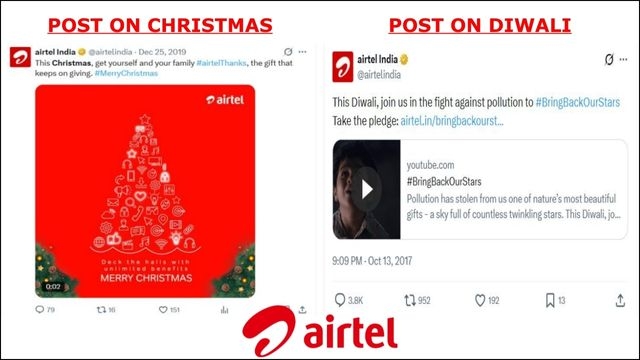
Corporate India mirrors this imbalance. Airtel’s Diwali messaging urged restraint, noise reduction, and pollution control. Its Christmas communication, however, offered unconditional festive greetings without advisory tones. The underlying principle appears consistent: advice and admonition for Hindu festivals, celebration without caveats for others.
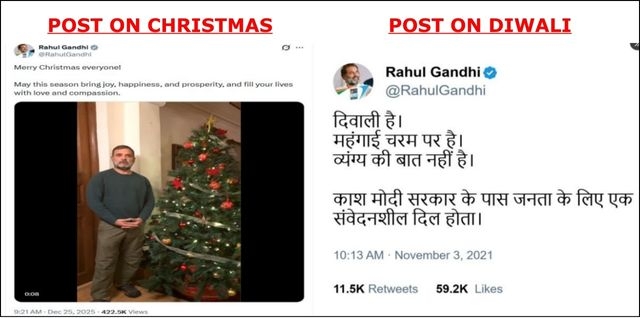
Political leaders and parties reinforce this trend. Rahul Gandhi’s Christmas greetings are warm, apolitical, and benevolent. His Diwali posts, by contrast, often pivot to criticism of governance and economic distress. The Congress party’s official handles wish peace and happiness on Christmas, while Diwali posts have spoken of danger, insecurity, and a supposed lack of reasons to celebrate.
Individual commentators follow similar patterns. Sagarika Ghose highlights pollution free Diwali narratives but limits Christmas posts to greetings alone. Perhaps most revealing are remarks from opposition leaders such as Akhilesh Yadav, who openly praise Christmas illumination while questioning the very act of lighting lamps on Diwali, effectively presenting one festival as ideal and portraying the other as wasteful or regressive.
These remarks cannot be dismissed as coincidence. They reflect deeper biases within sections of India’s English language media and political class towards Hindu cultural expression. Diwali, a festival rooted in light, renewal, and dharma, increasingly faces problematisation, while Christmas receives aestheticisation and uncritical celebration.
Article by

Kewali Kabir Jain
Journalism Student, Makhanlal Chaturvedi National University of Journalism and Communication