Regulating Faith, Preventing Exploitation: The Rationale Behind the Chhattisgarh Dharm Swatantrata Adhiniyam, 2026
The Chhattisgarh Dharm Swatantrata Adhiniyam, 2026 seeks to distinguish voluntary religious choice from conversions driven by force, inducement, deception, or organised manipulation.
Total Views |



The enactment of the Chhattisgarh Dharm Swatantrata Adhiniyam, 2026 marks a significant development in the State's regulatory approach towards religious conversion. While the constitutional framework under Articles 25 and 26 guarantees freedom of conscience and the right to profess, practise, and propagate religion, this freedom has never been absolute. It is circumscribed by considerations of public order, morality, health, and, most importantly, the autonomy and dignity of individuals. The recent conviction in the Gariyaband district provides a stark illustration of why legislative intervention in this domain has become both necessary and urgent.
The Constitutional Position: Freedom, Not Exploitation
The Indian Constitution protects voluntary and informed religious choice. However, it does not endorse conversion achieved through coercion, fraud, or inducement. Judicial precedents, including Rev. Stainislaus v. State of Madhya Pradesh, have clarified that the right to "propagate" does not include the right to convert another person by force or deceit.
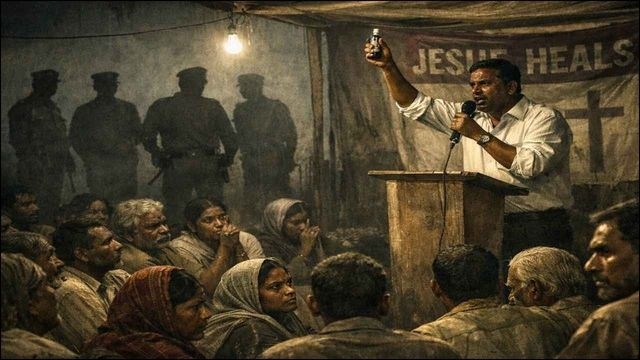
The problem, therefore, is not conversion per se, but illegitimate conversion. It is precisely this distinction that forms the normative backbone of the Chhattisgarh legislation. The Act does not prohibit religious change; rather, it seeks to regulate the process through which such change occurs, ensuring that it remains voluntary, informed, and free from external manipulation.
The Legislative Gap and Its Consequences
Prior to the 2026 enactment, the regulatory framework in Chhattisgarh was comparatively weak. There was no robust mechanism requiring prior intimation to authorities, no stringent verification of consent, and limited deterrence against organised or mass conversions driven by inducements.
This vacuum enabled certain exploitative practices to proliferate, particularly within vulnerable communities. Reports and ground-level observations suggested that conversions were sometimes facilitated through promises of employment, healthcare, education, or social mobility. In tribal and economically weaker regions, such inducements could significantly impair genuine consent.

The absence of regulatory oversight meant that the State lacked both preventive and corrective tools. The 2026 Act seeks to address precisely this lacuna by introducing procedural safeguards such as mandatory intimation, scrutiny by competent authorities, and stringent penal consequences for violations.
The Gariyaband Case: A Judicial Turning Point
The urgency of such regulation is vividly demonstrated in the recent judgment delivered by the Additional District and Sessions Judge, Raipur, concerning an incident in Gariyaband district.
The case involved the death of an 18-year-old Scheduled Caste girl who was subjected to brutal "healing" practices under the guise of religious intervention. Evidence before the Court established that the accused subjected the victim to physical abuse, including pouring hot oil and water on her and physically trampling her, purportedly as part of a ritualistic cure. Medical testimony confirmed that the victim suffered severe internal injuries, including rib fractures and internal trauma, which ultimately led to her death.
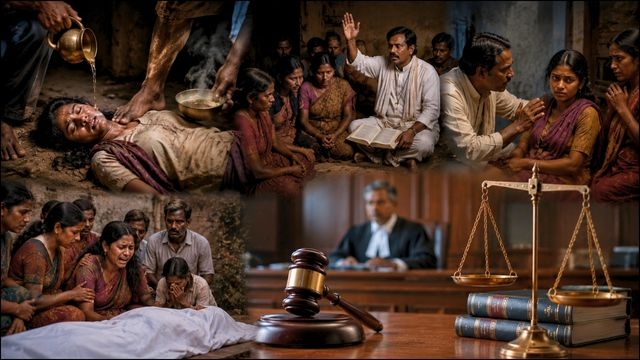
Witnesses also testified that the accused induced the victim's family to place faith in such practices and discouraged them from seeking external assistance, warning of divine displeasure if they disclosed the acts. Crucially, there was also evidence suggesting that religious conversion was implicitly or explicitly encouraged as part of the "healing" process.
The Court, after a comprehensive evaluation of the evidence, convicted the accused under multiple statutes, including:
- Section 105 of the Bharatiya Nyaya Sanhita, resulting in life imprisonment,
- The SC/ST (Prevention of Atrocities) Act,
- The Chhattisgarh Tonhi Pratarna Nivaran Act,
- The Drugs and Magic Remedies (Objectionable Advertisements) Act, and
- The Chhattisgarh Dharm Swatantrata Adhiniyam.
The imposition of life imprisonment underscores the gravity of the offence and the Court's recognition of the intersection between fraudulent religious practices and criminal violence.
From Isolated Incident to Structural Concern
While the Gariyaband case may appear to be an isolated criminal act, it in fact reflects a broader structural problem. Vulnerable individuals, particularly women, Scheduled Castes, and tribal communities, are often disproportionately affected by practices that combine superstition, coercion, and inducement.
The case illustrates three critical dimensions:
1. Fraudulent religious claims, including so-called miracle healing,
2. Coercive control over victims and their families, and
3. Linkages to conversion, whether explicit or implied.
Such situations blur the line between religious freedom and criminal exploitation. Without a regulatory framework, these practices can operate with relative impunity.
The 2026 Act: Key Regulatory Features
The Chhattisgarh Dharm Swatantrata Adhiniyam, 2026 attempts to institutionalise safeguards against such misuse. Its key features include:
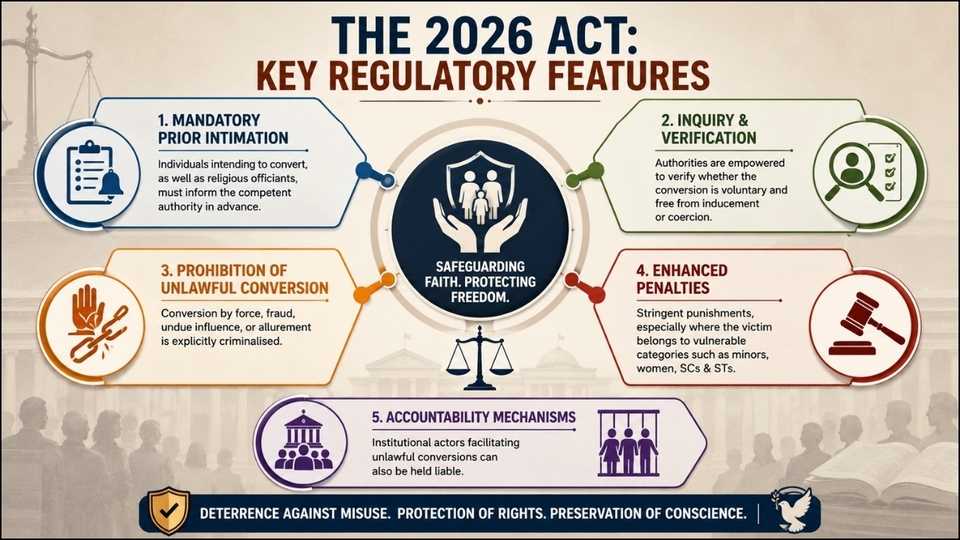
These provisions aim to create a deterrent environment while preserving the core constitutional guarantee of religious freedom.
Balancing Liberty and Regulation
Critics of such laws often argue that they risk overreach and may be used to harass legitimate religious activity. This concern is not unfounded and underscores the need for careful implementation. However, the answer lies not in the absence of regulation, but in proportionate and accountable regulation.
The State's obligation is twofold:
1. To protect individual autonomy by ensuring that religious choices are genuine and informed, and
2. To prevent exploitation, particularly where vulnerable populations are concerned.
The 2026 Act must therefore be read as a regulatory statute rather than a prohibitory one. Its legitimacy ultimately depends on its application, specifically whether it targets genuine wrongdoing or becomes a tool for indiscriminate interference.
Conclusion: Law as a Protective Mechanism
The Gariyaband judgment serves as a grim reminder of how unchecked practices in the name of faith can escalate into serious criminality, even resulting in loss of life. It exemplifies the very mischief that the Chhattisgarh Dharm Swatantrata Adhiniyam, 2026 seeks to address.
By introducing procedural safeguards, enhancing penalties, and emphasising accountability, the law attempts to strike a balance between religious liberty and social protection. In doing so, it reinforces a fundamental constitutional principle: that freedom of religion must coexist with the protection of human dignity, bodily integrity, and informed choice.
Far from curtailing freedom, such legislation, if implemented judiciously, can ensure that faith remains a matter of conscience, not coercion; of belief, not exploitation.
Written by

Abhinav K. Shukla
Assistant Professor of Law and Head, Centre for Comparative Law, Hidayatullah National Law University, Raipur