1956: Report of the Christian Missionary Activities Enquiry Committee (Part 2)
This part of the report traces missionary expansion, tribal outreach, conversion strategies, and the gradual rise of separatist narratives across several regions of Bharat.
The Narrative World 06-May-2026
Total Views |


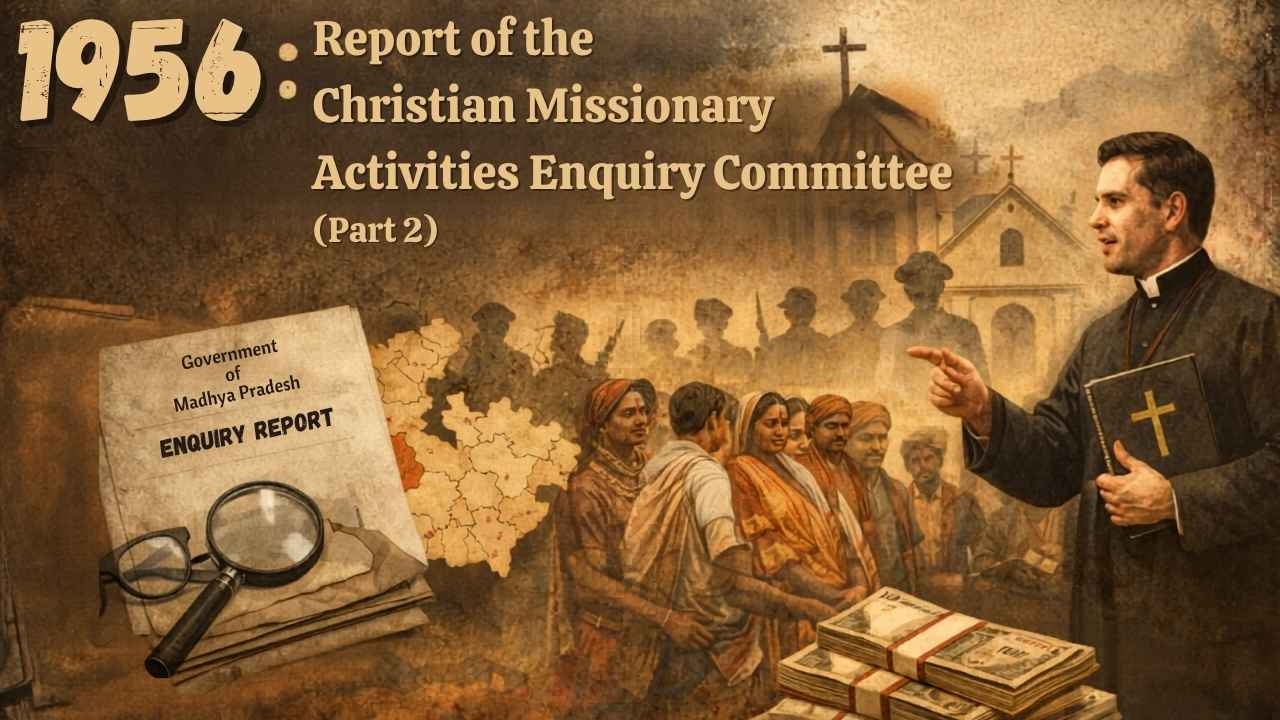
The report is 50 years old, yet the facts stated in it sound familiar even today. This series of articles is not an interpretation, but reading it gives readers an understanding of how the missionaries and the institutions they founded worked, and how an argument slowly and silently trickled down into our psyche. The narratives developed and the corollaries deduced gradually occupied the academic space and vitiated it.
The report explained in detail that whenever allegations could not stand scrutiny, missionaries resorted to making false accusations, and this was not surprising. Even the National Council of Christians supported many of these false claims. It was their style of functioning. Repeating the same allegations continuously was the gimmick used to make them sound true. Missionaries, especially foreign missionaries, tried to establish a foothold, and this caused public resentment. Proselytism was undoubtedly the ultimate aim. All these developments, in a way, obliged the government to examine the matter, and consequently this committee was appointed.
Many theories were fabricated by missionaries to create a rift in our society. The theory of Aryan invasion was one such example. It was claimed that Aryans pushed the aboriginal tribes from the fertile lands of the Indo-Gangetic region into forests and hilly areas. Later, unfortunately, zamindars, businessmen, and some other communities exploited them further by purchasing their produce at very cheap rates. Ultimately, the lands made cultivable by the tribal people were taken away when loans could not be repaid. The interest rates were exorbitant. This reduced many tribal people to the status of daily labourers. Obviously, they were left with no other source of income.
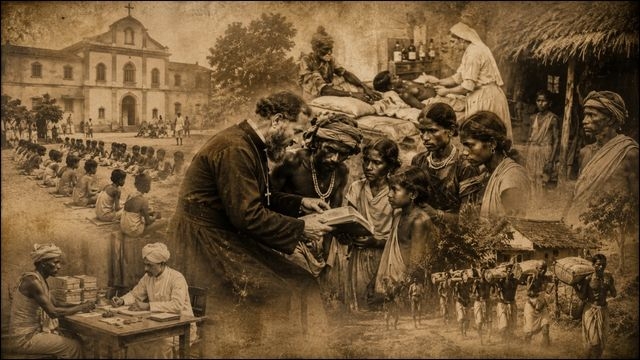
In these areas, missionaries were given a free hand to open schools and dispensaries during British rule. All these institutions were diligently used for conversion. This resulted in tribals viewing Hindus, especially those who lent money at exorbitant rates, as hostile to their interests, while Christians appeared to them as friends and protectors of their welfare. Our tribals are simple-minded people whose lifestyle depends largely on forests, hunting, and jungle produce. They used cloth prepared by village weavers and had rice, dal, and meat as their staple food. They could easily be tricked into conversion.
Of course, it was also stated that some tribes, like the Marias found in Chanda and Bastar districts, had no converts.
It is observed that many tribes residing in Durg, Raipur, Chanda, and Bilaspur districts followed Hindu rites and customs during occasions such as marriage. Festivals like Holi, Diwali, Dussehra, and Shivaratri were, and still are, celebrated by them. Despite this, Christian missionaries tried to claim that these tribes were not Hindus. They continuously attempted to foster a sense of separatism. Gandhiji too stated that "our society was not familiar with classifications like 'animist aborigines'; British rulers introduced them." He believed that "from time immemorial they were Hindus, and their roots lie deep in the soil."
The research scholar late M. M. Kunte, in his thesis written in 1880, stated that intermarriages between Aryas and aborigines were frequent. Vyas and Vidur were cited as the best examples. There are many such references. Hanuman and Valmiki too are presented as examples in this context.
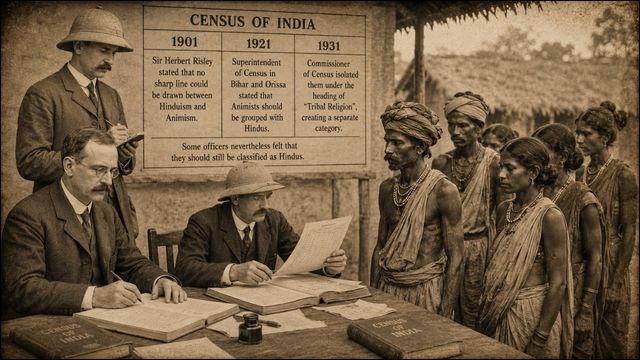
In the Census of 1901, Sir Herbert Risley also stated that no sharp line could be drawn between Hinduism and Animism. In 1921, the Superintendent of Census in Bihar and Orissa clearly stated that Animists should be grouped with Hindus. However, in 1931, the Commissioner of Census isolated them under the heading of "tribal religion", creating a separate category. Some officers nevertheless felt that they should still be classified as Hindus.
The purpose behind this separate categorisation can be understood by analysing missionary activities in tribal areas.
In 1941, Scheduled Tribes were not classified as Christians. As a result, the number of Christians reduced by approximately 2.5 lakh in official records, though in reality the number had actually increased.
Later, the Government of India made special provisions for the protection of SC and ST categories. Many facilities and services were provided to them.
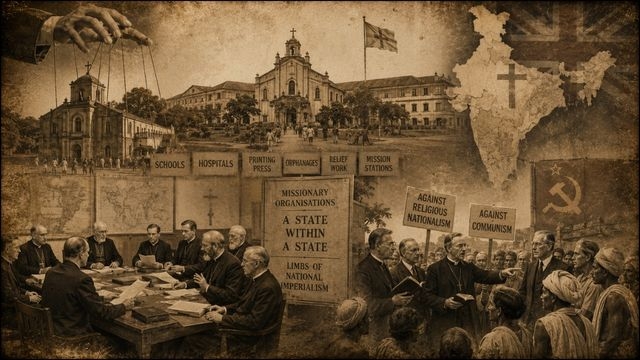
The report remarks that missionary organisations functioned like a State within a State. They were described as limbs of "National Imperialism". The missionaries wanted to attack the religious nationalism of the country while simultaneously defending themselves against Communism. Of course, many Christian organisations also had differences among themselves.
The report noted that there were 4,877 foreign personnel in the country at the time of the publication of the report in 1956, which was 500 more than the number recorded in 1952.
Protestant missions worked in five major areas:
Economic Activities: This included agricultural settlements, co-operative societies, printing presses, literature distribution centres, and several related activities.
Educational Activities: Schools and colleges were run under this category, along with teachers' training institutions, industrial schools, and schools for missionaries.
Evangelistic Activities: Theological colleges and seminaries, training institutions for workers in this field, Bible correspondence courses, and Christian ashrams were supported under this category.
Medical Activities: Hospitals and dispensaries were operated, while leprosy institutions and tuberculosis sanatoriums were also included in this category.
Philanthropic and General Activities: Homes for women and converts came under this category. Homes for the blind and deaf were also run alongside orphanages. Rest homes for missionaries, Christian retreats, and study centres too were included.
All these areas touched almost every aspect of life. It is obvious that, unfortunately, these activities were used as tools of conversion and not merely for the service of humanity. The report states that such activities started during the Syrian period and continue even today. The report provides a complete historical account along with all the necessary details.
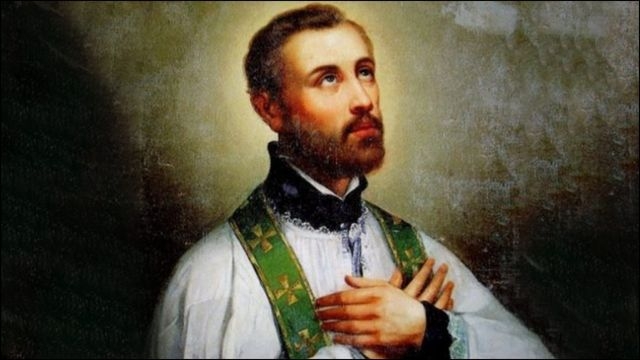
With the arrival of the Portuguese began a phase of conversion that included the cruel phenomenon of the Inquisition. Francis Xavier is stated to have converted about 60,000 people from fishing communities in Goa. It is a known fact that, following his note to the King of Portugal, orders were issued to destroy idols and impose severe penalties. Special privileges were granted to Christians and to those who wished to change their faith. The Portuguese continued compelling people to convert in the name of their Lord.
Robert De Nobili felt that focusing only on the lower castes would not help establish a strong foothold, so he decided to target the higher castes. He learned Tamil, Telugu, and Sanskrit, and started living like a Brahmin. He deceived people by naming the Bible as Yeshurveda. He succeeded in baptising 87 Brahmins between 1607 and 1611. Along with the converts, he worked here for 40 years.
By 1700, Bharat had around six lakh Catholics.
Of course, Protestants too were not behind in this race of conversion.
More about it in the next part.
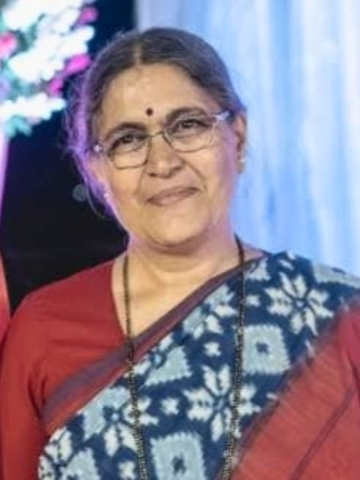
प्रो. विद्या देशपांडे
Professor Vidya Deshpande has over four decades of experience in education. Her main expertise is philosophy; she taught philosophy and logic at Nowrosjee Wadia College for 36 years. She has been associated with the Janakalyan Blood Bank for the last 38 years and served as a management committee member of Karve Stree Shikshan Sanstha for 10 years. Her special fields of interest include the philosophy of social sciences, school education, development of self-reliance skills, and top-up skills to make students profession-ready.